

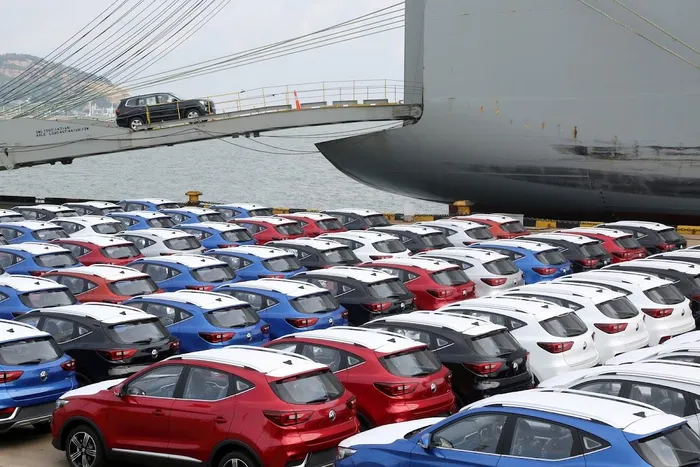
However, the Automotive Business Council (Naamsa) on Monday said export volumes dipped but remained resilient in view of softer global demand conditions and renewed geopolitical tensions. Meanwhile, domestic sales remained firmly on an upward trajectory.
Image: Supplied
South Africa’s new-vehicle market posted another month of robust growth in November, surging by 12.5% year-on-year buoyed by a favourable macroeconomic environment that strengthened household and business confidence while helping to ease affordability constraints.
However, the Automotive Business Council (Naamsa) on Monday said export volumes dipped but remained resilient in view of softer global demand conditions and renewed geopolitical tensions. Meanwhile, domestic sales remained firmly on an upward trajectory.
Data from Naamsa showed that aggregate new-vehicle sales rose to 54 896 units, an increase of 6 113 units compared to the 48 783 units sold during the same month a year ago.
The contrast with November 2024 is striking. Last year's units marked the best month of that year but was driven primarily by rental fleet deals as consumer demand declined.
It also stood in sharp contrast to the same period in 2023, when the market was still reeling from its fourth consecutive monthly decline. This November, growth was broader across segments and supported by real improvements in the economy.
Year-to-date, sales were 15.4% higher than the same period last year, reflecting steady improvements in underlying economic activity and consumer sentiment.
Lebo Gaoaketse, head of marketing and communication at WesBank, said the double-digit growth signals a vehicle market in festive form this November.
"November's performance reflects a market responding to a more supportive economic environment. Lower inflation, relief at the fuel pump and the first interest rate cut under the revised 3% target have helped restore a sense of predictability in household budgets. This stability is starting to show in mobility decisions," Gaoaketse said.
"The fundamentals are much healthier than they were a year ago. The market we see today is built on informed choices and realistic budgets. This discipline supports long-term stability for both consumers and the industry and is an encouraging sign of things to come."
Naamsa said a convergence of economic tailwinds such as inflation, fuel pricing, fiscal credibility, and monetary policy helped reinforce the sector’s performance after contributing to improved affordability and confidence across households and firms.
Fuel prices fell sharply in November, with petrol down 51 cents per litre, diesel by up to 21 cents, and LPG by 70 cents per kilogram, driven by softer international oil prices and a firmer rand.
Although the effect on immediate sales is lagged, lower fuel costs reduce operating pressures across households and logistics-intensive industries, lowering total cost-of-ownership expectations for prospective buyers.
Labour market conditions also improved modestly, with the unemployment rate easing to 31.9% in the third quarter from 33.2%. While fragile, the trend supports broader economic stabilisation.
Policy and fiscal developments have further strengthened the outlook. The Medium-Term Budget Policy Statement reaffirmed the government’s commitment to expenditure discipline and the new 3% inflation target.
This was followed by South Africa’s first credit rating upgrade in nearly 20 years, with S&P Global lifting the sovereign rating on the back of fiscal consolidation progress, revenue improvements and state-owned entity reforms, including Eskom’s return to profitability. The upgrade is expected to improve the country’s funding conditions over time, supporting vehicle financing activity.
Inflation trends also remained favourable with the headline consumer price inflation rising slightly to 3.6% in October, while core inflation eased to 3.1%, enabling the South African Reserve Bank to deliver a 25 basis points rate cut, reducing the repo rate to 6.75%.
However, vehicle exports fell 3.9% to 35 848 units amid cooling global demand and rising geopolitical tensions following renewed strain in South Africa–US relations post-G20 Summit.
Despite this, year-to-date exports remained 5.6% ahead of 2024 levels.
Naamsa warned that proposed US legislation potentially excluding South Africa from African Growth and Opportunity Act (Agoa) remains a significant risk, given the automotive industry’s heavy export exposure.
"Re-emergent geopolitical tensions between South Africa and the US administration following the G20 Summit—where the US announced that South Africa would not be invited to the 2026 gathering, alongside a Senate bill proposing a two-year Agoa extension that may explicitly excludeSouth Africa—remain a source of potential volatility," Naamsa said.
"Given the automotive industry’s significant export exposure, Naamsa continues to monitor these developments closely."
BUSINESS REPORT