

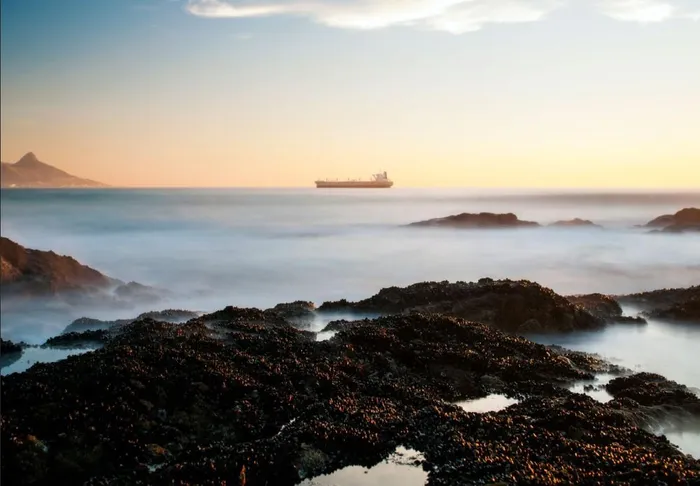
Saldanha Bay, home to South Africa’s primary iron-ore export terminal, already has plans under way to develop green ammonia production and expand port infrastructure to handle bunkering operations.
Image: Supplied
A new feasibility study has found that the South Africa–Europe iron ore shipping corridor could begin operating ammonia-fueled bulk carriers as early as 2029, positioning Saldanha Bay as a future global hub for green maritime fuels.
The analysis, released by the Global Maritime Forum (GMF) and conducted with a consortium of partners including Anglo American, CMB.TECH, Freeport Saldanha, VUKA Marine and ENGIE, concludes that the route linking Saldanha Bay to the Port of Rotterdam could reach full decarbonisation by 2035.
If realised, it would be one of the world’s first major green shipping corridors connecting the Global South to the Global North.
Saldanha Bay, home to South Africa’s primary iron-ore export terminal, already has plans under way to develop green ammonia production and expand port infrastructure to handle bunkering operations.
In the corridor’s early stages, ammonia-fueled vessels would likely refuel in Rotterdam, which has advanced safety and handling frameworks for ammonia. Saldanha Bay would progressively develop the capability to become the long-term bunkering and fuel-production hub.
“This phased approach gives shipowners and fuel producers a clear timeline to work toward, and we now need coordinated action from policymakers and industry to make this a reality by 2029,” said Shanon Neumann, associate for investment facilitation at Freeport Saldanha.
“However, to help Saldanha Bay transition quickly, blending public and private funding can unlock investment in infrastructure and reduce the risks of early projects.”
The GMF study outlines actions needed to launch the corridor by 2029, including creating fair contracting frameworks across the value chain, increasing engagement with South African government and industry, and mobilising funding for infrastructure tied to Saldanha’s hydrogen hub ambitions.
If implemented, the South Africa–Europe Iron Ore Green Corridor could become a global model for equitable, commercially viable zero-emission shipping—and a catalyst for South Africa’s emerging hydrogen economy.
The World Bank and World Economic Forum have both identified South Africa as a potentially significant producer of green fuels.
Several announced green hydrogen and ammonia projects near Boegoebaai, Saldanha and Walvis Bay could supply the corridor’s fuel demand, including a high-case scenario of servicing 22 bulk carriers annually by 2035.
High demand from shipping could strengthen investment cases for hydrogen developers, supporting final investment decisions and accelerating construction of new projects.
Combined with targeted financing mechanisms, tax incentives and potential port tariff discounts, South Africa could secure a competitive advantage as a global bunker fuel supplier.
The hydrogen economy is projected to contribute up to 3.6% of the national GDP by 2030, with shipping and steel expected to be early offtakers.
A green shipping corridor could also enhance export competitiveness, modernise a strategic port, and create local jobs and skills development linked to the Just Energy Transition.
Global and regional policy frameworks could substantially improve green ammonia’s competitiveness.
Europe’s FuelEU Maritime rules and the phased-in Emissions Trading System are expected to narrow the cost gap between ammonia and fossil fuels by more than 60% in some scenarios.
A strengthened International Maritime Organization Net-Zero Framework, currently under review after a delayed adoption, could add further momentum through emissions targets and incentives for zero-emission fuels.
“With binding global regulations delayed for now, there remains a business case to be made for green ammonia on this corridor,” said Marieke Beckmann, GMF deputy director of decarbonisation.
“The role of national and local governments becomes increasingly important in incentivising the adoption of scalable zero emission fuels. This, combined with EU measures, will help position South Africa as a competitive supplier of clean maritime fuel.”
BUSINESS REPORT