

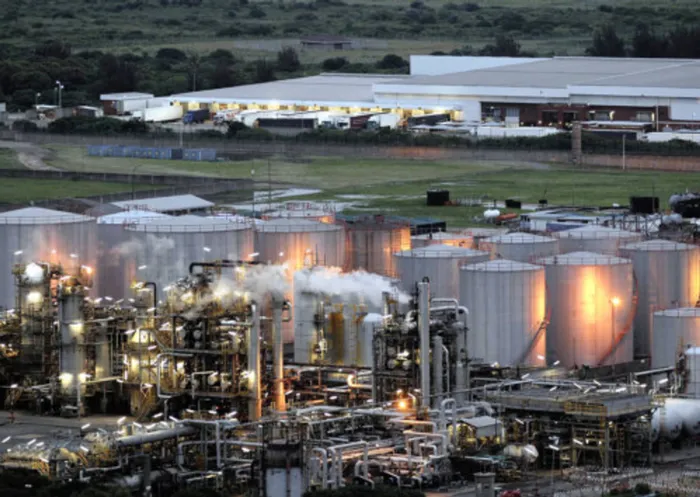
Msabala added that the CEF had completed a study into the structure of South Africa’s fuel distribution network, particularly the Durban corridor, which handles about 70% of national volumes.
Image: Reuters
Banele Ginindza
The Central Energy Fund (CEF) says it is preparing to absorb fuel infrastructure and other assets from global oil companies that are scaling down operations in South Africa, as part of its strategy to secure national fuel supply and strengthen its downstream footprint.
Acting Group CEO Sifiso Msabala told Parliament that several oil majors, including Shell, have approached the State-Owned Entity with proposals to offload assets as they retreat from the local market.
"We have a very clear understanding of how the majors have been behaving in wanting to sell in that space. A number of them are offloading their assets. The State cannot be caught in a situation where the assets are not attended to as we will be the last resort for fuel," Msabala said.
"Some of the acquisitions we are making are in talks with the oil majors who are knocking at our doors to float some of the assets. Our strategy, which is organic and external, talks to us also not paying a premium on acquisition."
Msabala said the CEF’s 15% capacity allocation at the Island View Terminal in Durban was a “big challenge” unless the entity developed a clear strategy to capacitate PetroSA’s downstream mandate.
"Part of the challenges PetroSA has been facing around the issue is getting the product at the market level because of our non-existence in terms of the market presence," he said.
"We have products sitting in tanks and if the majors don't pick up, then it means we don't have a business."
Msabala added that the CEF had completed a study into the structure of South Africa’s fuel distribution network, particularly the Durban corridor, which handles about 70% of national volumes.
He revealed that the CEF plans to scale up Sapref refinery output from 180 000 barrels per day to 400 000, leveraging available land to develop a higher-capacity facility.
"The process of acquiring the refinery started when it was in operational status, then it was damaged by the floods. It was offline and could have operated on day one, hence even the sale purchase agreement changed," Msabala said.
"The call for a bankable feasibility study talks to that. We understand the new type of refinery we are looking for. We are also increasing the nameplate from 180 000 barrels a day want to operate it at a more optimal level. We have the land to push it up to 400 000 barrels."
The CEF has also made progress on the Komati gas-to-power project, Msabala said.
The entity has already unlocked 800MW through the ROMPCO pipeline from Mozambique to Ekurhuleni and has secured an additional power purchase agreement (PPA) for 1 000MW.
"In terms of cost of values, we are looking at 50 petajoules that we require just at Komati at the mid-merit level, which is above 50% power factor if we include other projects on the same line. We are then gliding at above 75 petajoules, which talks to the gas cliff," Msabala said.
"We will unlock the critical investment on the side of Mozambique. Engagement with the Mozambicans has been positive."
He added that the CEF was not seeking a ministerial directive but was following the standard PPA approval process.
"Our position is that any decision made on that side of the border must find a market in South Africa, we have already created that market," he said.
Msabala said the Board had granted Final Investment Decision (FID) approval for a bioethanol project using sorghum, creating opportunities for blending and advancing the country’s clean fuel ambitions.
Meanwhile, CEF chief financial officer Ditsietsi Morabe said the group’s financial position had improved significantly by March 2025, supported in part by the acquisition of the SNPC refinery, formerly known as Sapref.
Between the 2020/21 and 2024/25 financial years, profit and loss performance improved by 2.4%, cash balances grew 8.5%, and net asset value increased 16%.
The turnaround from 2023/24 to 2024/25 was particularly stark as the CEF swung from a R522 million loss to a R533m profit, a 194% improvement. Cash balances rose from R13 billion to R16bn, a 21% increase.
BUSINESS REPORT