

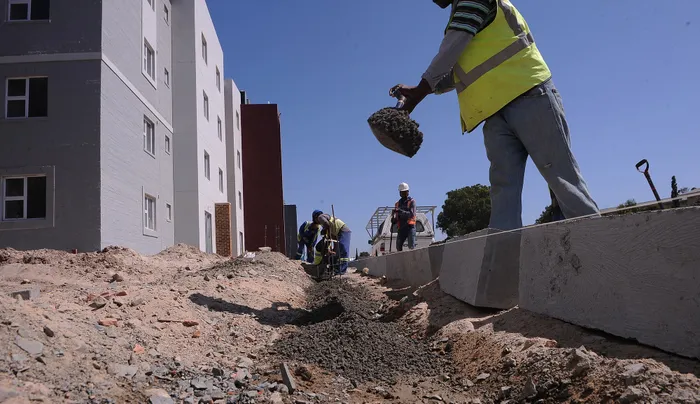
Construction sector activity outperformed the GDP by a healthy margin during the third quarter, although it lagged behind overall economic activity compared to the third quarter of last year.
Image: Courtney Africa/Independent Newspapers
South Africa’s construction sector posted a strong rebound in the third quarter of 2025, with the Afrimat Construction Index (ACI) recording a double-digit quarterly increase and signalling a marked improvement in industry activity.
The ACI, a composite measure of building and construction activity compiled quarterly by economist Dr Roelof Botha for Afrimat, rose 10.2% quarter-on-quarter, far outperforming the country’s 0.9% GDP growth over the same period.
Construction sector activity outperformed the GDP by a healthy margin during the third quarter, although it lagged behind overall economic activity compared to the third quarter of last year.
Importantly, the index also broke a long-running downward trend in its four-quarter moving average, registering a slight upward turn for the first time in several quarters.
Dr Botha said the latest results were driven by broad-based improvements across the sector.
“The majority of indicators recorded double-digit growth rates, whilst the volume of building materials produced enjoyed the second-highest year-on-year increase and the third-highest quarter-on-quarter increase,” he noted.
A 25-basis-point drop in the prime overdraft rate during the period also helped stimulate activity, particularly in building plans passed and hardware retail sales.
Of the 10 indicators tracked by the index, only construction works (in real terms) failed to show quarterly growth.
Botha warned that weak capital formation, typically a key driver of construction works, should concern policymakers.
“The lack of progress with capital formation in the economy, which is generally associated with a significant element of construction works, should be of concern to the government, as the country is in dire need of repairs and expansion of infrastructure, especially roads, water, and sewage,” he said.
Even so, Botha said South Africa’s growth outlook is improving, supported by lower interest rates and stronger fiscal stability.
“The latter has been boosted by the performance of gold and platinum prices, which played a key role in securing a healthy cumulative trade surplus during the first 10 months of the year,” Botha said.
Looking ahead, Botha expects construction activity to continue recovering after the latest reduction in the prime rate to 10.25%, though he cautioned that more rate cuts are needed to align South Africa’s capital costs with those of key trading partners.
“Although the modest relaxation of monetary policy is to be welcomed, more interest rate cuts are required to bring the cost of capital in South Africa in line with our key trading partners.”
Afrimat CEO Andries van Heerden said the company is already seeing positive contributions from its recently acquired Lafarge assets, which have begun realising the potential identified at the time of purchase.
“While these assets experienced some neglect during the Competition Tribunal approval process, they are now beginning to deliver on the potential we originally identified.”
While national government has yet to roll out large-scale maintenance or infrastructure development programmes, Afrimat is benefiting from increased provincial and private sector activity.
Van Heerden added that the Group’s cement plant in Lichtenburg has reached break-even and continues to improve in reliability and output.
“Even previously closed quarries, which we have successfully reopened, are now receiving meaningful orders, and margins are stabilising. This trend aligns with recent construction sector data reflected in the ACI and supports the recent upgrade of South Africa’s credit rating,” he said.
Strong demand for aggregates and cement, both bagged and bulk, mirrors the broader uptick signalled by the ACI and supports the recent upgrade to South Africa’s credit rating, he said.
“Although losses from the first half of the financial year will not be fully recovered, we do not anticipate that the losses will escalate further. Demand for cement remains strong in our local and regional supply regions, mirroring the robust demand for aggregates,” he said.
Van Heerden credited the progress to improved cooperation between provincial leaders and the private sector.
“We remain confident that collaboration between the public and private sectors will drive sustainable growth for all South Africans.”
He added that Afrimat’s diversified position as a multi-commodity mid-tier mining company places it in a prime position to support South Africa’s anticipated growth trajectory.
BUSINESS REPORT