

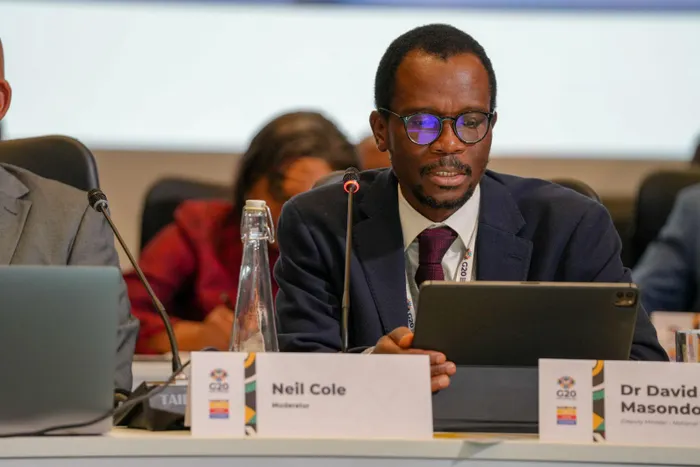
David Masondo, PIC chairperson and deputy finance minister, defended the corporation’s performance, noting that assets under management had grown from R2trln to R3.6trln during his tenure.
Image: GCIS
Banele Ginindza
The Black Business Council (BBC) has urged restraint in public attacks on the Public Investment Corporation (PIC), particularly regarding criticism of its R3.5 trillion in assets under management and concerns over the performance of its unlisted investment portfolio.
This comes amid mounting calls from political parties and civil society for increased scrutiny of the PIC’s governance and investment decisions.
The United Democratic Movement (UDM) is among the loudest voices demanding action.
The party has called on President Cyril Ramaphosa and Parliament to convene urgent public hearings with the PIC Board, its CEO, and the Government Employees Pension Fund (GEPF) to answer for what it describes as “ongoing governance failures, ethical breaches, and poor investment decisions.”
UDM leader Bantu Holomisa has further urged the Auditor-General and the Special Investigating Unit to conduct a forensic investigation into the Isibaya Fund and the broader Unlisted Investments Division, focusing on politically connected deals, loss-making projects, and compliance with the Mpati Commission’s recommendations.
In a statement on Monday, the BBC said it was “seriously concerned” about what it described as a coordinated campaign against the PIC’s unlisted investments, particularly the Isibaya Fund.
BBC CEO Kganki Matabane argued that critics were selectively highlighting a handful of failed B-BBEE deals while ignoring numerous success stories, as well as major failures among white-owned companies funded by the PIC, such as Steinhoff.
"The BBC is of the view that this choreographed selective criticism is meant to paralyse the PIC and entirely stop B-BBEE funding by creating fear in the PIC to an extent that no one at the PIC will have the guts to consider funding black business," Matabane said.
"The so-called critics are hellbent on protecting the apartheid status quo to ensure that the economy remains in white hands forever as the PIC is the only hope to fund big transactions for black people."
The Black Agricultural Commodities Federation echoed the BBC’s concerns, with its representative Mike Gcabo stressing that the success of black business transformation remained crucial for broad-based economic growth.
David Masondo, PIC chairperson and deputy finance minister, defended the corporation’s performance, noting that assets under management had grown from R2trln to R3.6trln during his tenure.
He said the unlisted portfolio had delivered a 16% internal rate of return and contributed 194 274 jobs to the economy in 2025, notwithstanding challenges with investments in Daybreak Farms, Acapulco Trade and Investments and more recently Enabled Capital, among others.
“A R100 billion investment will generate R16bn for the workers, so it is performing. It has its own challenges, but it is doing, by and large, better in terms of its performance," Masondo said.
"Many of the bad investments are pre-party investments, and we are doing our best to sort out all the challenges in strengthening our capacity to protect workers’ money and increase their wealth."
PIC officials have previously told Parliament that overall assets under management rose from R2.3 trillion in 2021 to R3 trillion by March 2025 — a 30% increase.
However, growth in unlisted investments slowed due to suspended mandates from the Unemployment Insurance Fund and the Compensation Fund. Since the start of the unlisted investment programme, the PIC says it has created more than 190,000 jobs.
Meanwhile, Matabane called on Masondo, the PIC CEO and its employees to disregard the "irritating noise and distractions", and to remain steadfast in their commitment to fund viable black-owned businesses in pursuit of the key liberation principle.
BUSINESS REPORT