

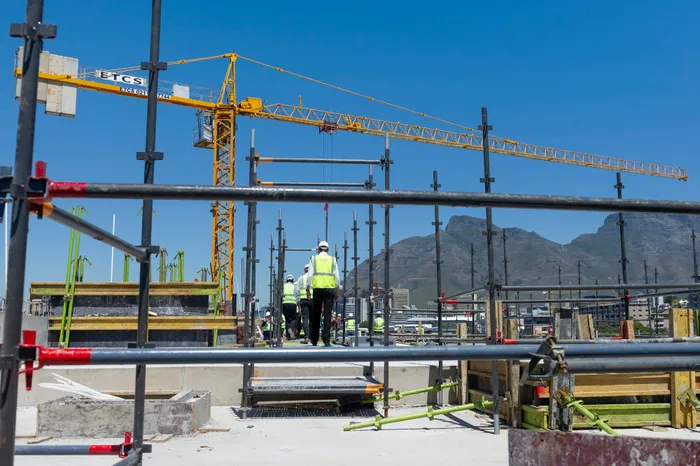
Data from FNB/BER Building Confidence Index showed that hardware retailers, sub-contractors and main contractors registered the lowest sentiment during the quarter with the sub-contractor index falling to zero. Photo: David Ritchie/African News Agency (ANA) The FNB/BER Building Confidence Index shows that building material manufacturers also posted a notable improvement, with confidence rising 14 points to 32—its best reading since the first quarter of 2022.
Image: File
South Africa’s building sector ended the year on a stronger footing, with the FNB/BER Building Confidence Index rising eight points to 43 in the fourth quarter of 2025—its joint highest reading in a decade and above the long-term average of 40.
The improvement follows a slight dip to 35 in the third quarter.
Yet, despite the encouraging jump, the latest index level released on Monday still indicates that more than half of survey respondents remain dissatisfied with prevailing business conditions.
Hardware retailers, buoyed by stronger sales, were the biggest drivers of the improvement, with confidence in this segment rising 21 points.
FNB senior economist Siphamandla Mkhwanazi said the rebound reflects resilient consumer demand supported by lower inflation, interest-rate cuts, and continued withdrawals from the two-pot retirement system.
“The jump in hardware retailer confidence returns the index to more or less the level registered at the start of the year and reaffirms some of the broader trends regarding theresilience of the SA consumer,” Mkhwanazi said.
“Household income has benefitted from lowerinflation, lower interest rates – including the November cut although it is too soon for that to add to sales but potentially to sentiment – and continued two-pot withdrawals.”
Building material manufacturers also posted a notable improvement, with confidence rising 14 points to 32—its best reading since the first quarter of 2022.
Main contractors, however, saw sentiment slip to 39 from 46 previously, despite better activity, profitability and stronger expectations for the next quarter.
“In all, sentimentmerely slipped back to its long-term average following a jump in 2025Q3. Theunderlying trends are still promising,” said Mkhwanazi.
Residential building activity accelerated, although tighter tendering competition kept profitability muted, resulting in unchanged confidence. Non-residential builder sentiment held steady at 50 despite weaker activity and profits.
Mkhwanazi said the softer reading likely reflects a slowdown in growth, not an outright decline, with investment levels still well below those seen in the 2010s.
“With this base and thebroader improvement in macroeconomic fundamentals, it is unlikely that thesofter activity reading this quarter reflects a decline in work. Rather, it suggests a slowdown in the growth profile,” he said.
Recent data from Statistics South Africa showed real investment in buildings falling 9.6% year-on-year in the third quarter—an improvement from the 10.7% contraction in the previous quarter—while rising 1.4% on a quarterly basis. The survey results suggest a similar pattern in the final quarter of the year.
Further along the value chain, architect confidence rose eight points, aided by better business conditions and activity. Quantity surveyors reported sharply weaker activity, but sentiment held up. Sub-contractors saw a significant 10-point increase in confidence.
“The building pipeline provided mixed results in terms of upcoming work and suggests that there is at least some activity likely to move along the value chain,” stated Mkhwanazi.
The latest results signal tentative but broad-based improvement across the building pipeline, from planning to production and construction.
“There is reason for cautious optimism about the prospects for the buildingsector next year. While there are still a number of hurdles to sustained growth, lower interest rates, faster economic growth and better momentum on structural reform – not to mention the very low base - could see noticeably morepronounced growth,” Mkhwanazi said.
BUSINESS REPORT