

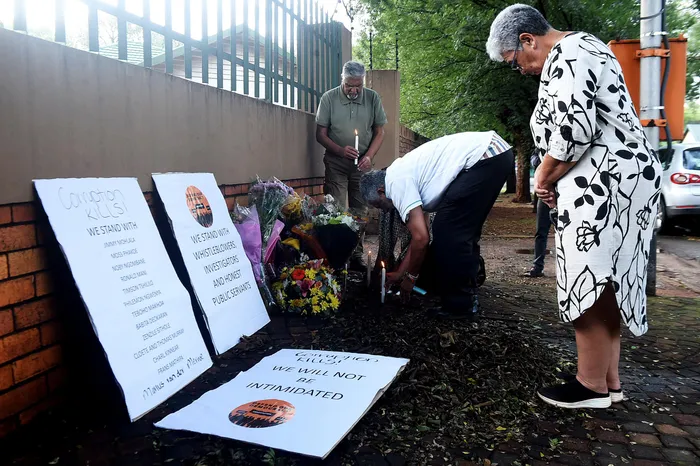
The Ahmed Kathrada Foundation (AKF), Defend our Democracy, and other civil society organisations on Sunday lent their support to the family of slain former Ekurhuleni Metro Police Department official Marius van der Merwe, who was murdered outside his house on Friday.
Image: Itumeleng English / Independent Newspapers
The assassination of a key witness in the Madlanga Judicial Commission of Inquiry has sparked renewed concern over South Africa’s ability to safeguard investors’ confidence, protect whistleblowers and uphold the rule of law.
The Madlanga Commission is investigating allegations of political interference and corruption in the criminal justice system, including alleged infiltration of criminal syndicates into law enforcement, intelligence, prosecution authorities, the judiciary, and correctional services, among others.
The murder of Marius van der Merwe, referred to as "Witness D" outside his Brakapan home at the weekend has raised alarms among governance specialists and economists just months after the country exited the Financial Action Task Force (FATF) greylist.
Business Against Crime South Africa (BACSA) said South Africa’s efforts to tackle organised crime and corruption depend heavily on strong, trusted whistleblower and witness-protection systems.
BACSA said the reforms needed to bridge the gaps between the Protected Disclosures Act and the broader witness-protection framework have been on hold for more than 18 months, and this pause is creating real vulnerabilities for those who step forward with critical information.
"This is a chance for the private sector not just to support government, but to lead by example. By putting meaningful resources behind these protections, business can reinforce public trust, help close the space in which criminal networks operate, and demonstrate a clear commitment to integrity," it said.
"BACSA underscores that credible, well-resourced whistleblower and witness-protection systems are fundamental to any successful anti-corruption strategy. When people feel safe to come forward, evidence flows, investigations strengthen, and organised crime loses ground."
Tshepo Matseba, managing director of Reputation 1st Group, said on Monday that the killing of Witness D presents “a serious risk for South Africa as an investment destination.”
"It also undermines confidence among local businesses and ordinary South Africans, because no investment can grow in an environment where people feel unprotected and lose hope," he said.
Matseba also stressed that strengthening whistleblower protections, ensuring an independent prosecution system and demonstrating that governance structures work are now critical to investment confidence.
"Business depends on predictability and trust. Investors must believe that the rule of law is intact and that accountability is consistent. If we fail to secure a safe and fair space for business to operate without corruption, investors will look elsewhere for markets where fairness, safety and security are prioritised," Matseba said.
"Protecting whistleblowers and strengthening the justice system is not only the right thing to do, but it is central to safeguarding South Africa’s reputation and competitiveness."
Vander Merwe was member of the security industry and former official of the Ekurhuleni Metropolitan Police Department (EMPD). He gave explosive testimony to the Madlanga Commission last month, exposing organised-crime syndicates that had captured the EMPD.
Dawie Roodt, chief economist at Efficient Group, placed the blame at the governent's doorstep, arguing that the State has failed in its most fundamental duty: protecting citizens’ lives, property and freedoms.
According to Roodt, the breakdown in the State’s core protective function raises a fundamental question about the continued legitimacy of the social contract between the government and the public.
"And then we, the people, must ask the question whether we still want to have this social pact because the State is clearly not fulfilling its functions. So why should we keep on funding the State? And if this goes on, the public will take the law in their own hands because the State is simply not doing that," he said.
North-West University economist, Professor Waldo Krugell, said Van der Merwe's killing has a very indirect effect.
“It's not the sort of stuff that you pick up in these sentiment indices or something like that. But it's there. I think it reinforces a view that South Africa is a sort of a lawless environment, that it's a dangerous environment, that to do business here is costly,” he said.
“In the long run, it's bad for investment. I think there's a lot of research that shows that an environment like this is typically associated with very low levels of investment.”
Professor Andre Thomashausen, a professor emeritus of international law at Unisa, said the assassination erodes the confidence in the South African Police Services (SAPS).
“Like the South African National Defence Force and most other key South African administrations, SAPS today is an international embarrassment. It feeds the perception of a mafia state and impacts negatively on the credibility of South Africa's foreign investment offerings.”
Chad Thomas, the CEO of IRS Forensic Investigations, said that the optics are very bad for South Africa.
“Having a witness assassinated on the very day that the commission wraps up for the year leads one to the assumption that a witness was taken out based on his testimony and also acts as a warning to future witnesses.”
Thomas added that what is even more perturbing is that the testimony from the deceased cannot be used in future court proceedings as the deceased cannot be cross examined, which is the right of any accused.
BUSINESS REPORT