

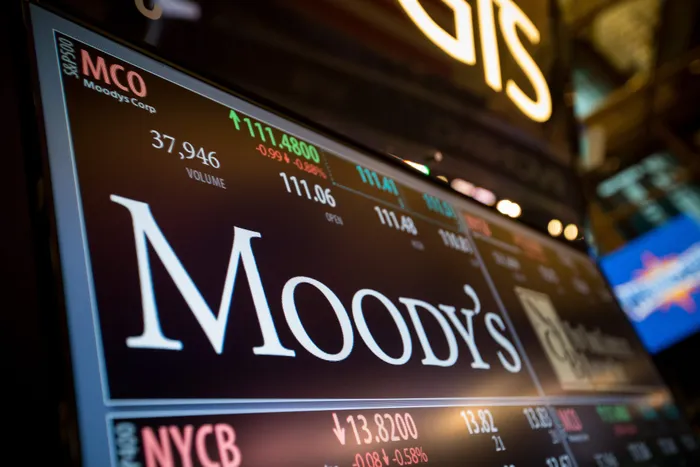
Moody’s Ratings has maintained South Africa’s credit rating at Ba2, highlighting improvements in economic conditions while cautioning against deep structural constraints that could hinder long-term growth.
Image: File.
Moody’s Ratings has reaffirmed its existing view on South Africa’s creditworthiness following a periodic review completed on 27 November 2025, cautioning that while economic conditions have improved, deep structural constraints continue to weigh on the country’s long-term prospects.
The review, which did not constitute a ratings action, maintains South Africa’s long-term issuer rating at Ba2 with a stable outlook.
This comes after S&P Global Ratings has announced an upgrade of South Africa’s credit rating, the first increment in almost 20 years. This upgrade signified a recognition of the country’s improved economic trajectory, buoyed by stronger revenue performance, enhanced growth prospects, and a gradual easing of pressures that have long beleaguered state-owned enterprises.
Moody’s said South Africa’s rating reflects chronically low growth potential linked to ageing infrastructure, a weak labour market, and entrenched socioeconomic inequalities that complicate policymaking and fuel social tensions.
Although operational and financial improvements have begun to emerge at some state-owned enterprises, the broader State-Owned Enterprises (SOE) sector continues to present fiscal risks for an already heavily indebted government.
These weaknesses are partially offset by the country’s strong macroeconomic framework, credible monetary policy, freely floating exchange rate, and substantial private-sector external assets that help cushion external shocks.
Economic activity strengthened in 2025 as power supply stabilised and rail and port performance improved, boosting output in mining, automotive manufacturing and chemicals.
Moody’s expects gradual gains in investment as reforms in energy and logistics continue, supported by resilient domestic demand.
However, global headwinds, tariff disputes and rising domestic political tensions could temper the recovery.
The South African Reserve Bank’s (Sarb) move in July to shift its inflation-targeting focus toward the lower end of the 3%–6% range is already helping re-anchor inflation expectations at 3%.
Moody’s believes this will, over time, lower borrowing costs and support fiscal consolidation, though tighter monetary policy will exert short-term pressure on growth.
The National Treasury’s Medium-Term Budget Policy Statement, delivered in November, reaffirmed its commitment to fiscal discipline, projecting a fiscal deficit of 4.5% of GDP in FY2025 and 3.6% in FY2026.
Moody’s forecasts a slightly narrower deficit of 4.1% next year, but warns that debt will rise to about 87% of GDP due in part to new guarantees for Transnet, liabilities the agency includes in its debt definition given the company’s weak financial condition.
"We expect the government burden to rise to around 87% of GDP in FY2025 from 83% of GDP in FY2024, in part due to slower nominal GDP deflator and also due to the provision of new government guarantees to Transnet (Ba3 Stable)," Moody's said.
"Due to Transnet's very weak financial situation, we include such guarantees in our definition of government debt."
Moody’s noted South Africa’s institutional strength, including the Sarb and judicial system, but highlighted ongoing corruption concerns. Elevated debt and weak affordability underpin a low fiscal strength assessment, while event risk is driven by political and banking-sector vulnerabilities.
ESG factors also weigh on the rating, particularly high exposure to social risks and the state’s limited financial resilience to shocks.
The stable outlook reflects expectations of modest but improving growth, likely reaching 1.8% by 2027, continued fiscal consolidation through primary surpluses, and gradual improvement in electricity and logistics performance.
This is in line with the Sarb and the National Treasury's medium-term GDP forecasts.
While coalition tensions may slow policymaking, Moody’s expects compromises will allow essential legislation to advance.
"We also foresee a gradual reduction in contingent liability risks from state-owned enterprises on the government's balance sheet given recent operational improvements. Risks to our baseline scenario are balanced, with growth potentially falling short of forecasts but interest rates possibly declining faster than expected," Moody's said.
Upward pressure on the rating would require faster-than-expected growth, sustained improvements in energy and logistics, stronger investment levels, or a meaningful decline in real interest rates.
Conversely, setbacks in reforms, worsening political fragmentation, adoption of credit-negative policies such as nationalisation, or larger-than-expected SOE support needs could trigger downward pressure.
Moody’s emphasised that this review reflects conditions at the date of publication and will only be updated during the next scheduled periodic review or upon material changes in South Africa’s credit profile.
BUSINESS REPORT