

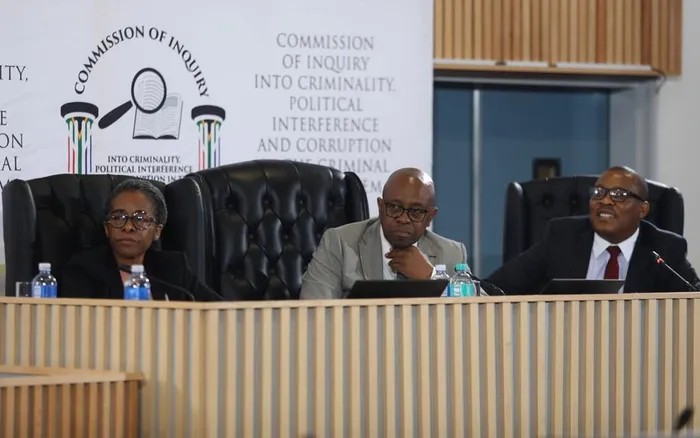
No society can expect ordinary people to expose wrongdoing when the cost is intimidation, victimisation or death. A nation that fails to protect whistleblowers ends up protecting the corrupt. writes the author.
Image: Oupa Mokoena / Independent Newspapers
Nqobani Mzizi
Corruption rarely calls itself by its name. It hides behind language that softens the offence and dulls our outrage. We speak of mismanagement, a saga, a scandal, price fixing, a commission of enquiry or corporate collapse. These words create distance from the truth.
On this United Nations International Anti-Corruption Day, we confront a reality that is neither abstract nor distant. It is real. Its impact is felt. Corruption is a deliberate act of harm. It steals from the public, weakens institutions and erodes the trust required for any nation to function. Corruption is an enemy to progress, and nothing good has ever come from it.
The drivers of corruption are not mysterious. Opportunity, greed, impunity, weak controls, compromised leadership and environments where accountability becomes negotiable, enabling wrongdoing to flourish. Corruption has no colour and no gender. It is not limited to the public sector or the private sector. It thrives wherever systems are fragile and leadership chooses silence over consequence. Before we know it, corruption becomes endemic and deeply entrenched. When ethical courage disappears, corruption fills the space.
We measure this systemic fragility. The annual Corruption Perceptions Index (CPI) from Transparency International examines bribery, abuse of public office, accountability mechanisms and protections for those who report wrongdoing, amongst numerous variables. Whilst it focuses on public sector corruption worldwide, the index provides a reliable signal of systemic integrity. It does not measure morality. It measures governance strength. It tells us whether institutions can withstand pressure and whether wrongdoing is likely to be uncovered or ignored.
South Africa ranks 82nd out of 180 countries, with a score of 41 out of 100. This reflects weaknesses in our integrity systems. Countries that rise on the Index strengthen oversight and accountability. Those that fall struggle with unstable leadership, weak enforcement and cultures where accountability becomes optional. Our score is less about who we are as a people and more about the systems we tolerate. It reflects the distance between where we are and where we must be.
As the United Nations reminds us this year, it is the youth who will live longest with the consequences of corruption. They inherit the institutions we have weakened and futures we have compromised. If integrity does not become the norm today, the burden of failure will fall on a generation that had no hand in creating the problems they will be forced to solve.
The impact of corruption is financial, operational and deeply human. It diverts money meant for clinics, schools, maintenance and infrastructure into private pockets. It inflates costs, disrupts operations, corrodes organisational culture and destroys public confidence. Service delivery collapses long before an enquiry ever begins. Corruption does not simply steal funds. It steals futures.
Nowhere is this felt more sharply than in the experiences of whistleblowers. Whistleblowing remains the most effective mechanism for exposing wrongdoing, yet, in South Africa, it has become one of the most dangerous. The brutal assassinations of whistleblowers like Babita Deokaran, Marius van der Merwe (Witness D of the Madlanga Commission), and insolvency specialist attorney Bouwer van Niekerk reveal a frightening truth. These killings cut across both public and private sector corruption, reminding us that this crisis is not confined to one domain of society. Telling the truth has become an act of personal risk. No society can expect ordinary people to expose wrongdoing when the cost is intimidation, victimisation or death. A nation that fails to protect whistleblowers ends up protecting the corrupt.
Although we have the Protected Disclosures Act and the Prevention and Combating of Corrupt Activities Act, including section 34A, which compels persons in authority to report corruption at or above the prescribed threshold, these laws do not provide adequate shields. They do not guarantee physical safety, financial support or immunity for good faith disclosures. They do not prevent retaliation that appears as demotions, stalled careers, isolation or targeted intimidation. They do not provide long-term protection for those whose careers and security are destroyed by speaking out.
This is why the Draft Whistleblower Protection Bill now before Parliament is so important. It offers the promise of stronger anonymity frameworks, better support structures and clearer obligations on institutions to act. Legislation cannot create courage, but it can create safety.
While other laws, such as the Labour Relations Act, provide general workplace protections, they are no match for the sophisticated retaliation whistleblowers face. Without stronger, dedicated protections, we cannot expect people to risk their lives for the truth. Strengthening this legal ecosystem is a governance imperative.
Against this backdrop of legal insufficiency, organisational responses are often equally frail. Many organisations maintain policies on fraud and corruption, conflicts of interest and gifts and entertainment. These policies matter, but they cannot replace ethical leadership. Policies are administrative. Culture is lived. A hotline means nothing when fear outweighs trust. Tone at the top is not a phrase. It is a lived expectation that must be visible in decisions and behaviour. The most sophisticated frameworks collapse when the values on paper contradict the behaviour in practice. Morality cannot be outsourced. It must be embodied.
This is where governance becomes central. Corruption is not defeated in courtrooms. It is prevented in boardrooms. The King V Code, building on King IV, positions the board as the moral centre of the organisation. Principles 1 and 2 emphasise that ethical and effective leadership is sacrosanct in every organisation. This means boards must move beyond approving ethics policies to actively modelling and rewarding ethical behaviour, investigating allegations with rigor and holding even senior leaders accountable without exception.
These are not symbolic expectations. They influence appointments, oversight decisions and organisational responses to wrongdoing. Boards that treat ethics as a procedural requirement create conditions in which corruption becomes possible. Boards that set a clear ethical standard build institutions capable of resisting wrongdoing long before it escalates.
The State’s commitment to strengthening whistleblower protection is vital, but legislation cannot replace integrity. Organisations must build cultures where transparency is the norm, where wrongdoing is confronted early, and where truth tellers are not punished for their courage. Boards must interrogate patterns, demand transparency and refuse to normalise ethical shortcuts. They must protect whistleblowers because it is lawful and because it is right. Silence in the boardroom has a cost, and South Africa continues to pay that cost through collapsed municipalities, failing state entities and service delivery failures that harm those with the least power to absorb the damage.
South Africa has examples of ethical leadership that have rebuilt broken systems and restored public confidence. The challenge is scale. A nation cannot rely on isolated examples of courage. Corruption is defeated when integrity becomes the organising principle of governance. It requires consistent consequence management, visible accountability and leadership that is stronger than the discomfort of confronting wrongdoing.
As I reflected earlier this year on whistleblowers and the cost of silence, governance fails when truth tellers stand alone. That reality remains unchanged. Boards carry a responsibility that cannot be delegated. They determine whether integrity becomes embedded or optional. They decide whether wrongdoing is confronted or explained away. They choose whether courage is celebrated or punished.
Before any organisation declares itself ethical, four questions must be answered with honesty:
The fight against corruption starts with a simple truth. Corruption is a choice. So is integrity. The future of South Africa depends on which one leaders choose. On this International Anti-Corruption Day, we are not called to observe. We are called to act. Integrity must win, not through slogans or policy statements, but through the daily, decisive choice to value truth over convenience and accountability over fear. The future will judge us not by what we said about corruption, but by what we refused to tolerate.

Nqobani Mzizi is a Professional Accountant (SA), Cert.Dir (IoDSA) and an Academic.
Image: Supplied
Nqobani Mzizi is a Professional Accountant (SA), Cert.Dir (IoDSA) and an Academic.
** The views expressed do not necessarily reflect the views of IOL or Independent Media.
BUSINESS REPORT