

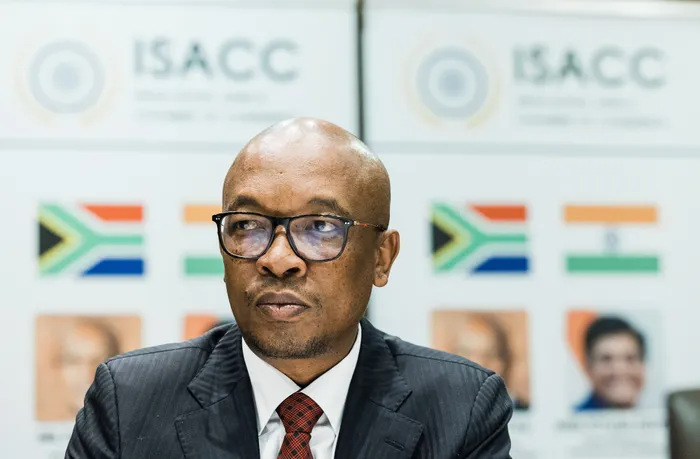
Kaamil Alli, spokesperson for the Department of Trade, Industry and Competition, said the Bill will go to the House and follow the legislative process in the US.
Image: Independent Media Archives
US legislators have introduced a bill to extend the African Growth and Opportunity Act (Agoa) for three more years, seeking to restore stability to Washington’s flagship trade programme with sub-Saharan Africa after it lapsed on 30 September.
The Agoa Extension Act (H.R. 6500), sponsored by Representatives Jason Smith (R-MO) and Adrian Smith (R-NE), aims to renew the programme until 31 December 2028, giving US companies and African exporters much-needed certainty as policymakers consider a longer-term overhaul.
Agoa, first enacted in 2000, provides eligible sub-Saharan African countries with duty-free access to the US market for more than 1 800 products, in addition to the more than 5 000 products that are eligible for duty-free access under the Generalized System of Preferences program.
It has been widely credited with expanding trade and investment between the US and sub-Saharan Africa by providing eligible countries duty-free access for thousands of products. The programme includes strict annual eligibility reviews covering rule of law, human rights, intellectual property protections, anti-corruption measures and market access.
Supporters of the extension warn that the lapse has created risks for US interests in the region.
Africa holds an estimated 30% of the world’s critical mineral reserves, and lawmakers note that China has already invested between $8 billion and $10bn to deepen its influence over these supply chains.
A prolonged gap in Agoa, they argue, could allow “malign actors” such as China and Russia to expand their strategic footprint.
Jason Smith, chairman of the Ways and Means Committee, said the renewal of bipartisan trade programs, Agoa serves America’s economic and national security interests, adding that Africa alone is home to roughly one third of all the world’s critical minerals.
"In Africa, China and Russia have been aggressive players, economically bullying developing nations, extracting and controlling that continent’s critical minerals in dirty and dangerous ways, all in a bid to assert global dominance. Agoa is a key part of how America protects our interest in a region important to our future," Smith said.
"Not only does the program strengthen relationships with key economic partners, it also opens the door to more customers for American farmers and producers in some of the world’s fastest-growing economies. As China continues to grow its presence around the globe, America must provide an alternative path to nation’s looking to tie their economic prosperity to the United States and not our adversaries."
The bill’s sponsors say a three-year extension would provide a stable planning horizon for US firms sourcing from Africa and would give Congress time to work with the Trump administration on long-term reforms. The proposed renewal does not affect the administration’s separate tariff agenda, which operates outside Agoa’s statutory schedule.
The lawmakers also highlighted the administration’s diplomatic efforts in the region, including President Trump’s involvement in peace initiatives between Rwanda and the Democratic Republic of Congo. They argue that renewing Agoa will reinforce those stability efforts by strengthening economic ties.
If passed, H.R. 6500 would revive the US’s primary trade mechanism with sub-Saharan Africa, helping avoid disruptions to supply chains and supporting ongoing investment in the continent’s manufacturing and export sectors.
Kaamil Alli, spokesperson for the Department of Trade, Industry and Competition, said the Bill will go to the House and follow the legislative process in the US.
"We are tracking progress closely. As we have stated, we continue to lobby for South Africa’s inclusion in any extension of the Agoa legislation," Alli said.
Meanwhile, US Trade Representative, Ambassador Jamieson Greer, said they have had some conversations with Pretoria but there was still a lot of foreign policy issues that he does not get into with South Africa.
"But when it comes to trade, they have a lot of barriers. We have made it clear to the South Africans that if they want to have a better tariff situation with us they need to take care of these tariff and non-tariff barriers," Greer said.
"They are a real economy, they are a big economy, right. They have an industrial base, they have an agricultural base; they should be buying things from the United States."
BUSINESS REPORT