

The report concludes that while the G20 has delivered decisive outcomes during moments of global crisis, its effectiveness has declined in recent years due to geopolitical tensions, an overcrowded agenda and weak continuity between presidencies.
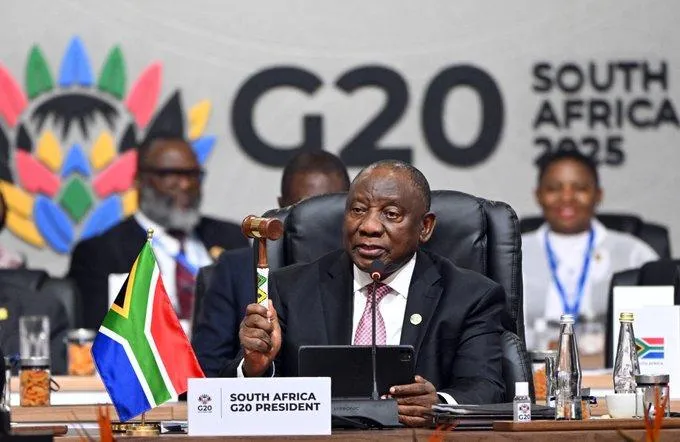
Image: African Union/ X
The Group of Twenty (G20) remains a critical pillar of global economic co-operation but risks losing relevance unless it sharpens its focus and streamlines its agenda, according to a major review released under South Africa’s 2025 G20 Presidency.
The G20@20 Review, published on Monday, assesses the bloc’s first full cycle of presidencies since it was elevated to a leaders’ forum during the 2008 global financial crisis.
The report concludes that while the G20 has delivered decisive outcomes during moments of global crisis, its effectiveness has declined in recent years due to geopolitical tensions, an overcrowded agenda and weak continuity between presidencies.
Commissioned by G20 leaders at the 2024 Rio de Janeiro Summit, the review was conducted through surveys, Sherpa-level discussions and expert input, with support from the OECD, the South African Institute for International Affairs and the University of Toronto’s G20 Research Group.
“The G20 still matters,” the report states, describing it as the world’s premier forum for international economic co-operation.
However, it warns that the bloc is operating in a more fragmented and polarised global environment, marked by slower growth, record public debt and deepening geopolitical rivalries.
According to the review, the G20 has been most effective during periods of acute crisis. Coordinated action during the 2008–09 financial meltdown helped stabilise global markets, while collective measures during the Covid-19 pandemic, including fiscal stimulus, debt relief initiatives and the establishment of the Pandemic Fund, prevented a deeper global downturn.
Beyond crisis management, the G20 has also shaped long-term global policy in areas such as financial regulation, international tax co-operation, development finance and food security.
Initiatives such as the Financial Stability Board, the OECD/G20 Base Erosion and Profit Shifting framework, and the Agricultural Market Information System are cited as examples where political consensus translated into lasting institutional change.
However, the review finds that momentum has slowed. Three-quarters of G20 members surveyed believe the group’s effectiveness has decreased over time, with many pointing to an ever-expanding agenda that has diluted focus and strained diplomatic and administrative capacity.
More than 20 working groups and multiple task forces are currently active, leading to overlapping mandates and limited follow-through.
The report recommends streamlining workstreams, pausing or merging less central initiatives, and prioritising issues directly linked to the G20’s core mandate of promoting strong, sustainable, balanced and inclusive growth.
Core areas identified for continued focus include macroeconomic co-ordination, financial stability, international tax, development, food security, employment, trade, energy and climate. By contrast, newer agenda items such as tourism, culture and disaster risk reduction were widely viewed as having limited impact at leaders’ level.
Continuity between presidencies also emerged as a key concern. Each rotating presidency sets its own priorities, often resulting in new initiatives without sufficient time or political backing for implementation.
To address this, the review suggests strengthening the role of the G20 Troika, comprising the past, current and incoming presidencies, while preserving each presidency’s right to shape its agenda.
There is interest among Members in further enhancing the Troika’s function to strengthen year-to-year continuity and momentum on multi-year workstreams.
"In this context, some Members propose developing joint high-level objectives that span all Troika countries to strike a better balance between each Presidency’s priorities and ongoing legacy work," read the report," read the report.
"Some Members would also like to see an enhanced role for the Troika in guiding the G20’s engagement with non-Member countries and other key stakeholders. At the same time, many Members as well as the Advisory Panel caution that any expansion of the Troika’s function – including through joint multi-year priorities – may be at odds withthe prerogative of each Presidency to set its own agenda."
Despite calls for reform, the report strongly defends the G20’s informal and leader-led character.
Members reaffirmed their commitment to consensus-based decision-making and rejected proposals for a formal charter or permanent secretariat, arguing that flexibility and informality underpin the G20’s ability to respond quickly to shocks.
The review also highlights tensions inherent in the G20 model, including balancing inclusiveness with effectiveness and breadth with depth. Participation by guest countries, international organisations and engagement groups has broadened perspectives but also increased complexity and summit-level congestion.
Among its recommendations, the report calls for shorter and more focused leaders’ declarations, clearer monitoring of commitments, closer alignment between the Sherpa and Finance tracks, and regular stocktakes to assess the real-world impact of G20 decisions.
As the G20 prepares to enter its second cycle of presidencies in 2026 under United States leadership, the review concludes that reform, rather than reinvention, is needed.
“A well-functioning G20 may be needed more than ever,” the report says, warning that failure to adapt could weaken one of the few remaining forums where advanced and emerging economies meet on equal footing.
BUSINESS REPORT