

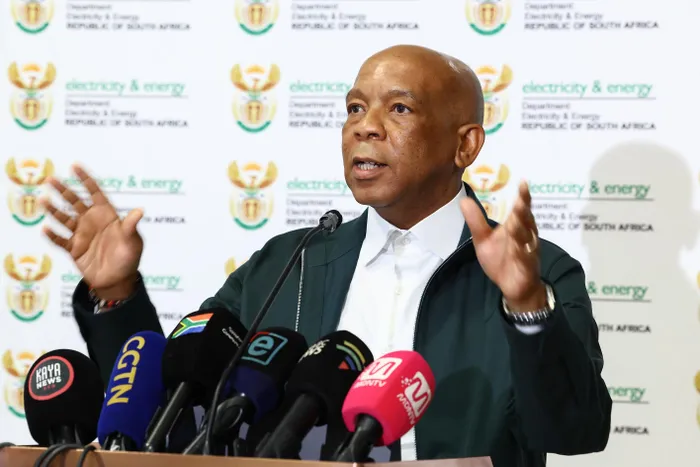
Speaking to the media on Monday, Ramokgopa said the proposed range was significantly lower than the 87c/kWh currently on the table and would bring South African smelters closer to the pricing enjoyed by competitors in other jurisdictions.
Image: GCIS
Banele Ginindza
Electricity and Energy Minister Kgosientso Ramokgopa has said that he is confident that negotiations to rescue South Africa’s struggling ferrochrome smelter industry are nearing a breakthrough, with electricity tariffs of between 60c and 70c per kilowatt-hour (kWh) emerging as a realistic target.
Speaking to the media on Monday, Ramokgopa said the proposed range was significantly lower than the 87c/kWh currently on the table and would bring South African smelters closer to the pricing enjoyed by competitors in other jurisdictions.
Ramokgopa said other countries that South African smelters compete with are offering electricity in the range of 60 to 70 cents per kilowatt-hour. He said despite South Africa holding more than 70% of global ferrochrome ore reserves, much of this ore is exported because the country cannot beneficiate locally at current electricity prices.
He said electricity pricing had been the key factor preventing companies from proceeding with Section 189 retrenchments and from keeping smelters under care and maintenance.
Ramokgopa outlined the steps already taken in negotiations, noting that smelters had moved off Eskom’s standard Megaflex tariff of R2.12/kWh to a negotiated price of R1.35/kWh, then to R1.28/kWh, before government and Eskom made a firm offer of 87c/kWh.
Electricity costs account for 40% to 52% of total production costs at ferrochrome smelters, making power pricing the central obstacle to restarting idled furnaces and halting job losses at operations owned by Samancor Chrome and Glencore–Merafe.
"We had a conversation. We then went to 128 cents a KWh and had further discussions and we made a concrete offer of 87 cents a kWh, but that's still not sufficient and it's really not a selfish consideration on behalf of the two parties," he said.
"We know there's a sweet spot. That sweet spot will be anything between 60 and 70 cents for us to really be in the mix."
The minister stressed that the proposed tariff would be a fully loaded price, covering electricity generation, transmission and related costs. However, reaching that level would have significant financial implications.
"It's a huge number. It has huge implications, that's why we are having conversations about how it can be financed. We have a good proposal before us, we don't want to negotiate through media. But we have a solid solution that will not burden the fiscus," Ramokgopa said.
"We don't want to get to a situation where this effort is fully subsidised. If there is a shortfall, that shortfall must be socialised. There's no free lunch, somebody must pay for it. Ultimately it must be the end consumer. We don't want to burden the end consumer, that's why we need that bit of time to work, but the core element of what will support this is the proposal are in place. We are answering the primary energy and the like."
Ramokgopa revealed that the 87.7c/kWh proposal carried a R5.2 billion shortfall, which could not simply be passed on to households or other users. He said government was developing mechanisms to reduce the tariff further and expected to finalise a solution by March 2026.
Ferro Alloy Producers Association (FAPA) chairperson Nellis Bester said it was too early to comment in detail, as the implementation plan was still being developed.
Meanwhile, Eskom confirmed that the National Energy Regulator of South Africa (Nersa) is processing an application for an interim tariff adjustment for ferrochrome smelters.
Eskom recently signed a memorandum of understanding (MoU) with Samancor Chrome and the Glencore–Merafe Chrome Venture, acting as industry representatives.
Under the MoU, once the interim tariff is approved, smelters have committed to suspend retrenchment processes and bring about 40% of furnace capacity back online, while a longer-term pricing framework is finalised.
According to Solidarity's deputy general secretary, Willie Venter, a win-win agreement is nevertheless possible and hard work must now be done to find a sustainable solution.
"We hope the new proposed tariff will be of such a nature that it can make the employers sustainable. With this, the ferrochrome industry will hopefully be able to revive, and the smelters will be able to start working again, which will create thousands of new job opportunities. South Africa urgently needs this," Venter said.
"This will, of course, also be good news for downstream companies, and we hope that through this process, retrenchments will disappear entirely from the table."
BUSINESS REPORT