

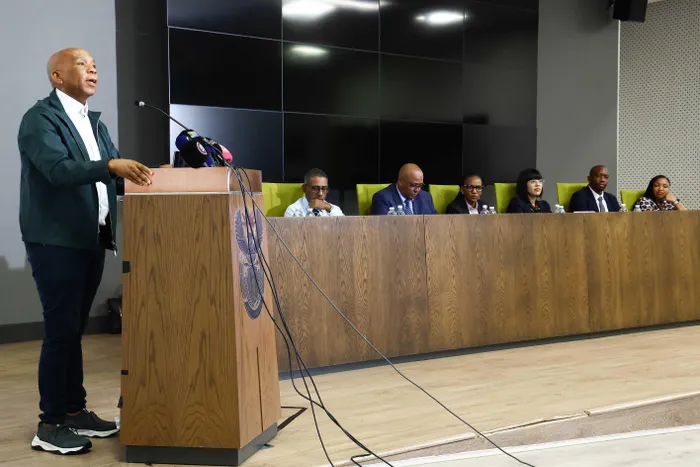
The Minister of Electricity and Energy, Dr. Kgosientsho Ramokgopa, announces preferred pre-qualified bidders under the first phase of Independent Transmission Projects (ITP) Procurement Programme and additional Prefered Bidders under Bid Window 7 of the Renewable Energy Independent Power Producer Procurement Programme (REIPPPP) in a media briefing.
Image: GCIS
Banele Ginindza
Electricity and Energy Minister, Kgosientso Ramokgopa, has stressed that South African companies will be positioned to secure preferred bidder status in later phases of the country’s 10-year transmission expansion programme, even as international firms dominate the first phase of the landmark Independent Transmission Project (ITP) initiative.
Ramokgopa on Monday announced seven pre-qualified bidders for the initial R17 billion, 1 064-kilometre phase of the transmission development programme, selected from 17 respondents to the prequalification process.
A request for proposals (RFP) for the first phase is expected to be issued in the second half of 2026. The pre-qualified consortia are:
"The flavour is an international flavour. I want to, when I come back for the third and fourth round, be able to show that the lead member is South African. But let the project mature so that we are getting to levels where we are building enough local capacity," Ramokgopa said
He emphasised that localisation and industrialisation would be central to the programme’s design, with lessons drawn from shortcomings in earlier renewable energy procurement rounds.
"We have learnt from the IPP programme on the generation side. There are players that circumvented the rules, undermined the transformation elements of this programme," he said.
"We are guarding against those. We are working with the Department of Trade, Industry and Competition, the National Treasury to have a dispensation that will make sure we are able to domesticate the benefits. We are not going to export the employment opportunities," he said.
The pre-qualifying bidders were announced as the RFP for the initial ITP projects has also been delayed to coincide with the launch of a new Credit Guarantee Vehicle (CGV), which will enable the projects to proceed in the absence of the National Treasury guarantees.
The CGV, which will be a private non-life insurance company, regulated by the Prudential Authority, is scheduled to be launched in July 2026, with the National Treasury having already announced that it will inject seed equity of R2bn into the vehicle, giving it a minority shareholding.
Shakira Karolia, economic advisor at the Department of Electricity and Energy, said the remaining equity would be sourced from development finance institutions, with the timing of the launch aligned to approvals from the World Bank Group and the International Finance Corporation (IFC), which is expected to participate as a shareholder.
"We are already working hard on the CGV led by National Treasury, with support from the Department of Electricity and Energy and next year a lot of that work will intensify,"she said.
"There are various engagements, board engagements at the World Bank level, which are envisaged for early next year and then the International Finance Corporation and NIGA with the IFC also taking an equity stake. But critical to that, the State takes a minority but anchor shareholding in the CGV with it being a blended finance risk sharing platform."
She said it was essential that key milestones envisaged for the CGV during next year were met because it is a critical component in the Department releasing the RFP.
"The draft RFP is also intended to ensure that the final RFP we release is bankable, robust and has sufficient input from the market. What needs to be resolved between now and the release of the RFP, there are many elements pertaining to the Credit Guarantee Vehicle and it's a process on its own, contingent on development partners that are also taking equity in that vehicle," Karolia said.
"Our uptake thus far has been exceptionally encouraging and we are really sitting with quite a lot of commitments from development partners. The CGV operationalisation Credit Guarantee Vehicle is envisaged in the second half of next year, and that is very important from a lender and bidder certainty to ensure that they will have full understanding of what the mechanisms are to actually de-risk investment into the sector."
BUSINESS REPORT