

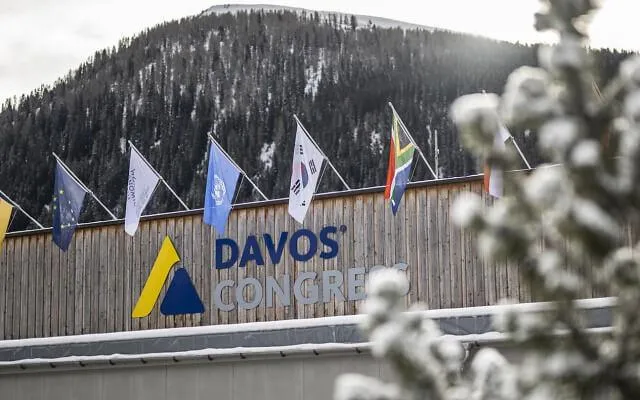
The World Economic Forum’s (WEF) Annual Meeting 2026 will convene in Davos next week.
Image: Supplied
The World Economic Forum’s (WEF) Annual Meeting 2026 will convene in Davos next week against what organisers describe as the most complex geopolitical backdrop since the end of World War II, with rising global tensions, economic uncertainty and rapid technological change shaping discussions at the start of the year.
Unveiling key details of the meeting during a press briefing on Tuesday, WEF President and CEO Børge Brende said the gathering comes at a pivotal moment for the global economy, which has proven more resilient than many expected.
“Despite the geopolitical challenges, the global economy has been very resilient,” Brende said, adding that growth of more than 3% is expected this year, an improvement on the more pessimistic outlook seen in 2025.
However, he cautioned that sustaining growth would depend on avoiding major conflicts and unlocking new engines of expansion, particularly through frontier technologies.
Against this backdrop, the Forum has chosen “Spirit of Dialogue” as the theme for the 2026 meeting, underscoring the need for cooperation at a time of fragmentation and uncertainty.
“Dialogue is not a luxury. Dialogue is a necessity,” Brende said, pointing to shared global risks such as future pandemics and cybercrime, which he estimated costs the world between $5 trillion and $6trln a year.
The scale of this year’s meeting reflects that urgency. More than 3 000 leaders from around 130 countries are expected in Davos, including a record number of political and business leaders.
Brende said 64 Heads of State and government have confirmed their attendance so far, with numbers continuing to rise. Six of the seven G7 leaders are expected to be present, alongside leaders from emerging economies at levels not seen before at the Forum.
Business participation will also be at record levels, with around 1 700 business leaders attending, including more than 850 chief executives and chairs of leading global companies.
Technology will feature prominently, with major industry figures such as Nvidia CEO Jensen Huang and Microsoft CEO Satya Nadella among those expected to attend, reflecting the growing role of artificial intelligence and other frontier technologies in driving productivity and growth.
Geopolitics will dominate much of the agenda. Brende said more than 30 foreign ministers will join heads of state and government to discuss conflicts and flashpoints including Ukraine, Gaza, Iran, Venezuela and broader instability in parts of Latin America and the Middle East.
Ukrainian President Volodymyr Zelensky is expected to attend as the war in Ukraine approaches its fourth year, while leaders from the Middle East, including Lebanon, Syria, Jordan and Qatar, will focus on preventing further regional escalation.
The United States will be strongly represented, with President Donald Trump expected to return to Davos leading the largest-ever US delegation, including five cabinet secretaries, members of Congress and state governors.
China will send a senior delegation led by Vice Premier He Lifeng, while Asia will also be represented by leaders from Indonesia, Pakistan, India and other key economies. European Commission President Ursula von der Leyen and multiple EU commissioners are also expected.
Managing Director Mirek Dušek, who oversees the annual meeting programme, said discussions have been structured around five core challenges reflecting a new economic reality where geopolitics, innovation and resilience are deeply interconnected.
These include navigating a more competitive geopolitical and geoeconomic environment, unlocking new sources of growth in a low-growth, high-debt world, investing in people and skills, strengthening resilience across climate, nature, food and water systems, and deploying artificial intelligence and other technologies responsibly and at scale.
“Artificial intelligence is now a super-system,” Dušek said, noting its growing impact not only on technology, but also on finance, energy, real estate and other sectors.
Managing Director Sadia Zahidi said the programme will also focus heavily on jobs, skills and societal cohesion, amid growing concerns about workforce disruption and inequality.
Discussions will examine risks such as rising debt, geopolitical fragmentation and asset bubbles, alongside opportunities emerging from technological change, healthcare and care services.
Around 150 academics, university leaders and heads of think tanks will take part, including 10 Nobel Prize winners, alongside religious leaders, labour representatives, civil society groups and young leaders, reflecting what the Forum describes as its unique multi-stakeholder model.
As preparations intensify ahead of the late-January meeting, organisers said their aim is to create space for leaders from government, business and society to identify common ground and practical areas for cooperation.
“We hope that a spirit of dialogue can help leaders find overlap in interests,” Brende said, “so we can move the world forward at a very pivotal moment.”
BUSINESS REPORT