

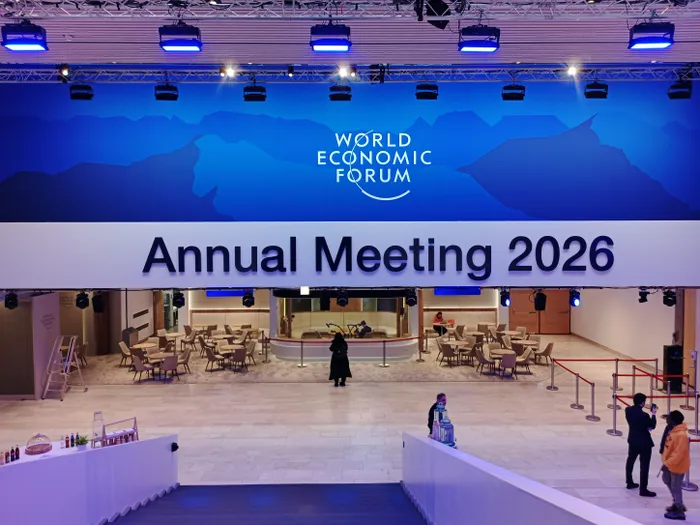
The WEF Annual Meeting, which gets under way in earnest on Monday, is set to draw a record gathering of global decision-makers.
Image: Siphelele Dludla / Independent Newspapers
Amid the biting cold of Switzerland’s winter, the alpine town of Davos is warming up with final preparations and full-scale rehearsals ahead of the week-long Annual Meeting of the World Economic Forum (WEF), where global economic and policy challenges will be placed firmly under the spotlight.
The WEF Annual Meeting, which gets under way in earnest on Monday, is set to draw a record gathering of global decision-makers.
Around 400 top political leaders are expected, including nearly 65 heads of state and government, alongside close to 850 of the world’s leading chief executives and board chairs. They will be joined by almost 100 unicorn founders and technology pioneers, underscoring the central role of innovation and artificial intelligence in this year’s agenda.
Security and political attention are expected to intensify midweek with the arrival of US President Donald Trump, who is scheduled to deliver a special address on Wednesday. His presence is likely to spark robust debate among participants, particularly European leaders, amid rising transatlantic tensions.
Trump recently announced a new trade offensive targeting Denmark and several European allies, declaring his intention to impose tariffs to pressure the sale of Greenland to the United States.
Under the plan, the US would introduce a 10% tariff on all goods from Denmark, Norway, Sweden, France, Germany, the United Kingdom, the Netherlands and Finland from February 1, 2026, with the rate set to rise to 25% from June 1, 2026.
While in Davos, Trump is also expected to hold discussions with WEF President and CEO, Børge Brende, as well as BlackRock chair and CEO, Laurence D. Fink.
Arriving in Davos-Klosters on Sunday around midday, the Independent Media team encountered a town buzzing with activity. Roadblocks, heightened security checks and last-minute infrastructure installations were visible throughout the resort, yet the scale of operations appeared seamless and highly coordinated.
And of course, it wouldn't be a global showpiece without a demonstration from some human rights or environmental activists as it often is the case with international conferences these days.
The WEF Annual Meeting is centred around three main conference hubs — the Kongresszentrum Davos, the Ice Village and the Kurpark Village — complemented by a wide array of smaller venues across the town where countries, companies and organisations host side events and bilateral engagements.
Although Davos is best known as a premier winter sports destination and health resort, the WEF Annual Meeting takes precedence at this time of year. Shops along the main thoroughfare temporarily vacate their premises, renting them out to countries and organisations that transform the spaces into national pavilions and meeting hubs.
South Africa is among the countries hosting a pavilion. Team INDY met with Mpumi Mabuza, general stakeholder manager for Brand South Africa, who was overseeing final preparations, with the pavilion fully set up and ready to host events.
Brand South Africa’s programme will open with a discussion on converting Africa’s mineral wealth into structural economic transformation, focusing on moving beyond extraction towards beneficiation, industrialisation and competitive value chains.
This will be followed by a strategic conversation on how investments in ports, rail, energy and logistics corridors can unlock trade, drive industrialisation and deepen regional integration.
As the week progresses, the conversation will move on to unlocking trade and investment through the African Continental Free Trade Area (AfCFTA) agreement, credible energy reform and investment confidence, how to mobilise long-term capital through sovereign wealth funds, development finance institutions and private investors; before culminating in the business of tourism.
According to the WEF's latest Chief Economists’ Outlook published on Friday, the global economic outlook has shown modest improvement heading into 2026, but uncertainty remains high as a complex mix of elevated asset valuations, rising debt burdens, geoeconomic realignment and the rapid deployment of artificial intelligence (AI) continues to reshape growth prospects.
AI is reshaping how industries operate, compete and create value, and is projected to add over $15 trillion to global GDP by 2030. Nearly 90% of businesses across all sectors expect AI and other technologies to transform their businesses in the short-term, including through productivity gains.
In this context, it's crucial for businesses, governments, and civil society to work together to find common solutions and take decisive action.
Meanwhile, the global economic outlook has shown modest improvement heading into 2026, but uncertainty remains high as a complex mix of elevated asset valuations, rising debt burdens, geoeconomic realignment and the rapid deployment of AI continues to reshape growth prospects.
Some 53% of chief economists now expect global economic conditions to weaken over the coming year, down sharply from the 72% who held this view in September 2025. The shift suggests a growing belief that the global economy may avoid a severe downturn, even as structural vulnerabilities deepen.
However, the WEF Global Risks Report 2026 published on Wednesday identified geoeconomic confrontation has emerged as the most pressing global risk for 2026. This underscores a world increasingly shaped by rivalry, fragmentation and economic weaponisation.
Geoeconomic confrontation — defined by the use of trade restrictions, sanctions, industrial policy and economic leverage to advance national interests — climbed eight places to top the near-term risk rankings for 2026.
It was also ranked as the most severe risk over the next two years, reflecting deep concern over the impact of geopolitical rivalry on global supply chains, inflation, growth and international cooperation.
Technological risks also featured prominently in the report, particularly concerns around artificial intelligence.
While misinformation and disinformation ranked second in the two-year outlook, adverse outcomes of AI showed the steepest rise over the longer term, climbing from 30th place in the two-year horizon to fifth over the next decade.
BUSINESS REPORT