

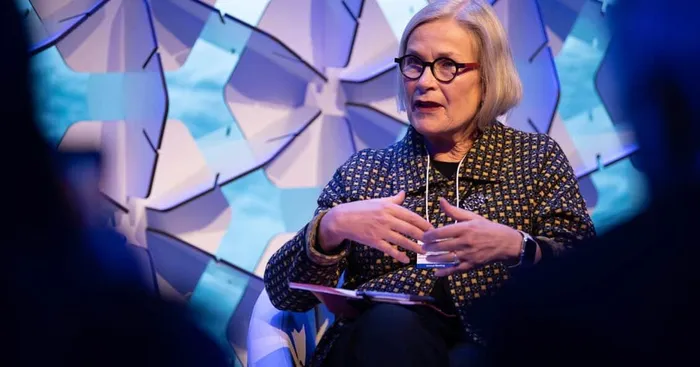
UNI Global Union general secretary, Christy Hoffman, argues that without intervention, the AI boom risks repeating a familiar pattern in which private actors capture the gains while society absorbs the costs.
Image: Supplied
UNI Global Union general secretary, Christy Hoffman, has cautioned that working people are facing a convergence of crises as artificial intelligence (AI) accelerates job displacement while a swelling far-right, techno-authoritarian politics concentrates power and deepens inequality.
Hoffman’s intervention comes as the World Economic Forum’s (WEF) latest Global Risks Report ranks adverse outcomes from AI among the top global threats.
While debate around AI has often focused on productivity gains and innovation, Hoffman argues that 2026 will mark a critical turning point, with job losses accelerating faster and on a far greater scale than governments and institutions are prepared to manage.
“Tech companies insist it’s the role of government to manage the social costs. But they are simultaneously capturing state power to shape policy in their own interests,” Hoffman said.
“Communities need stronger safety nets to survive disruption, and we urgently need tougher regulation of AI. Instead, we’re witnessing a rise in techno-authoritarianism that attacks unions, undermines regulation and concentrates power even further.”
According to Hoffman, the scale and speed of the transformation risk overwhelming existing social protections. She warned that governments, employers and global institutions are dangerously unprepared for the social impacts of widespread automation and AI deployment.
“We are just not ready to deal with the social impacts of this transformation,” she said.
“There is almost no serious discussion about who pays the costs of disruption. Governments should prepare new tax structures and new public investments. Employers must drop resistance to unions and collective bargaining. People must be able to negotiate over their working conditions and shape their futures.”
UNI Global Union, which represents more than 20 million workers in sectors including services, media, telecoms and technology, has increasingly framed AI not only as a technological issue but as a political and economic one.
Hoffman argues that without intervention, the AI boom risks repeating a familiar pattern in which private actors capture the gains while society absorbs the costs.
She warned that the rapid expansion of AI infrastructure is already generating significant social and environmental pressures, from soaring electricity demand and water use in data centres to increased carbon emissions.
At the same time, she said, the disruption of “good jobs” is being treated as collateral damage rather than a central policy concern.
“We should not allow billionaire tech oligarchs to externalize the costs of AI, including water use, electricity demand, carbon pollution or the destruction of good jobs,” Hoffman said. “We hear endless talk of ‘shared prosperity,’ but there is no plan to redistribute the gains.”
Hoffman highlighted that many workers lack the bargaining power needed to navigate these changes, with white-collar and tech employees increasingly among the first to feel AI’s disruptive effects.
Traditionally less unionised, these workers are often exposed to rapid restructuring with little say over how new technologies are introduced or how productivity gains are shared.
“Most workers lack collective bargaining power with their employers,” she said. “This is especially true for white-collar and tech employees, who are already among the first to feel the disruptive impact of AI.”
She also criticised what she described as a contradiction at the heart of the tech industry’s response to AI disruption. While companies insist that managing the social consequences of AI is the responsibility of governments, Hoffman argued that many of the same firms are actively shaping public policy to protect their own interests.
As political and business leaders gather in Davos for the 2026 WEF Annual Meeting to debate global risks and opportunities, Hoffman said the decisions taken now will shape whether AI becomes a tool for shared progress or a force that entrenches inequality.
“The choices made now will determine whether AI delivers shared progress or entrenched power,” she said. “If we choose to ‘wait and see,’ it will be a decision to let inequality win.”
BUSINESS REPORT