
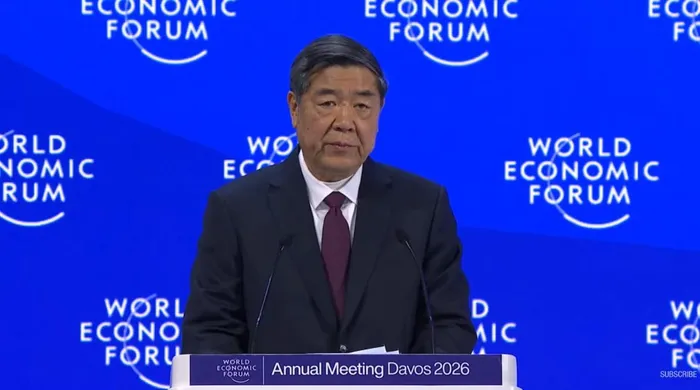
China’s Vice Premier He Lifeng said the world is undergoing transformations “not seen in a century,” marked by growing unilateralism, trade tensions and regional conflicts that are reshaping the global economic and trade order.
Image: WEF/YouTube
China has used the World Economic Forum’s annual meeting in Davos to deliver a strong defence of multilateralism, free trade and dialogue, warning that rising protectionism and geopolitical fragmentation are undermining global growth and threatening shared prosperity.
Delivering a special address on Tuesday, China’s Vice Premier He Lifeng said the world is undergoing transformations “not seen in a century,” marked by growing unilateralism, trade tensions and regional conflicts that are reshaping the global economic and trade order.
Against this backdrop, he urged countries to resist zero-sum thinking and recommit to cooperation.
Under the forum’s theme, Spirit of Dialogue, Li said it was vital for nations to “listen to each other, learn from each other and build stronger trust,” recalling Chinese President Xi Jinping’s landmark Davos speech in 2017, which defended globalization at a time of mounting backlash.
Li said Xi’s warning that attempts to reverse globalization were like trying to channel the ocean back into isolated lakes and creeks remains as relevant today as ever.
He noted that tariff and trade wars since last year have delivered “significant shocks” to the world economy, disrupting supply chains and weakening confidence.
"China advocates a universally beneficial and inclusive economic globalization. We are committed to building bridges, not walls. We will firmly support trade and investment liberalization and facilitation and continue to share development opportunities with the world," Li said.
"We will work with all parties to create a bright future of prosperity and development where every country and every community shares the dividends of development. Second, we should firmly safeguard multilateralism and make the international economic and trade order more just and equitable. The multilateral trading system now faces the most serious challenges in years."
Citing the World Trade Organization (WTO) data, Li said the share of global trade conducted under most-favoured-nation terms has fallen sharply, while the International Monetary Fund (IMF) estimates that economic fragmentation could reduce global output by around 7%, a loss that would hurt all countries.
"Economic globalization, driven by international specialization, collaboration, complementary strengths, and the pursuit of win-win, is a prevailing trend of history. It has benefited many countries, including China, and enabled them to achieve fast development," Li said.
"On the contrary, tariff and trade wars have no winners. Beyond driving up costs for production and trade, they fragment the world economy and disrupt the global distribution of resources."
Li called for dialogue-based solutions to steer globalization in a more inclusive and balanced direction. China, he said, supports an economic globalization that is “universally beneficial and inclusive,” and is committed to building bridges rather than walls.
Li also warned that the multilateral trading system faces its most serious challenges in years, as unilateral measures by some countries undermine WTO rules. He said multilateralism remains the only viable path to maintaining a stable international order and ensuring development gains are shared more fairly.
Li also addressed China–US economic relations, acknowledging recent ups and downs but stressing that dialogue and consultation have helped stabilize ties.
"Facts have demonstrated once again that China and the United States will gain from cooperation and lose from confrontation, and that they should and can help each other succeed and prosper together. The trade talks also showed that as long as the two sides engage in equal food consultation and work in the same direction, there will always be more solutions than problems," he said.
"To be frank, it's normal for countries with different social systems, stages of development, histories and cultures, to encounter divergences and frictions as they develop and interact. But sometimes these are merely misunderstandings. The key is to uphold the spirit of equality, respect, and mutual benefit, build trust through dialogue, and resolve disputes through consultation.
"Instead of looking for answers from confrontation or antagonism, we must find a way out through communication and consultation and explore the path of win-win and all-win. China is a trading partner, not a rival for other countries. And China's development presents an opportunity, not a threat, to the world's economy."
BUSINESS REPORT