

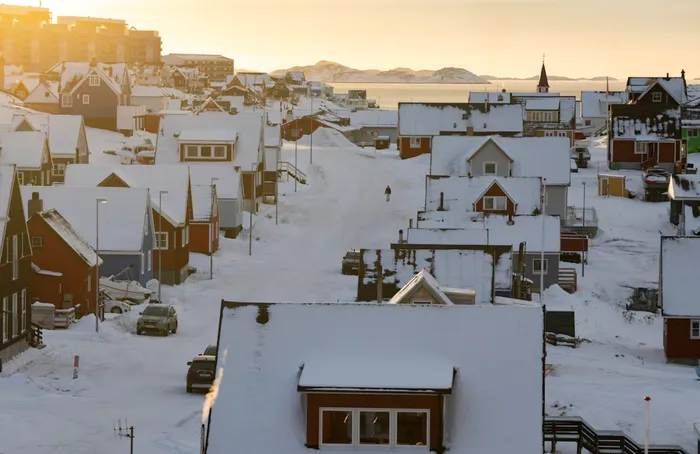
A person walks along a street on the day of the meeting between top U.S. officials and the foreign ministers of Denmark and Greenland, in Nuuk, Greenland, January 14, 2026.
Image: REUTERS/Marko Djurica
Greenland has moved to the centre of Europe’s strategic thinking, as European Commission President Ursula von der Leyen warned that the Arctic island sits at the crossroads of security, sovereignty and global power competition.
This comes as the US President Donald Trump over the weekend threatened to impose tariffs on eight European countries, including Germany, France and the UK, from next month, unless they support his ambition to take control of the Arctic island.
Trump stated that starting February 1, 2026, the United States will levy a 10% tariff on all goods from Denmark, Norway, Sweden, France, Germany, the United Kingdom, the Netherlands, and Finland, with the rate increasing to 25% on June 1, 2026.
He characterised the move as a matter of "Global Peace and Security," claiming that the Danish territory is currently vulnerable to foreign adversaries.
"China and Russia want Greenland, and there is not a thing that Denmark can do about it," Trump said. "They currently have two dogsleds as protection, one added recently."
Speaking at the World Economic Forum in Davos on Tuesday, Von der Leyen framed Greenland not as a peripheral territory, but as a defining test of Europe’s ability to defend its interests, uphold international law and adapt to a rapidly changing global order.
“When it comes to the security of the Arctic region, Europe is fully committed and we share the objectives of the United States in this regard,” she said.
Her remarks linked Greenland directly to Europe’s broader drive for independence, economically, militarily and geopolitically. For Europe, von der Leyen argued, these shifts demand a firmer and more coordinated response.
She underscored that the European Union shares security objectives in the Arctic with the United States, citing Finland — one of NATO’s newest members — selling its first icebreakers to the US as proof that Europe already has Arctic-ready capabilities. But she cautioned that unity among allies is essential.
Von der Leyen also stressed that Arctic stability can only be achieved through cooperation among allies. At the same time, she made clear that the sovereignty and territorial integrity of Greenland and the Kingdom of Denmark are non-negotiable.
Greenland’s strategic importance has grown sharply as climate change opens Arctic shipping routes, increases access to critical minerals and intensifies great-power rivalry in the High North.
Von der Leyen warned that the proposed additional tariffs between long-standing partners risk undermining shared security interests.
"The European Union and the United States have agreed to a trade deal last July. And in politics, as in business, a deal is a deal. And when friends shake hands, it must mean something," she said.
"We consider the people of the United States not just our allies, but our friends. And plunging us into a downward spiral would only aid the very adversaries we are both so committed to keeping out of the strategic landscape.
"So our response will be unflinching, united, and proportional. But beyond this, we have to be strategic about how we approach this issue, and this is why we are working on a package to support Arctic security."
Von der Leyen outlined a clear framework for Europe’s approach to Greenland, signalling a more assertive and strategic posture in the Arctic.
She reaffirmed full solidarity with Greenland and Denmark, stating unequivocally that their sovereignty and territorial integrity are not up for negotiation.
The European Union is also planning a major investment surge in Greenland, working closely with local authorities and Copenhagen to strengthen economic development and critical infrastructure. These investments aim to support resilient communities while ensuring that economic opportunities benefit Greenlanders themselves.
Von der Leyen said Europe will deepen cooperation with the United States and other partners on Arctic security, stepping up investment in capabilities suited to the region’s harsh conditions. She suggested that Europe’s defence spending surge should be used to develop a dedicated European icebreaker capability and other equipment vital for Arctic operations.
The EU also intends to strengthen security partnerships across the region, including with the United Kingdom, Canada, Norway and Iceland, recognising that Arctic stability depends on collective action.
Beyond military and economic considerations, Von der Leyen placed Greenland within a broader values-based framework. She stressed that Europe’s Arctic policy will be anchored in a fundamental principle: it is for sovereign peoples to decide their own future.
This principle, she said, will sit at the heart of a new European security strategy and an updated Arctic strategy, both expected later this year. These frameworks will reflect the reality that security in the High North is inseparable from global security, supply chains and democratic resilience.
Von der Leyen acknowledged that Greenland was not initially expected to feature so prominently in her Davos address, yet its rising importance illustrates how quickly global priorities are shifting.
"When I started preparing for this year's address, security in the High North was not the main theme," she said.
"But in many ways, it feeds into the wider point I started with today, that Europe must speed up its push for independence: from security to economy, from defense to democracy, having the dialogue with our friends and partners, also, if necessary, with adversaries."
BUSINESS REPORT