

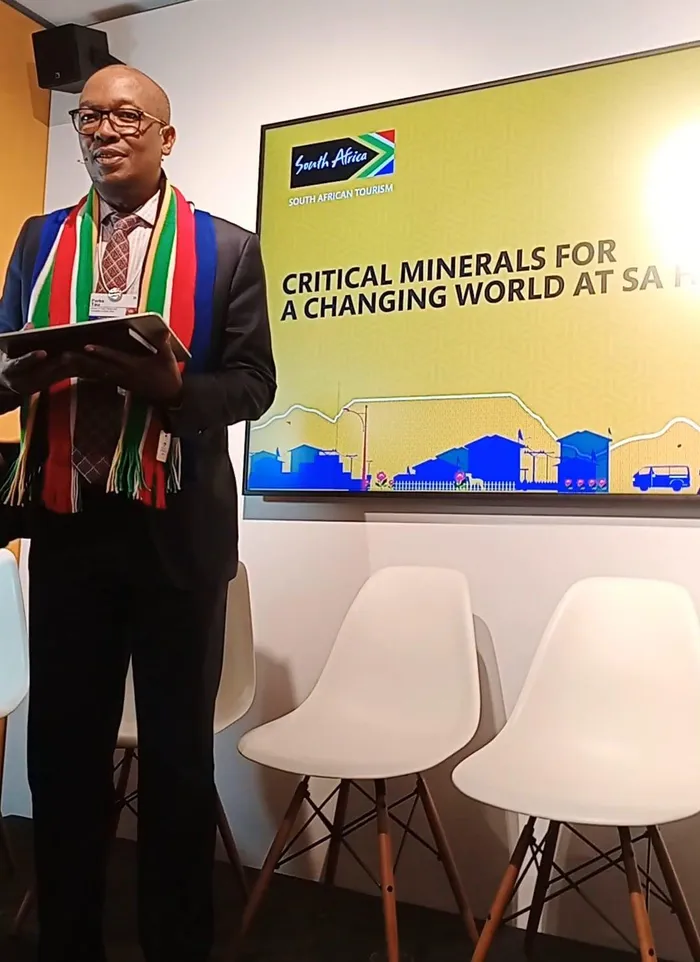
Minister of Trade, Industry and Competition, Parks Tau, spoke on the sidelines of the ongoing World Economic Forum (WEF) Annual Meeting in Davos about the country's strategy on critical minerals.
Image: Siphelele Dludla / Independent Newspapers
South Africa is positioning itself at the centre of the global energy and technology transition, leveraging its vast mineral wealth to drive industrialisation, investment and deeper trade partnerships, as the country recalibrates its economic strategy for a decarbonising world.
Speaking on the sidelines of the ongoing World Economic Forum (WEF) Annual Meeting in Davos, Minister of Trade, Industry and Competition, Parks Tau, underscored that South Africa’s mineral endowment extends well beyond the legacy resources of the past.
Tau said while coal and abundant sunshine remain central to the current energy mix, the country is increasingly focused on the critical and rare earth minerals that underpin clean energy systems, digital technologies and advanced manufacturing.
"So we are sitting pretty much at the crossroads as a country where we are transitioning not only from an energy point of view but also from a technology point of view into what the future looks like and having the benefit of the deposits in our backyard," Tau said.
"So we have taken a view as a country that in fact we need to position our industrial policy and strategy against the backdrop of one, the global context and developments from a trading point of view and an investment point of view, but also from a transition point of view, to say, how do we position South Africa in this context?"
Against this backdrop, South Africa has developed a new industrial policy framework, currently in the final stages of government approval, anchored on three core pillars: decarbonisation, diversification and digitisation.
Together, these pillars seek to align domestic industrial development with global shifts in energy systems, supply chains and technology platforms.
Decarbonisation focuses on supporting the move towards clean energy solutions, including renewables and green technologies, while ensuring a just transition that protects jobs and communities.
Diversification aims to broaden the country’s industrial base beyond traditional sectors, fostering new industries linked to clean energy, electric mobility, advanced manufacturing and downstream mineral processing.
Digitisation, meanwhile, recognises that future competitiveness will depend on embedding digital technologies, data and innovation across the economy.
Critical minerals cut across all three pillars.
As the global economy accelerates its shift towards electric vehicles, renewable energy infrastructure and digital systems, demand for minerals such as platinum group metals, manganese and other rare earth elements is surging.
South Africa’s policy response is to ensure these resources become a platform for industrialisation rather than remaining locked in a raw-export model. To that end, the country has adopted a dedicated critical minerals policy and reoriented its trade strategy to support investment-led partnerships.
"As we diversify our industrial place, we diversify into new industries, and those new industries would be around decarbonization and digitization,"Tau said. "So in many ways, it is an integrated way in which we're looking at industrial policy."
A recent Trade and Investment Partnership signed with the European Union reflects this shift. Instead of exporting raw minerals, South Africa is promoting a “pit-to-product” approach, encouraging investors to process, beneficiate and manufacture locally.
"The partnerships that we enter into - and we'll be signing a few more of these trade partnerships - have evolved from being just clean, if you like, just vanilla trade relations. It is a transition into an investment-based trade partnership, an investment partnership," Tau said.
"In fact, we had discussions with business and government in Switzerland yesterday, in Zurich, discussing exactly that, how do we evolve into a situation where they come in as investors at the back of our critical analysis and ensure that they're able to move, not just the industrial base, but also the intellectual and research capability that they've built over time and build their industries against that research capability into the South African industry and country."
South Africa’s strategy also extends beyond its borders, anchored in its commitment to the African Continental Free Trade Area (AfCFTA). The country is actively engaging strategic partners on the continent to build complementary value chains, recognising that no single country holds all the minerals required for the energy transition.
By working with countries such as the Democratic Republic of Congo, Angola and others, South Africa aims to align investments across borders, combining mineral endowments to support regional industrial hubs.
Recent invitations to investment summits, including from the DRC, are part of efforts to structure partnerships that complement South Africa’s industrial policy while advancing regional development.
Development finance institutions (DFIs) are also being drawn into this strategic shift.
Government is urging DFIs to align their investments in Africa with South Africa’s broader industrial and transition objectives, ensuring capital deployed on the continent reinforces regional value chains and positions Southern Africa as a key node in the global clean energy economy.
"So we can't just be bystanders and contributors of raw minerals. We must be the center for actual industrialization and commercialization of this mineral service," Tau said.
BUSINESS REPORT