

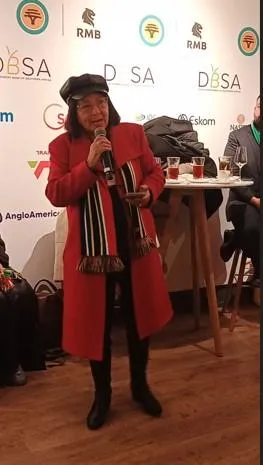
Minister of Tourism Patricia de Lille, speaking as part of the South African delegation engaging international partners and investors at the World Economic Forum (WEF) Annual Meeting in Davos, stressed the importance of clearly distinguishing, while strategically aligning, the country’s nation brand and its tourism promotion.
Image: Supplied
South Africa is stepping up efforts to align its nation branding and tourism marketing as part of a broader push to drive inclusive economic growth, attract investment and create jobs, government and Brand South Africa leaders said on Monday night.
Speaking as part of the South African delegation engaging international partners and investors at the World Economic Forum (WEF) Annual Meeting in Davos, Minister of Tourism Patricia de Lille stressed the importance of clearly distinguishing, while strategically aligning, the country’s nation brand and its tourism promotion.
De Lille, who is attending her first WEF meeting, explained that nation branding, led by Brand South Africa, focuses on shaping the country’s overall global identity across areas such as investment, governance, exports and diplomacy.
Tourism marketing, by contrast, has a more targeted mandate: selling South Africa as a destination and translating the national reputation into compelling visitor experiences.
“While these two forms of branding are connected, they serve different audiences and purposes,” De Lille said. “The nation brand offers a broader, reputation-based foundation, while destination marketing delivers a focused promise of experience.”
Tourism promotion is led by South African Tourism, which receives around R1.2 billion a year, roughly half of the Department of Tourism’s budget, to market the country globally.
De Lille said the strategic opportunity now lies in streamlining messaging so that South Africa speaks with one voice, strengthening its overall identity while effectively inviting the world to experience the country’s natural beauty, culture and diversity under the banner of “inspiring new ways”.
She acknowledged that this alignment has been missing for many years, but said it is now being actively addressed. De Lille said she has set up a series of meetings with counterparts and partners, including collaboration with Saudi Arabia’s Tourism Minister Ahmed Al-Khatib, who is also attending.
“We live in this beautiful country, and sometimes we take its beauty for granted,” she said. “We are here to sell South Africa as a destination for people to visit, working closely with those responsible for nation branding. We are interconnected.”
Tourism, she emphasised, is central to South Africa’s inclusive growth strategy and offers “low-hanging fruit” for job creation.
The sector currently contributes about 8.8% to GDP and supported 1.6 million jobs last year, with significant potential to absorb semi-skilled and unskilled young people through training and recruitment.
“This is one of the three key priorities of government, to create jobs,” De Lille said. “Tourism can contribute a lot more.”
Echoing the focus on credibility and substance, Brand South Africa chairperson Ipeleng Selele said international investors are increasingly demanding fact-based evidence of progress rather than rhetoric.
“When you speak to investors, they want to know how critical and credible you are as a nation brand,” Selele said. “It’s about articulating clearly what progress has been made, particularly on reforms and infrastructure.”
Selele pointed to tangible developments, including improvements at Transnet, infrastructure collaboration along the Nacala (Maputo) Corridor, and growing momentum in skills development, digital infrastructure and data centres.
She also highlighted South Africa’s progress in restoring international confidence, noting the country’s removal from the FATF grey list and its deletion from the EU’s list of high-risk third-country jurisdictions.
“These changes matter in real terms,” she said. “They affect how quickly companies can transact, invest and get paid. Being off those lists is a confidence boost.”
Selele also emphasised improved cooperation between the public and private sectors, saying the relationship has shifted from one characterised by mistrust to one focused on partnership and delivery.
“We no longer just talk about the deficit between the public and private sectors,” she said. “There is real collaboration, and we have something tangible to talk about, even though there is still a lot of work to do.”
She cited progress in energy reforms, transmission projects, renewables, green hydrogen and regional integration, as well as South Africa’s expanding diplomatic and trade engagement across Africa and globally through forums such as the G20 and V20.
Both leaders stressed that while South Africa should not oversell itself, it now has a credible and compelling story to tell — one grounded in reform, collaboration and opportunity.
“Our job,” Selele said, “is to go out there proudly, backed by facts, and show the world that South Africa is open for tourism, trade and investment, and serious about growth.”
BUSINESS REPORT