

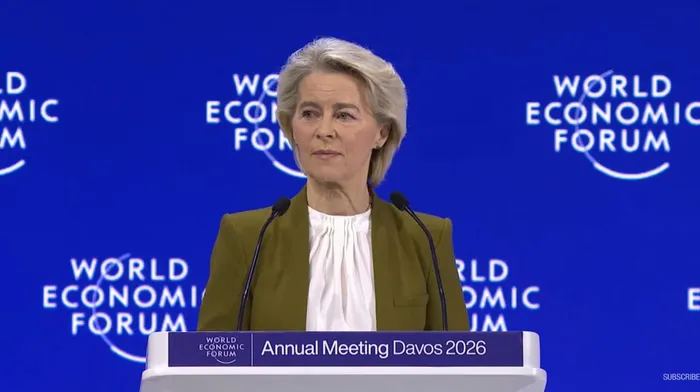
European Commission President Ursual Von der Leyen has become one of the most prominent advocates for strengthening Europe’s strategic autonomy while defending multilateralism and a rules-based international order.
Image: YouTube
European Commission President Ursula von der Leyen has called for a decisive shift towards greater European independence, arguing that geopolitical shocks and a fractured global order must be treated not as temporary crises, but as a permanent reality demanding structural change.
The European Commission is the European Union's independent executive arm, responsible for proposing new laws, implementing decisions, upholding EU treaties, and managing the budget, acting as the primary initiator of legislation and representing EU interests globally.
This comes as the US President Donald Trump over the weekend threatened to impose tariffs on eight European countries, including Germany, France and the UK, from next month, unless they support his ambition to take control of the Arctic island.
Delivering a special address at the World Economic Forum (WEF) in Davos on Tuesday, Von der Leyen said Europe was living through a “seismic change” comparable to the collapse of the Bretton Woods system in the early 1970s, saying that was a moment that reshaped the global economic order and forced Europe to rethink its dependencies.
"The world may be very different today, without any question, but I believe the lesson is very much the same," she said.
"That geopolitical shocks can and must serve as an opportunity for Europe, and in my view, the seismic change we are going through today is an opportunity, in fact a necessity to build a new form of European independence. And this need is neither new, nor a reaction to recent events. It has been a structural imperative for far longer."
Her remarks followed a formal welcome that praised her leadership during an era of historic uncertainty, from the Covid-19 pandemic and Russia’s invasion of Ukraine to intensifying global competition and rising economic fragmentation.
Von der Leyen has become one of the most prominent advocates for strengthening Europe’s strategic autonomy while defending multilateralism and a rules-based international order.
Von der Leyen drew a historical parallel with 1971, when the United States unilaterally delinked the dollar from gold in what became known as the “Nixon shock”, triggering the collapse of Bretton Woods.
While destabilising at the time, she argued, it inadvertently laid the groundwork for a more globalised economic system — and delivered a lasting warning to Europe about overreliance on external anchors.
“Back then, it was a warning to reduce our dependency on a foreign currency,” she said. “Today, the imperative is broader, but no less urgent.”
According to Von der Leyen, Europe now faces structural dependencies across energy, raw materials, defence technologies and digital infrastructure — vulnerabilities that have been exposed and amplified by war, supply chain disruptions and geopolitical rivalry.
The answer, she said, is not isolationism, but a new form of European independence that must reinforce, rather than dilute, the continent’s core values. A central pillar of Europe’s independence strategy, Von der Leyen argued, is trade diversification.
She highlighted the signing of the long-awaited EU-Mercosur trade agreement, a breakthrough after 25 years of negotiations between the European Union and Latin America that creates the world’s largest free trade zone, spanning 31 countries and more than 700 million consumers.
"So this agreement sends a powerful message to the world that we are choosing fair trade over tariffs, partnership over isolation, sustainability over exploitation, and that we are serious about de-risking our economies and diversifying our supply chains," Von der Leyen said.
"And that will not stop in Latin America. Last year, we reached new agreements with Mexico, Indonesia, and Switzerland, our host country. We're working on a new free trade agreement with Australia. We are also advancing with the Philippines, Thailand, Malaysia, the United Arab Arama- Emirates, and more.
"And right after Davos, the next weekend, I will travel to India. There's still work to do, but we are on the cusp of a historic trade agreement. Indeed, some call it the mother of all deals. One that would create a market of 2 billion people, accounting for almost a quarter of global GDP, and crucially, that would provide a first mover advantage for Europe with one of the world's fastest growing and most dynamic continents.
"Europe wants to do business with the growth centers of today and the economic powerhouses of this century from Latin America to the IndoPac- Pacific and far beyond. Europe will always choose the world, and the world is ready to choose Europe. And this reality also reflects the fact that Europe has all the asset its needs to attract investment."
Under her leadership, the European Commission has advanced policies aimed at boosting industrial competitiveness, safeguarding supply chains and supporting innovation, while maintaining social cohesion and environmental ambition.
Von der Leyen argued that Europe already possesses the assets required for independence: deep savings, a skilled workforce and strong innovation capacity, particularly in artificial intelligence and advanced manufacturing. What is needed now is collective mobilisation.
BUSINESS REPORT