

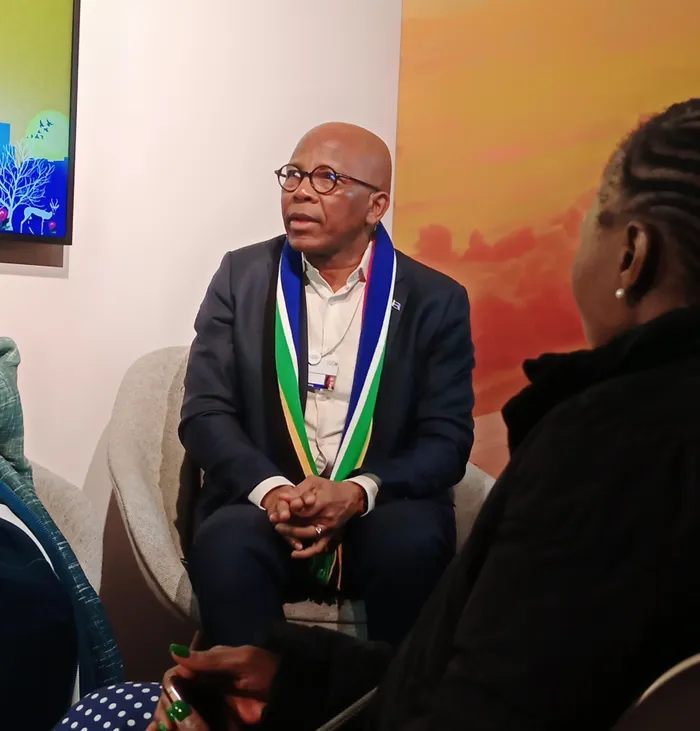
Eskom board chairperson Mteto Nyatispeaking during a panel discussion on energy reform on the sidelines of the World Economic Forum in Davos on Thursday.
Image: Siphelele Dludla / Independent Newspapers
Eskom board chairperson Mteto Nyati has cautioned that South Africa’s recent load shedding crisis has underscored that deeper regional cooperation is essential if Africa's industrialisation is to succeed.
Addressing a panel discussion on energy reform on the sidelines of the World Economic Forum in Davos on Thursday, Nyati reflected on how South Africa’s neighbours have historically relied on Eskom for electricity, with countries such as Namibia, Mozambique and Botswana long-standing customers that continue to depend on South African power exports.
Nyati said while this relationship has generally been welcomed, the recent supply constraints had forced the region to confront uncomfortable realities about over-reliance on a single energy system.
“The lesson out of load shedding is that, as a region, we cannot have all our eggs in one basket,” Nyati said, pointing to Europe as an example of interconnected resilience.
He said that in Europe, countries such as Germany can draw electricity from neighbours like France or Italy during times of crisis.
In Southern Africa, by contrast, “everybody was looking to South Africa” when the power system faltered. This experience, Nyati argued, should drive a new regional mindset—one that balances national interests with collective investment.
Rather than viewing regional cooperation as empowering one dominant utility or country, Nyati suggested that Southern African nations should see shared infrastructure as a mutual insurance policy.
“If we are facing problems in South Africa, we should also be able to rely on them,” he said, referring to neighbouring states.
Energy security was also framed as a prerequisite for Africa’s long-stated ambition to move beyond exporting raw materials.
While beneficiation and local value addition are widely supported goals, Nyati cautioned that without reliable electricity, such ambitions remain unattainable.
He said such infrastructure would enable industrial projects such as mineral beneficiation in countries like Zambia to thrive, provided power could be transmitted efficiently across borders.
"Until we realize that without power, we cannot do any of that. So this discussion about the energy, about them investing in their own generation capacity, they do not have to have a plan if we have the transmission lines that can take power to that," he said.
The post–load shedding moment, Nyati suggested, offers South Africa an opportunity to reposition itself as a driving force for regional industrialisation rather than a single point of dependence.
The debate now centres on whether South Africa and its partners should build and own regional infrastructure themselves, or encourage others to take the lead through partnerships.
Drawing on his private-sector experience, Nyati advocated for local partnerships as the most sustainable model. He said successful companies expanding into Africa are those that work with local partners rather than going it alone.
"We need to work together with the local countries. The kind of partnership that we are looking for is where we are going to work together for the next 20 years," he said.
BUSINESS REPORT