

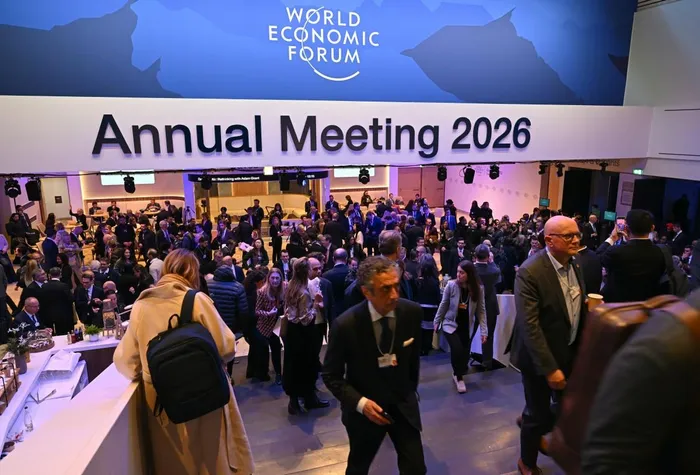
Eskom CEO Dan Marokane spoke at WEF.
Image: AFP
Eskom is racing against time to secure a new power supply agreement with Mozambique’s Hidroeléctrica de Cahora Bassa (HCB), as the current deal that supplies electricity to Mozal aluminium smelter is set to expire at the end of March, raising the risk of major operational disruptions if negotiations fail.
Speaking amid growing concern over the looming deadline, Eskom CEO Dan Marokane on Thursday confirmed that the existing power supply agreement will formally end in March and that no replacement contract has yet been concluded.
This has heightened anxiety around the future of Mozal, one of southern Africa’s largest aluminium smelters owned by South32 and a significant industrial consumer of electricity.
Late last year, South32 said its facility, which is the biggest industrial employer in Mozambique with more than 2 500 staff, will be put on care and maintenance when its electricity agreement expires at the end of March 2026.
Historically, most of the electricity for Mozal has been generated in Mozambique by a hydro-electric power generator, Hidroeléctrica de Cahora Bassa (HCB).
Under the current agreement, electricity from Eskom is supplied to Mozal when HCB is unable to meet all of Mozal’s electricity requirements. HCB recently indicated that drought conditions had the potential to impact its capacity to deliver sufficient hydro-electric power to Mozal.
Behind the scenes, Marokane said in an interview on the sidelines of the World Economic Forum (WEF) in Davos, Eskom and its partners are still engaged in discussions aimed at finding a workable solution.
While Marokane said he remained cautiously optimistic, he acknowledged that any new deal will have to be negotiated on revised terms that reflect current realities in the regional electricity market.
"I remain hopeful that the party's efforts in trying to find a solution will yield something. But that's all I can say at the moment, that the conversation is still on the table. But it has to be a conversation that recognizes that new terms are required for supply agreement going forward," he said.
"So let's leave it at that point. All I can assure is that we are playing ourselves rigorously in re-engaging with the other party. But I do think it's getting a little bit late. So every day that passes without an agreement is a day that will likely contribute towards some delays."
The uncertainty around the Mozambique deal comes as Eskom is simultaneously grappling with broader challenges linked to energy-intensive smelters closer to home.
In South Africa, the utility, government and major smelter operators have established a joint task team to address the long-standing issue of electricity pricing for large industrial users.
The objective of this task team is to put a concrete proposal on the table by the end of February.
According to those involved, the work has focused on striking a delicate balance: finding a price structure that allows smelters to remain viable while avoiding the creation of new financial pressures for Eskom, which is still in the midst of its own recovery.
"The teams have been working and trying to figure out how to arrive at the price that will make the smelters work and also arrive at the solution that will create new financial pressures for Eskom," Marokane said.
"So end of February is the time that we're targeting, and comfortable we'll be there."
These negotiations are unfolding against a backdrop of renewed efforts by Eskom and government to restore investor confidence in South Africa’s energy sector and broader economy.
Marokane emphasised that their presence at international engagements such as WEF was aimed squarely at reinforcing the message that South Africa is once again investable.
He pointed to data showing progress in addressing electricity supply constraints, including improvements in generation performance and the narrowing gap between supply and demand.
He reiterated that structural reforms are also underway, guided by South Africa’s Integrated Resource Plan, which sets out a diversified energy mix tailored to the country’s unique circumstances.
"We've overcome the limitations in terms of supply and demand. We are implementing reforms that are premised on our own unique situation because there's no universal path to transition," Marokane said.
Crucially, Marokane argued that the narrative has shifted significantly over the past year.
Where previous engagements focused on promises and plans, the current message is backed by delivery. More than 250 days without severe load shedding has strengthened the credibility of South Africa’s story and made it easier to engage with investors.
"This year we are talking about what we have achieved in relation to what we said we're going to do. And it's important that we continue to sustain this because that's how you build confidence," Marokane said.
"So our performance is central to maintaining the momentum and the recovery of the investment convenience in the country. But we also need to show the long-term plans that we have laid out and make sure that investors can come along."
BUSINESS REPORT