

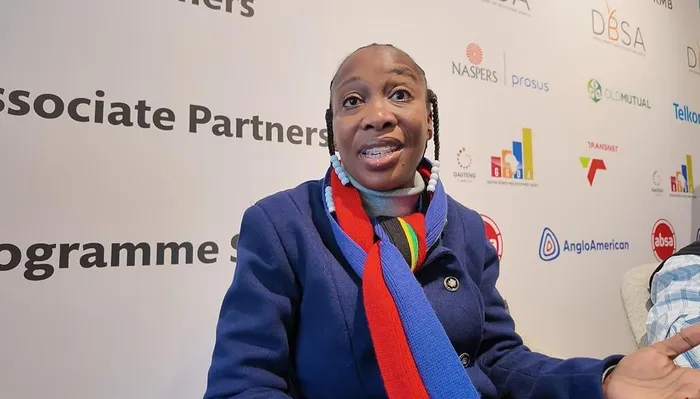
Zanele Matome, the CEO and founder of digital health tech start-up Welo Health, speaking during an interview on the sidelines of the World Economic Forum in Davos this week.
Image: Siphelele Dludla / Independent Newspapers
Zanele Matome, the CEO and founder of Welo Health, is making her mark on the global stage as one of the few African tech entrepreneurs invited to the World Economic Forum (WEF) in Davos.
Born and raised in Rustenburg in South Africa’s North West province, Matome is using her debut appearance at WEF to seek strategic investors who can help make her digital health startup a household name globally.
Matome is the CEO and co-founder of Welo Health, a South Africa–based digital health tech startup that helps employers better manage the health of their workforce.
Welo Health connects corporates, health insurers, and healthcare professionals through a single, flexible ecosystem designed to improve health outcomes while boosting productivity.
Built as an infrastructure platform, Welo Health enables companies to reduce absenteeism, manage chronic diseases, and ultimately improve productivity by making healthcare more accessible and data-driven.
"So we like your healthcare platform partner for you to better service your employees and to make sure that you have less absenteeism caused by chronic health care diseases and other diseases," Matome says.
Her presence at Davos is no accident. Matome was selected through the Davos Innovation Week programme, which handpicked just 22 startups from around the world to participate in keynote sessions and investor pitches.
Only two African startups made the cut — and Welo Health was one of them.
"This is my first time at WEF, and it’s incredibly exciting," Matome says. "Being invited here means African innovation is being recognised at the highest level."
Raised in Rustenburg in South Africa’s North West province, Matome credits her entrepreneurial resilience to growing up in an environment where resources were limited and perseverance was essential.
She believes African founders often arrive on the global stage with a unique advantage.
"I always say if you are an entrepreneur coming from Africa, you have a higher chance of making it because we know struggle, we know working with limited resources and things like that. So when we go in, we go all in because we have nothing to lose," she says.
"And comparing it to the culture of Silicon Valley, what I like about Silicon Valley is that they have that culture where you are given an opportunity to fail and learn from your failures and get up quickly and build again.
"Where in Africa, what I struggle with is that we don't give people, we don't give entrepreneurs opportunities to fail. We don't see failure as a learning curve and we don't celebrate failure."
At Davos, Matome is not only pitching Welo Health to investors, but also engaging with government leaders, industry executives and policymakers — including representatives from South Africa’s own government.
Her mission is clear: to ensure entrepreneurs have a seat at the table where global decisions are made.
"WEF is usually associated with presidents, ministers and Fortune 500 CEOs. So what I want to bring as a young woman from Rustenburg is my voice and say we matter too," she says.
"And we want to be part of the decision makers in the table because we know what's happening in the coalface. So we matter and our voice matters. And I'm glad that WEF saw it fitting to invite me to come and raise my voice and give this keynote speech."
Not only did she sweep the delegates off their feet on Wednesday, her pitch won the Innovator Award in the health category, the only female-owned founder from Africa to win.
Welo Health, founded in 2020, already operates in six African countries and has secured both local and international investors.
At Davos, Matome is focused on raising a Series A funding round that will enable the company to expand its operations in the United States beginning in the rural areas as it already has a presence in Silicon Valley.
But for Matome, funding alone is not enough.
"We want to see investors but not only people who are going to bring in the money, but people who are going to bring in the expertise to take us to another level, who are going to bring in access market and who are believers in this thing that says health must be accessible to everyone," she says.
"So we are here to fundraise, but fundraise with a course."
As she bridges African innovation with Silicon Valley ambition, Matome’s journey from Rustenburg to Davos stands as a powerful example of how homegrown ideas can reshape global industries.
BUSINESS REPORT