

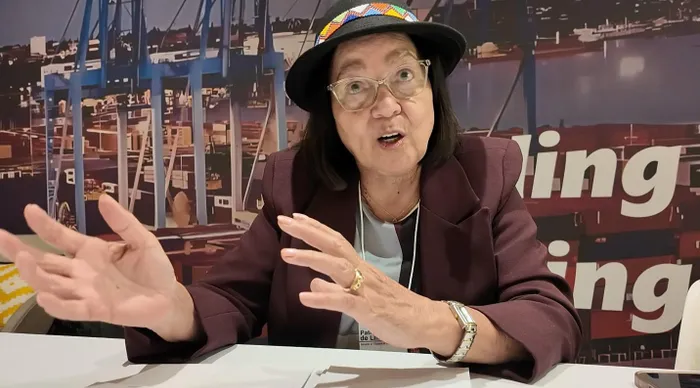
Speaking in an interview on the sidelines of the World Economic Forum (WEF) Annual Meeting in Davos on Wednesday, De Lille said criticism of SA Tourism was unfounded and ignored the progress made since the appointment of an interim board.
Image: Siphelele Dludla / Independent Newspapers
Tourism Minister Patricia de Lille is facing mounting criticism after stating that “there has never been a crisis at South African Tourism (SAT),” a remark that has sparked outrage among opposition parties and industry stakeholders.
Speaking during an interview at the World Economic Forum (WEF) in Davos last week, De Lille defended the embattled tourism agency and her decision to dissolve its board last year, replacing it with an interim structure.
The move followed the suspension of SAT CEO Nombulelo Guliwe over allegations of financial misconduct. Among the claims was a R4.1 million prepayment to a service provider for work that investigators allege was never completed. The company implicated in the matter has denied any wrongdoing.
“There’s never been a crisis in SA Tourism because at every financial year, as government departments, we all have our annual performance plan,” De Lille said. “We all have our medium-term development plan. So it is just that those things need to be implemented by whoever is leading SA Tourism.”
Her comments have been sharply rejected by the Democratic Alliance (DA) and figures within the tourism sector, who argue that SAT is experiencing a deep governance and leadership crisis.
DA tourism spokesperson, Haseena Ismail, confirmed she has written to the chairperson of Parliament’s portfolio committee on tourism, requesting that De Lille and SAT urgently appear before lawmakers to account for what she described as an ongoing governance collapse.
Ismail said the private sector’s continued withholding of Tourism Marketing South Africa (TO
MSA) Levy funds, pending improvements in governance and accountability, signals a serious erosion of confidence in SAT under De Lille’s leadership.
Ismail said the situation has been compounded by the resignation of acting CEO, Darryl Erasmus, effective 13 February. He had been serving in a temporary capacity while Guliwe remains on paid suspension, with her disciplinary process still unresolved.
SAT currently has no permanent CEO, chief operations officer or chief marketing officer, and is operating without a permanent board.
“This assertion that there is no crisis is at odds with reality,” Ismail said. “SAT is under investigation by the Special Investigating Unit (SIU), governed by an interim board, and experiencing sustained instability at senior management level.”
Ismail added that these governance failures are already affecting operations.
President Cyril Ramaphosa has authorised a far-reaching investigation into SA Tourism by the Special Investigating Unit (SIU), marking one of the most significant interventions in the entity’s recent history.
Industry stakeholders have raised also concerns about the planning and execution of Meetings Africa, one of the country’s flagship tourism trade events, citing operational weaknesses and declining confidence.
At the same time, the withholding of TOMSA Levy funds is limiting SAT’s ability to market South Africa internationally, support destination promotion and drive demand in key source markets.
While De Lille maintains that SAT’s performance is measured against indicators in its Annual Performance Plan, including governance stability, programme delivery, financial management, risk mitigation and stakeholder confidence, critics argue that the current leadership vacuum and loss of private-sector trust directly undermine those targets.
Former SAT board member and tourism industry veteran, Oupa Pilane, was even more blunt, calling the minister “a menace to South African tourism.”
“Her constant interference and dictatorial approach are crippling the sector at a time when we need stability, confidence and decisive action to grow visitor numbers and economic contribution,” Pilane said.
"This statement is dangerously detached from reality and directly contradicts the sustained instability, operational weaknesses, and loss of stakeholder trust plaguing the organisation.
"SAT’s performance against its own Annual Performance Plan indicators – governance stability, programme delivery, financial management, risk mitigation, and stakeholder confidence – is being undermined by this leadership vacuum and private-sector distrust."
Opponents now say the evidence of institutional decline is clear and are calling for intervention by the President and Parliament to restore stability and accountability at the agency.
They argue that with millions of jobs and a significant share of economic growth tied to tourism, the sector cannot afford prolonged instability — and that leadership change may be necessary to rebuild confidence.
BUSINESS REPORT