

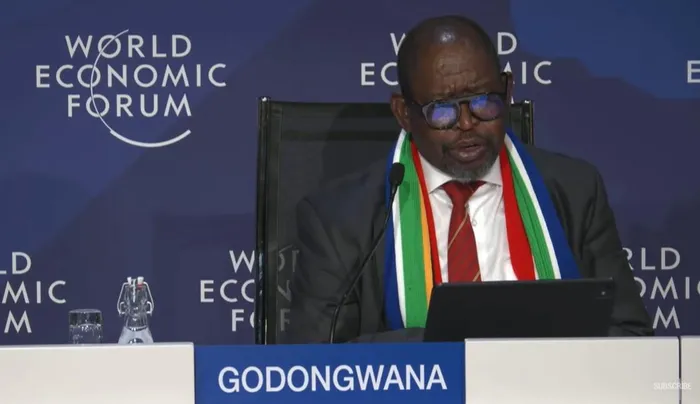
Finance Minister Enoch Godongwana on Friday said this year’s engagement with investors took place against a far more positive domestic backdrop, particularly regarding electricity supply.
Image: YouTube screengrab
Team South Africa has returned from the 2026 World Economic Forum (WEF) Annual Meeting in Davos expressing confidence that the country’s reform agenda is beginning to resonate with global investors, a marked shift from previous years dominated by concerns over energy shortages and logistics bottlenecks.
Finance Minister Enoch Godongwana on Friday said this year’s engagement with investors took place against a far more positive domestic backdrop, particularly regarding electricity supply.
“The positive thing is that we have come to this WEF with good news. Electricity challenges and outages are now a thing of the past,” Godongwana said in an interview on Friday.
He added that structural reforms are starting to bear fruit, while South Africa’s macroeconomic environment remains stable — a necessary, though not sufficient, condition for stronger growth.
“The government has presented a strong case about South Africa’s investment strengths,” he said. “Several business leaders I met, who are not South Africans, told me there is a positive story emerging about South Africa. Some are coming for the Mining Indaba, and others for different investment-related engagements.”
Responding to concerns about political tensions within the Government of National Unity (GNU), Godongwana downplayed the risks, describing policy differences among parties as normal in such arrangements.
“The parties in the GNU are not struggling to find consensus. There will be differences on some issues. We formed the GNU very quickly — a president within 14 days after the elections and a government within a month. Some policy matters are still being discussed, but I don’t think it’s a train smash,” he said.
The WEF’s latest Chief Economists’ Outlook pointed to continued global economic resilience despite turbulence, while warning of risks related to asset valuations, sovereign debt pressures, and the rapid, economy-wide rollout of artificial intelligence (AI).
AI and the infrastructure supporting it featured prominently in discussions, with leaders highlighting both technological advances and the need to broaden access so that gains are shared across advanced and developing economies.
Christine Lagarde, President of the European Central Bank, cautioned that AI-driven productivity gains could be undermined by regulatory and standards fragmentation.
“The development of AI and the productivity gains we hope for are difficult to reconcile with fragmentation in terms of standards, licensing and access,” Lagarde said. “This can only be remedied by a degree of cooperation.”
European leaders also met to discuss deepening market integration, scaling investment, and maintaining economic security amid geopolitical pressures.
Wandile Sihlobo, chief economist at the Agricultural Business Council of South Africa, said geopolitics and trade dominated many conversations at Davos. He attended the forum at the invitation of the South African government.
“The central theme in many discussions was geopolitics and trade,” Sihlobo said, noting strong interest in strengthening partnerships and expanding trade and investment ties.
He said the South African delegation leveraged this environment to promote economic diplomacy and position the country as a reliable trade partner, with a focus on export expansion into Asia and the Middle East, while retaining established markets in Europe, the UK, the US, and across Africa.
Calls to strengthen multilateralism and protect global institutions such as the World Trade Organisation (WTO) also featured strongly — an issue Sihlobo said is particularly important for agriculture.
South Africa’s agricultural sector has more than doubled in value since 1994, with trade playing a central role in that growth. The country now exports roughly half of its agricultural output.
“When the final figures for 2025 are released, I expect agricultural exports to exceed $14 billion for the first time, up from $13.7bn in 2024,” Sihlobo said.
Top export products include citrus, grapes, maize, apples and pears, wine, nuts, fruit juices, sugar, berries, avocados, wool and beef, among others.
In 2024, the African continent accounted for 44% of South Africa’s agricultural export value, followed by Asia and the Middle East at 21%, the European Union at 19%, the Americas at 6%, and the rest of the world — including the UK — at 10%.
“This is a solid platform to build on,” Sihlobo said, adding that improving logistics efficiency, more reliable power supply, and ongoing macroeconomic reforms strengthened South Africa’s message in Davos.
While global headlines were dominated by geopolitical tensions, he said the underlying conversations about trade, investment and reform offered meaningful opportunities for South Africa.
BUSINESS REPORT