

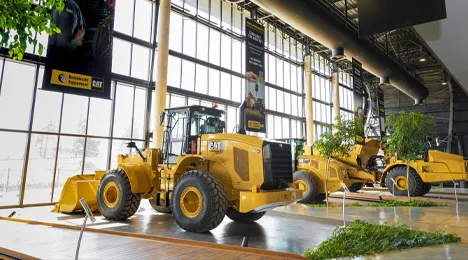
Barloworld Equipment showroom in Ganda Ganda in Angola.
Image: Supplied
The board of Barloworld, which delists from the JSE on Tuesday after 86 years on the market, would remain focused on strategy, disciplined governance and transparent stakeholder communication, said the chairman Lulu Gwagwa.
The group, which focuses on heavy industrial equipment and services, and food and ingredient solutions for the consumer industries, is delisting from the JSE and A2X after being acquired by Saudi Arabia's Zahid Group.
"Looking ahead under private ownership, our priorities are clear: to safeguard the well-being of our people and to execute our strategy with pace, while upholding the board's duty to act in the organisation's best interests by integrating diverse stakeholder perspectives to ensure long-term, sustainable value creation," said Gwagwa in the integrated report released Monday.
She welcomed soon to be newly appointed directors and their new chairman, the Saudi businessman Haytham Zahid. Zahid Group paid about R23 billion to acquire Barloworld in January 2023. The group annual general meeting is scheduled for February 20, 2026.
Over the past year, the group invested R1.5 billion towards the growth of it rental fleet, environmental investment into the rebuild facility and Kliprivier effluent plant, and ongoing maintenance of the plant and equipment.
CEO Dominic Sewela, who is part of the consortium that has acquired Barloworld, said Equipment Southern Africa finished the year with a strong order book, driven by significant orders in coal, copper and uranium.
He said they anticipate that Mongolia's growth rates would stabilise, reflecting a more balanced economic trajectory in the near term. VT (Vostochnaya Technica), Barloworld's Russian equipment subsidiary, which saw a revenue decline of over 25% in 2025 due to reduced inventory and sanctions, is currently trading close to break-even with adequate capital reserves to maintain self-sufficiency for the foreseeable future, he said.
In October and November 2025, planned board changes announced included the retirement of non-executive directors Nicola Chiaranda, Nomavuso Mnxasana, Vuyisa Nkonyeni, Bashirat Odunewu and Peter Schmid. Non-executive directors to be appointed included Erdi Kursunoglu, Augostino Sfeir, Hamza Zahid and Haytham Zahid.
Nopasika Lila retired as group finance director on November 30, 2025, and was replaced by Relebohile Sehoole (Malahleha) on December 1, 2025. The group ended the financial year with 6 003 staff, compared with 6 234 a year before.
Sewela said the macroeconomic outlook was intermingled with geopolitical developments, as shifting trade policies and ongoing conflicts contribute to divergent patterns of global growth and deepen regional economic fragmentation.
"For Ingrain, we continue to monitor market conditions closely to anticipate and respond effectively to evolving dynamics. Ingrain's maize supply is secured for the 2023/24 season, supported by favourable crop projections," he said.
There was a positive outlook on Zambia's growth potential, supported by strong copper prices. However, hard currency liquidity challenges across Greater Africa might present obstacles to realising these growth objectives, he said.
In South Africa, they were optimistic about the progress of structural reforms in the logistics sector and a more reliable energy supply. Export performance was expected to strengthen, although US tariffs presented a downside risk to certain industries.
"The construction sector is anticipated to recover, supported by government infrastructure initiatives. However, consumer sentiment remains cautious due to rising living costs and limited disposable income. The near-term outlook is mixed, with consumer confidence continuing to fluctuate," he said.
He said maize prices were expected to ease following the 2023 harvest, and favourable weather conditions were projected to persist.
BUSINESS REPORT