

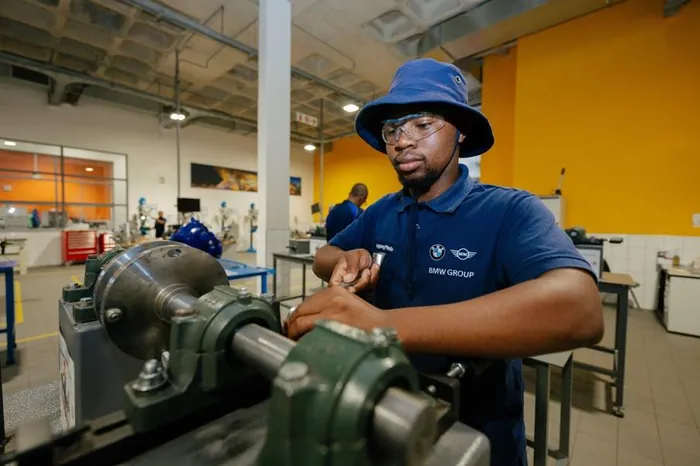
The objective, BMW Group South Africa CEO Peter Van Binsbergen said, is to encourage genuine production, including body welding, painting and full vehicle assembly, rather than “screwdriver assembly” operations associated with semi-knocked-down (SKD) plants.
Image: Supplied
South Africa’s automotive industry is not calling for punitive tariff hikes on cheap vehicle imports from China and India, but rather for targeted policy adjustments that strengthen local manufacturing without triggering price shocks for consumers.
This was the message from BMW Group South Africa on Wednesday after industry representatives appeared before Parliament on the implementation of the South African Automotive Masterplan (SAAM) on Tueday.
The National Union of Metalworkers of South Africa (Numsa) has called on government to impose steep tariffs on imports from BRICS partners China and India, warning that local industry is under siege and that trade imbalances are deepening.
The Department of Trade, Industry and Competition (the dtic) is currently reviewing measures, including higher import duties and excise taxes, and updating the country’s tariff schedule to align import levies with World Trade Organisation (WTO) rules for most-favoured nations, in a bid to support the domestic automotive industry.
According to data from Lightstone, 36% of all vehicles sold in South Africa are imported from India, while 37% were locally manufactured. Chinese imports accounted for 11% of sales. The majority of Japanese- and Korean-branded cars sold locally are also now sourced from India, highlighting the growing reliance on imported vehicles.
Speaking at the start of the year media engagement on Wednesday, BMW Group South Africa CEO, Peter van Binsbergen, said that while a 50% tariff may be legally permissible, it is not what the industry is seeking.
“Fifty percent is the bound rate within the WTO, so to be WTO-conform we could go to that level,” Van Binsbergen said. “But no one from the industry side is asking for that. That must be very clear.”
Van Binsbergen, speaking in his capacity as president of the Automotive Business Council (Naamsa), said such a move would amount to a “big hammer” approach that could have serious unintended consequences, particularly for affordability in the entry-level vehicle segment.
“That would be a shock and we don't want a shock to the system because there's often unintended consequences. The worst being affordability for the entry-level consumer who suddenly has 50% duty and put it onto a car or double the duty that it has today,” he said.
Instead, Van Binsbergen said the industry is advocating for a fine-tuning of policy instruments within the Automotive Production and Development Programme and the Automotive Production and Business Programme (APBP), aimed at making full-scale vehicle manufacturing in South Africa more viable.
The objective, Van Binsbergen said, is to encourage genuine production, including body welding, painting and full vehicle assembly, rather than “screwdriver assembly” operations associated with semi-knocked-down (SKD) plants.
“We need to make real production viable for more brands as they come to South Africa and become part of the solution. That means creating an attractive business case, not just protecting the market through tariffs,” he said.
“There might be a lever that is change of duties, but there's other levers we've asked for and proposed, which would also make the local producers have an advantage to be able to make their vehicles even more attractive to the consumer. So not making it harder for an importer, but making our business case more attractive.”
Part of that effort includes closing what the industry describes as the “SKD loophole”, which allows some importers to operate with minimal duties by classifying components under aftermarket categories.
According to Van Binsbergen, this has enabled some manufacturers to enter the market with little investment and limited job creation.
“And that's why we've asked them as well, very clealy, [to] close the SKD loophole because with that, SKD manufacturers are coming in close to duty-free," he said.
"They're using aftermarket categories, import the engine duty-free, and they're actually having a very easy time here in South Africa without creating any investments and hardly creating any jobs. So we're asking for small adjustments, not for the big hammer approach.”
Van Binsbergen also highlighted the importance of expanding South Africa’s automotive manufacturing base, noting that only seven manufacturers currently produce vehicles locally.
He said increasing that number to around 10 would help draw global suppliers into the country, amplify job creation and strengthen the sector’s contribution to economic growth.
Meanwhile, BMW Group South Africa outlined its 2025 performance and strategic direction for the year ahead, highlighting record premium segment leadership and strong local production.
In 2025, the BMW brand achieved its highest-ever premium segment share locally, exceeding 46.15%, despite ongoing affordability pressures and intensifying competition in the South African automotive market.
A cornerstone of BMW Group South Africa’s presence in South Africa remains BMW Group Plant Rosslyn, which produced more than 79 000 vehicles in 2025, the highest volume in the 52 year history of the plant.
"Operating at this scale, while maintaining quality and efficiency, speaks to the capability, resilience and commitment of our Rosslyn team," said Danny Bester, director of BMW Group Plant Rosslyn.
"Our focus remains on building a future-ready plant that can continue to serve global markets with confidence, underpinned by skills development and sustained investment in South Africa.”
BUSINESS REPORT