

Bank of America Sub-Saharan Africa analyst, Tatonga Rusike has now projected a further 25bps rate cut in March, with inflation seen averaging 3.4% this year. In January, the Sarb left its main lending rate unchanged at 6.75%.
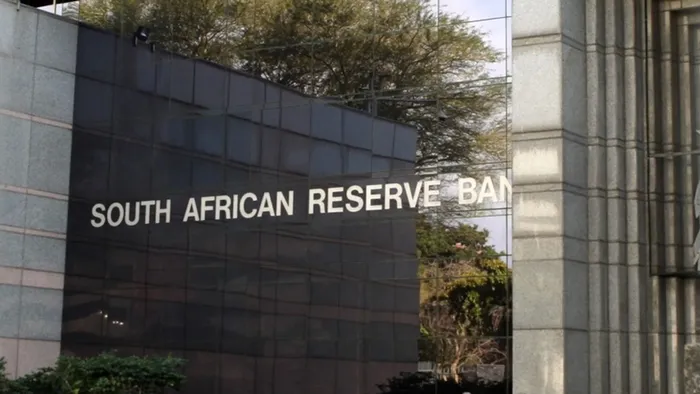
Image: File
Tawanda Karombo
South Africa is increasingly likely to see another 25 basis point interest rate cut as early as next month, as confidence in the country’s economic turnaround gains traction, according to Bank of America (BofA).
However, ratings agency Moody’s has cautioned that persistent structural weaknesses — including high government debt, weak labour market outcomes and underperforming State-Owned Enterprises (SOE) — continue to pose significant risks.
BofA analysts on Tuesday said they expect that South Africa’s economic growth will spring up to above 1.5% this year on the back of stronger precious metals prices and improved consumption. The South Africa Reserve Bank (Sarb), in tandem with Treasury, has also revised downwards the inflation target to 3%.
BofA Sub-Saharan Africa analyst, Tatonga Rusike has now projected a further 25bps rate cut in March, with inflation seen averaging 3.4% this year. In January, the Sarb left its main lending rate unchanged at 6.75%.
“But we think the central bank is likely to be cautious in its extended rate-cutting cycle post the move to a 3% inflation target. We now see the first 2026 cut in March, with further cuts at every other meeting, taking the policy rate to 6% by year-end (and) we see limited room for cuts to below 6%,” said Rusike.
Concurrently, BofA sees South Africa’s economic growth improving to 1.5% in 2026, buoyed by rising consumption and domestic investment.
Household consumption, marked as the main driver of economic growth, with private sector credit “now growing faster” after stagnating at around 4% over the last two years and reaching 7.8% in November 2025.
Analysts at Moody’s also recently highlighted easing inflation and interest rates, South Africa’s removal from the Financial Action Task Force (FATF) grey list, stabilisation in electricity supply and improvements in rail and port operations as supportive of stability for banks' credit strength. However, wider risks persist.
“Risks remain from high government debt and the country's low growth potential, given ageing infrastructure, a sluggish labour market and a still weak SOE sector,” said the Moody’s analysts.
Yet, Bank of America sees “near-term economic reforms, mainly in the logistics sector” as likely to translate to an improvement in fixed investment in the second half of 2026.
Rusike said he expects the government to deepen opening of ports and rail networks to private operators although South African mining executives attending the Steel and Ferro Alloys Conference in Cape Town on Tuesday insisted that electricity supply and costs for road, rail as well as port inefficiencies and border delays were hobbling the industry.
“On the domestic front, higher electricity prices above 6%, Eskom's approved baseline, for instance to correct a Nersa revenue calculation error, could jeopardise the inflation trajectory," he said.
"In 1Q26, we will pay close attention to price seasonality: in January, food, financial services, personal care price increases; in February, medical aids, and insurance price increases; and in March, education prices, among others."
He, however, said that high gold and PGM prices were likely to boost external balances, leading to a current account surplus.
With a fiscal deficit of 4% of GDP, explained Rusike, South Africa’s debt could start a downward path. This would brighten prospects and expectations that rating agencies will respond with upgrades, possibly before the end of this year.
Commodity analysts at Bank of America assume that gold, which has remained elevated despite easing down on last week’s record prices, will average $4 500 per ounce in 2026 with the same volume of production, implying that South Africa’s current account could narrow by 0.5% of GDP.
“Adding higher platinum prices, averaging $1 825 in 2026E contributes a further 0.7% of GDP to exports. As a result, we forecast a current account surplus of 0.5% of GDP in 2026 and a balanced current account in 2027. This is positive for ZAR - we now forecast 15.6 per USD by year end 2026,” said Rusike.
BUSINESS REPORT