

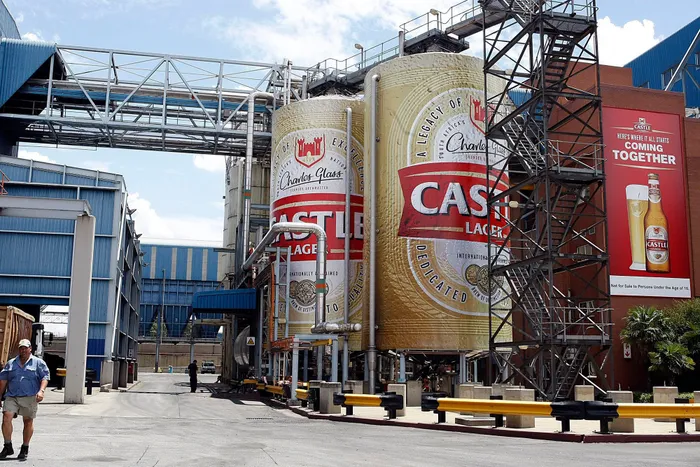
Beer has one of the most localised value chains in South Africa, with more than 95% of inputs sourced domestically, supporting an estimated 250 000 livelihoods across agriculture, manufacturing, logistics, tavern owners and retailers.
Image: Leon Nicholas / Independent Newspapers
By Fatsani Banda
As debate intensifies around excise increases and the growth of illicit trade, South Africa’s expanding illicit alcohol market is too often reduced to a question of enforcement. This misses the deeper issue. Illicit trade flourishes when excise policy, affordability and the regulatory environment are out of kilter, and increasing evidence suggests that alcohol policy in South Africa has reached precisely that point.
Recent research indicates that illicit alcohol now accounts for approximately 18% of total alcohol consumption in South Africa. Nearly one in every five drinks consumed falls outside the regulated system. This is no longer a marginal issue confined to informal markets; it is a structural shift with material consequences for tax revenue, public health, employment and the sustainability of local manufacturing.
The underlying economics are straightforward. When excise increases consistently outpace inflation in a price-sensitive market, legal products become progressively less competitive relative to illicit alternatives. Consumption does not disappear — it migrates. Over time, this erodes legal volumes, weakens compliant businesses and ultimately shrinks the tax base government is trying to protect.
South Africa’s excise framework has long lacked tax certainty, with insufficient inflation-linked adjustments to maintain the real value of excise duties. Yet over the past 12 years, excise increases have aligned with inflation on only two occasions. The cumulative effect has been a widening gap between legal and illicit alcohol, with recent estimates suggesting illicit products are now almost 40% cheaper than regulated alternatives.
This matters because alcohol demand, particularly in lower-income segments, is not infinitely inelastic. In a constrained consumer environment, sustained above-inflation excise increases push consumers toward unregulated products rather than reducing overall consumption. The result is a lose-lose outcome: higher health risks from unsafe products, declining legal sales, job losses across the value chain and lower revenue collection over time.
The experience of the tobacco sector offers a sobering parallel. The recent announcement of a closure of one of the local manufacturing facilities by a major tobacco producer was not driven by declining demand, but by the rapid expansion of illicit trade that hollowed out the legal market. The risk now is that alcohol follows the same trajectory.
Beer, in particular, illustrates what is at stake. It has one of the most localised value chains in South Africa, with more than 95% of inputs sourced domestically, supporting an estimated 250 000 livelihoods across agriculture, manufacturing, logistics, tavern owners and retailers. When legal beer becomes increasingly unaffordable relative to illicit alcohol, the consequences extend far beyond producers — they ripple through farms, factories, township and urban economies and small businesses.
There is also a policy coherence problem. South Africa’s excise system should be consistently designed around alcohol content, with higher-strength products taxed more heavily to support public-health objectives. Persistent above-inflation increases on beer risk distorting this structure by disproportionately increasing the price of lower-alcohol products, while pushing consumers toward illicit, higher Alcohol By Volume and unregulated alternatives. This undermines both fiscal and public health goals.
Against this backdrop, government’s indication that it intends to launch a renewed illicit-trade programme in the coming weeks is encouraging. But enforcement alone will not resolve the problem if policy continues to incentivise illicit activity. International experience shows that the most effective illicit-trade strategies combine credible enforcement with tax policy that reduces affordability differentials in favour of legal products.
Crucially, compliant industries must be embedded in policy design as a strategic partner, not consulted after the fact. Illicit trade operates through complex, adaptive supply chains that cannot be dismantled by the state acting alone. Data sharing, traceability, market intelligence and coordinated interventions are essential. Excluding industries from programme designs risks repeating past mistakes where well-intentioned initiatives fail to address the underlying economic drivers.
At its core, illicit alcohol is in part a feedback signal. It tells policymakers when assumptions about price, behaviour and revenue no longer hold. Ignoring that signal does not strengthen the system — it weakens it.
South Africa still has an opportunity to recalibrate. An excise policy anchored in inflation, combined with strengthened enforcement and genuine collaboration, would support revenue sustainability, protect local manufacturing and reduce incentives for illegal trade. The alternative of continuing down a path where legal markets shrink, compliance erodes and fiscal outcomes worsen — is just not an option.
Illicit trade always wins when policy fails. The question is whether we are prepared to adjust course before the damage becomes irreversible.

Fatsani Banda is the senior manager of excise tax and policy manager for regulatory and public policy at SAB.
Image: Supplied
* Fatsani Banda is the senior manager of excise tax and policy manager for regulatory and public policy at SAB.
** The views expressed do not necessarily reflect the views of IOL or Independent Media.
BUSINESS REPORT