

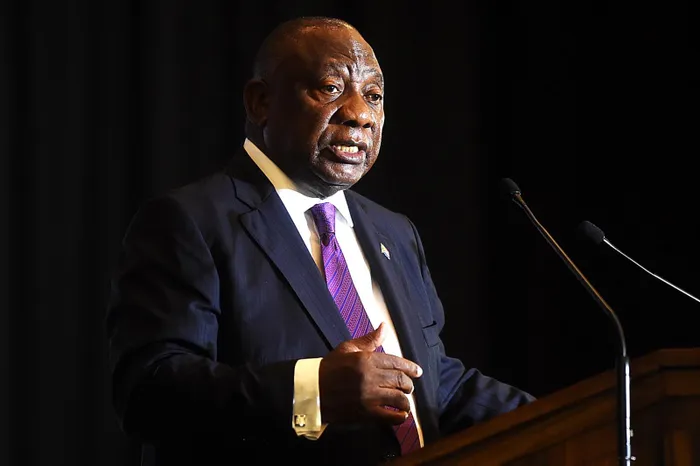
President Cyril Ramaphosa is expected to use his address to outline South Africa’s vision for industrialisation, export diversification, decarbonisation and digitisation, and to reaffirm the country’s commitment to advancing Africa’s economic integration.
Image: Itumeleng English/Independent Newspapers
South Africa on Wednesday will formally transition to Class A Shareholder status in the African Export–Import Bank (Afreximbank), a move that signals a deepening of the country’s strategic engagement with one of Africa’s most important multilateral financial institutions.
The country's partnership with the African Export-Import Bank (Afreximbank) has strengthened considerably in recent years, paving the way for deeper collaboration on infrastructure development, trade facilitation, and industrialisation across the continent.
President Cyril Ramaphosa is set to deliver the keynote address at the signing of the Instrument of Accession to the Afreximbank Establishment Agreement, marking South Africa’s sovereign membership of the bank.
The ceremony represents a milestone in the country’s efforts to advance industrial development, export-led growth and deeper intra-African trade integration.
Afreximbank is a pan-African multilateral development finance institution mandated to facilitate, promote and expand both intra- and extra-African trade.
Over the past decade, the bank has emerged as a central player in financing Africa’s industrialisation agenda, supporting trade infrastructure, value-chain development and cross-border investment.
South Africa’s transition to Class A Shareholder status elevates its relationship with the bank from that of a participating member to a sovereign shareholder, strengthening its influence within Afreximbank’s governance structures and strategic direction. It also unlocks tangible benefits for South African companies, commercial banks and State-Owned Enterprises.
Sovereign membership is expected to provide access to more competitive trade finance, expanded funding opportunities linked to the African Continental Free Trade Area (AfCFTA), and greater participation in cross-border projects and investments across the continent.
It also opens the door to enhanced cooperation with other African financial institutions and access to risk mitigation tools designed to support trade and investment in challenging environments.
The partnership comes at a time when South Africa is seeking to reposition itself as a leading industrial and export hub within Africa, while navigating a global environment marked by trade fragmentation, supply chain disruptions and tightening financial conditions.
By strengthening ties with Afreximbank, South Africa aims to leverage continental markets to boost manufacturing, diversify exports and support inclusive economic growth.
Ramaphosa is expected to use his address to outline South Africa’s vision for industrialisation, export diversification, decarbonisation and digitisation, and to reaffirm the country’s commitment to advancing Africa’s economic integration.
These priorities align closely with Afreximbank’s strategic mandate, particularly its focus on supporting the AfCFTA and financing projects that enhance regional value chains.
The signing ceremony will be attended by Afreximbank president and chair of the board of directors, Dr George Elombi, alongside members of the bank’s board and management, cabinet ministers, senior government officials, business leaders and members of the diplomatic corps. Their presence underscores the political and economic significance of South Africa’s accession as a Class A shareholder.
For Afreximbank, South Africa’s formal accession strengthens the bank’s shareholder base with one of Africa’s most industrialised economies, enhancing its capacity to mobilise capital and scale up trade finance across the continent.
For South Africa, the move represents both a strategic investment and a statement of intent: to play a more active role in shaping Africa’s trade and development architecture.
Last month, the Afreximbank officially terminated its credit rating relationship with Fitch Ratings following a review of the relationship and its firm belief that the credit rating exercise no longer reflects a good understanding of the Bank’s Establishment Agreement, its mission and its mandate.
In November, Deputy Minister of Public Works and Infrastructure, Sihle Zikalala, acknowledged that the recent progress made by Finance Minister Enoch Godongwana in accelerating South Africa’s ratification as a full sovereign shareholder in Afreximbank would unlock even greater opportunities.
“Now that South Africa is becoming a full affiliate of the Bank, it opens more space for entities to source funding and for Afreximbank to partner directly with government,” Zikalala said.
He said his department had signed a Memorandum of Understanding (MoU) with Afreximbank focused on project preparation — including feasibility studies, business plans, and environmental permits — to ensure that major infrastructure projects are bankable.
“At present, Afreximbank has already committed over R90 million to project preparation for Infrastructure South Africa. We’re now working to scale that up,” he said, adding that Afreximbank’s involvement would help “alleviate fiscal pressure” on government at a time when the national budget remains constrained.
“Partnering with institutions like Afreximbank and the African Development Bank gives us more funding options to drive infrastructure development.”
BUSINESS REPORT