
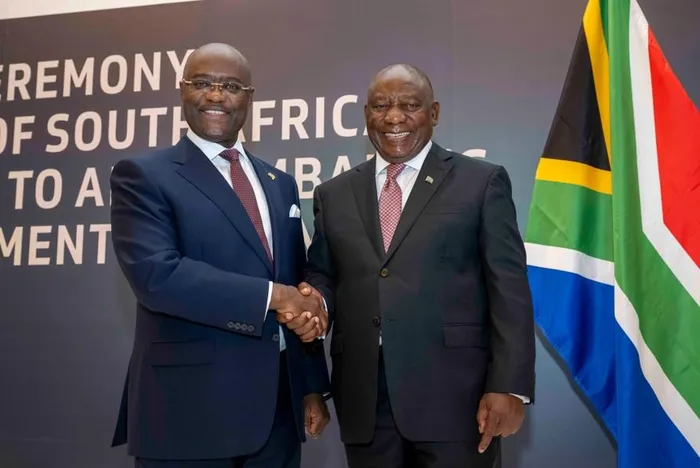
Afreximbank president and chairman, Dr George Elombi, with President Cyril Ramaphosa at the the signing ceremony of the Instrument of Accession by South Africa to the Establishment Agreement of the African Export–Import Bank (Afreximbank).
Image: Supplied
The South African government has unveiled plans to establish a domestic export–import bank focused exclusively on supporting exporters, industrial projects and regional value chains, as the country seeks to shield itself from rising global protectionism and escalating trade wars.
The announcement coincided with South Africa’s official accession on Wednesday to the Establishment Agreement of the African Export-Import Bank (Afreximbank), formally bringing one of Africa’s largest economies into the membership of the Pan-African multilateral lender.
South Africa has thus transitioned to Class A Shareholder status in the Afreximbank, which elevates its relationship with the bank from that of a participating member to a sovereign shareholder, strengthening its influence within Afreximbank’s governance structures and strategic direction.
To operationalise this partnership, the Afreximbank committed an initial $8 billion (about R128 billion) country package for South Africa, aimed at accelerating industrialisation, expanding infrastructure investment and strengthening integration into regional and continental markets.
Afreximbank president and chairman, Dr George Elombi, said the country programme was aligned with South Africa’s National Development Plan 2030 as well as its industrial and trade policy priorities, and would target key strategic sectors.
“This affirmation of the membership of South Africa in Afreximbank marks a decisive step towards uniting around the continent’s economic interests, the interests of our mother continent,” Elombi said.
“South Africa's membership of the Bank, while providing Afreximbank a full continental coverage, brings the country into the heart of Afreximbank's vision and its aspirations to promote the change so much desired in the structure of Africa’s trade.”
Wamkele Mene, secretary general of the African Continental Free Trade Area Secretariat, said South Africa's accession sends a clear and powerful signal that Africa's leading economies are committed to African solutions.
"Today's step comes at a time of heightened geoeconomic tensions, trade fragmentation, and the increasing weaponization of trade, investment, and industrial policies," Mene said.
"These trends have weakened the multilateral trading system and have increased uncertainty. For our continent, the conclusion could not be clearer."
South Africa becomes the 54th state to accede to the Bank’s Establishment Agreement, a milestone that both parties said comes at a time when the global financial and trading system is increasingly fragmented by protectionist policies and shifting geopolitical alliances.
President Cyril Ramaphosa said South Africa’s accession to Afreximbank reaffirmed the country’s commitment to African industrial development and to deepening trade, investment and economic integration across the continent.
Ramaphosa said the move also brings South Africa closer to the creation of a national Export–Import Bank, which would play a central role in supporting domestic exporters and industrial expansion.
“Working closely with Afreximbank, and building on the experience of our Export Credit Insurance Corporation (ECIC), we are laying the foundations for a national institution that will support exporters, crowd in investment and provide financing aligned to our industrial priorities,” he said.
The relationship between South Africa and Afreximbank is not new. In 2018, Afreximbank and the ECIC signed a memorandum of understanding to launch a $1bn financing programme aimed at promoting and expanding trade and investment flows between South Africa and the rest of Africa.
When South Africa joined Afreximbank as shareholder in November 2017, it named the ECIC as its designated investor and became eligible for the bank’s trade promotion programmes and financial services as a result of that shareholding.
Minister of Trade, Industry and Competition Parks Tau said the government had been evaluating whether to convert the ECIC into a sovereign shareholder entity, restructure it, or establish a new export–import bank or national credit agency that would either replace or complement the ECIC.
“The business case has pretty much been concluded as to the direction that we take with regard to the establishment of a local Exim capacity,” Tau said.
According to Elombi, the Afreximbank will invest heavily in the local processing of natural resources, with a major focus of the funding on value-added industrial activity, particularly in mineral beneficiation and the expansion of automotive manufacturing, as well as investments aimed at broadening South Africa’s fiscal revenue base.
Elombi said Afreximbank would also prioritise critical infrastructure development, with a strong emphasis on energy generation and transmission, which he described as central to South Africa’s industrial future.
Tau said discussions were under way with Afreximbank to finalise the details of the South Africa country programme, emphasising that the initiative would go beyond merely submitting projects for funding.
“The idea is to have a programme linked directly to national industrial policy, our intent and our mission as a country, both on the continent and internationally, as we diversify our markets and identify strategic partners,” Tau said.
Tau said government expected to finalise the details of the country programme in the coming weeks, with the objective of maximising its impact on growth, development and South Africa’s integration into regional and global value chains.
BUSINESS REPORT