
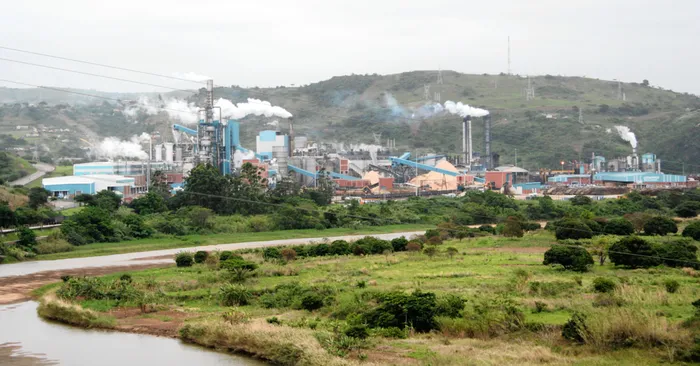
Sappi Saiccor mill near Umkomaas, KwaZulu-Natal. challenges. The group's profits fell in the first quarter to December 31, 2025 due to overcapacity in global markets and weak consumer demand which drove down product prices.
Image: File Photo
Sappi, the JSE-listed forestry and woodfibre resource group Sappi traded through difficult global market conditions in the three months to December 31, with macroeconomic pressures, subdued consumer confidence and overcapacity driving price declines across all its product segments.
This was according to the CEO Steve Binnie, who was commenting after the group's first quarter results showed adjusted earnings before interest tax depreciation and amortisation (aEDITDA) slumping by 56% to $90 million for the first quarter of the group's 2026 financial year, over the same period a year earlier.
"The results were impacted by rand appreciation against the US dollar, a combination of scheduled and unscheduled maintenance work as well as lower dissolving wood pulp (DWP) prices. These impacts were partially offset by ongoing group-wide cost saving initiatives and the annual energy refunds in Europe," he said.
In North America, the scheduled maintenance shut at the Somerset Mill and further unplanned operational disruptions affected production, sales volumes and costs.
The forestry fair value adjustment for the quarter was also a loss of $9m, due to declining domestic wood prices in South Africa.
He said demand for dissolving wood pulp continued to be solid due to high downstream viscose staple fibre industry operating rates, and relatively low inventories in the value chain. Sales volumes for the pulp segment were 10% higher driven by a 13% increase in DWP volumes. However, net selling prices fell 12% below the previous year.
Subdued textile fibre pricing combined with low paper pulp prices, which continued to incentivise paper pulp substitution by some non-integrated VSF producers, contributed to a $33 decline in the hardwood DWP price to about $785 per ton.
Packaging and speciality papers sales volumes improved 6% year-on-year. Underlying containerboard in South Africa remained healthy, but paperboard markets in North America and Europe continued to be challenged by weak demand and oversupply.
In response to the challenges in the group, Binnie said a number of cost saving initiatives were being implemented to offset lower selling prices and the weakening of the dollar against the rand and Euro. In addition, "we have further reduced our capital expenditure for FY2026 to about $260m to proactively manage the balance sheet and preserve cash."
Liquidity improved further after quarter-end, with the increased international RCF (revolving credit facility) and the new term loan, he said. Binnie said they remained focused on executing their "Back to Basics" phase of their strategy, closely monitoring external developments, while prioritizing strong cost discipline and targeted operational efficiency improvements to strengthen the balance sheet and maintain agility during this period of market weakness.
Sappi also provided an update on the potential formation of a 50/50 joint venture with UPM-Kymmene Corporation (UPM), first announced in December 2025, for graphic papers in Europe. The proposed venture will combine Sappi's European graphic paper operations with UPM's Communications Paper business in Europe, the UK, and the US.
Binnie said the parties intend to sign definitive agreements in the first half of 2026 and expect to complete the transaction by the end of 2026, subject to the fulfilment of conditions precedent.
On the outlook, he said they were erring on the side of caution due to the rapidly evolving global trade environment. aEBITDA for the second quarter was expected to be below that of the first quarter of the financial year.
"A challenging global macroeconomic environment and persistent geopolitical and trade tensions continue to disrupt market stability and dampen consumer demand, negatively impacting our industry," he said.
Despite the weaker results and outlook, Sappi's share price increased a sturdy 5.88% to R19.82 on the JSE on Wednesday, after the first quarter results were released. However, over a year the share price has dropped sharply from R45.57.
BUSINESS REPORT