

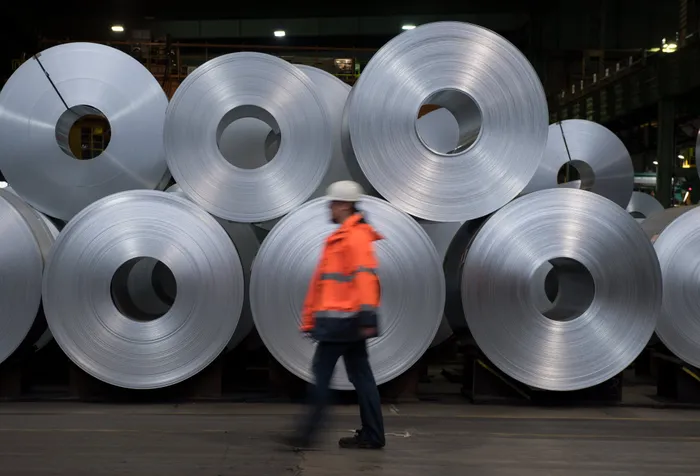
South Africa’s steel manufacturing industry remains a key manufacturing cog and driver of infrastructure development, despite the numerous challenges. Steel maker ArcelorMittal South Africa reported lower losses in its 2025 financial year, even as it shut its Longs business, which affected some 4000 jobs.
Image: EPA
ArcelorMittal South Africa (AMSA), the steel maker in talks to be acquired by the government, reduced its loss by nearly half in 2025 after putting in place tighter cost controls, raw material costs fell, fixed costs stabilised and operations became more reliable.
The group, some two thirds owned by Luxembourg-based ArcelorMittal Group, is in talks with the state-owned Industrial Development Corporation. In its results for the year to December 31, released Thursday, AMSA reported that its market environment in 2025 remained tough and was characterised by falling global steel prices due to international overcapacity, weak domestic economic activity, high import penetration and elevated administered input costs.
"Despite an exceptionally difficult year for the steel industry, AMSA has taken decisive steps to address structural challenges, materially reduce losses, and stabilise the core of the business," said Kobus Verster, CEO.
The Long steel business was wound down and put into care and maintenance by the end of 2025. In the Flats Business, sales volumes fell by 4% to 1.4 million tons, while crude steel production increased by 8% to 1.8 million tons on improved reliability.
Realised steel prices fell 5% in rand terms (down 3% in US dollars), and the current rand strength against the US dollar represented a material risk to the first-half 2024 outlook, he said.
The raw material basket fell 15% in rand terms. The earnings before interest, tax, depreciation and amortisation (EBITDA) loss reduced by nearly two thirds to R1.11bn from a R2.95bn loss the year before. The headline loss reduced to R3.4bn from R5.1bn.
Excluding the Longs Business closure, about R740m of structural footprint adjustments were expected to support the 2024 business plan.
"Trading conditions are expected to remain cautious in the first half of 2026, though improvement is anticipated later in the year subject to fair-trade protections being implemented by the Department of Trade, Industry and Competition," said Verster in a statement.
The Value Plan, a group strategy to restore profitability, strengthen the balance sheet and reposition steel operations for sustainability, delivered R1.1bn in savings (R910m in 2024).
"To preserve these gains, (the) focus is on addressing operational inefficiencies and negative incidents, which impacted EBITDA by about R410m during 2023," said Verster.
Liquidity was strengthened with R1.23bn in incremental cash generation from the disposal of surplus metallics and by-products, supporting cash flow during a restructuring period.
"Improved reliability and capacity utilisation in the Flats Business have created a more stable operating platform and positioned the core business for further recovery as market conditions allow," said Verster.
Revenue decreased by 16% to R32.3bn due to a 12% decline in total steel sales volumes and a 5% fall in realised steel prices in rand terms.
The raw material basket (iron ore, coking coal, and scrap), representing 39% of cash cost per ton (2023: 46%), was 15% lower in rand terms. Consumables and auxiliaries represented 40% of cash cost per ton (36%). Electricity tariffs increased by 15%, while dollar-denominated commodity-indexed consumables declined, partially offsetting cost increases.
Average capacity utilisation increased to 68% from 64% in 2023, driven by better operational reliability in the Flats Business.
Verster said the wind-down of the Longs Business had been necessary to address a chronically loss-making operation. The impact of the Longs Business on EBITDA was neutralised in 2023, compared to a loss of R1.7bn in 2022, he said.
Liquidity continued to be prioritised, generating some R1.23bn in incremental cash from selling surplus metallics and other by-products, albeit at a R470m negative impact on EBITDA, to support cash flow during the complex Longs Business wind-down. Net borrowings increased to R6.45bn from R5.11bn.
"Actions are underway to strengthen the balance sheet and restore the remaining business, particularly the Flats Business, to operating profitability in a difficult and volatile steel market," said Verster.
AMSA's share price increased 1.59% to R1.28 on the JSE Thursday afternoon. The price has increased 30.6% over a year.
Visit:www.businessreport.co.za