

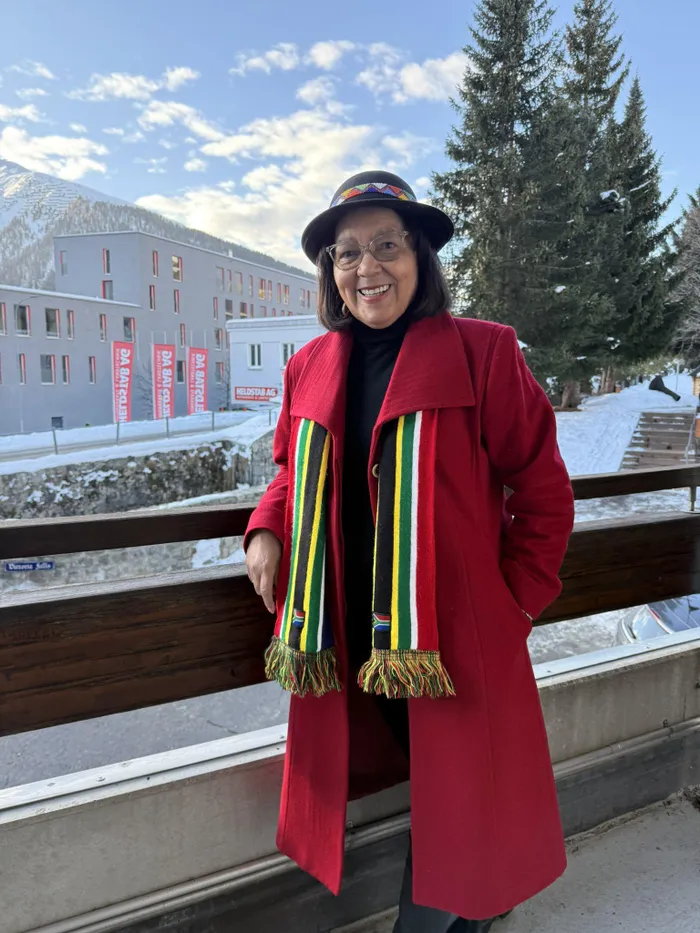
Minister of Tourism, Patricia de Lille, at the WEF Annual Meeting in Davos last month. Bright, warm and unmistakably South African, the scarf became one of the most sought-after items at SA House, drawing hundreds of visitors daily and creating a visible, moving billboard for the country across the snow-covered alpine town.
Image: Supplied
At the recently concluded World Economic Forum (WEF) Annual Meeting in Davos, Switzerland, South Africa found an unlikely but powerful branding triumph wrapped around delegates’ necks: the South African scarf.
Bright, warm and unmistakably South African, the scarf became one of the most sought-after items at SA House, drawing hundreds of visitors daily and creating a visible, moving billboard for the country across the snow-covered alpine town.
From early morning until late evening, visitors streamed into SA House not only for coffee and conversation, but in hopes of securing one of the now-iconic scarves.
On the very first day of the WEF meeting, Brand South Africa handed out 500 scarves. By the end of the week, supplies were running dangerously low as demand far outstripped expectations.
For Tourism Minister Patricia de Lille, the scarf’s success is both practical and symbolic.
“You and I have been here for the past few days — we know it’s bloody cold,” she said. “The scarf looks warm, and of course the colours can match just about everything.”
But De Lille believes the appeal goes deeper than warmth or aesthetics.
“People are also looking for the scarf to show solidarity with South Africa,” she said, pointing to the country’s prominent global stance on moral and humanitarian issues, including its advocacy for peace and justice internationally.
“We do have that moral high ground that people would like to be associated with.”
She traced the scarf’s origins back to the 2010 FIFA World Cup, noting that it has long served as a soft-power symbol of national pride.
“Every time I see the scarf, I remember the early days of approving our flag design,” she recalled. “I once joked that it looked like a beach towel — but today, we carry it very proudly.”
The scarf’s popularity extended well beyond the walls of SA House. Everywhere in Davos, wearers were instantly identified as South African, often stopped mid-walk by strangers keen to strike up conversations about the country.
In one instance, an Italian porter at the AlpenGold Hotel, where US President Donald Trump was staying, approached this reporter directly to ask for the scarf, prompting an impromptu act of generosity.
At the same hotel, a European diner interrupted his lunch to exclaim enthusiastically: “South Africa! I love South Africa! Great country!”
Mpumi Mabuza, acting chief marketing officer at Brand South Africa, described the scarf as an instant conversation starter and a highly effective branding tool.
“It’s the most recognisable colours — honestly,” she said. “From day one, even while we were still setting up, people were already asking for scarves.”
She recounted how police officers, hotel staff and even members of the US Secret Service discreetly tucked scarves into pockets during previous WEF meetings.
“They hide them,” she laughed. “It’s become the souvenir of the day.”
Mabuza noted that while other countries have attempted to replicate the idea, none have matched South Africa’s success.
“You see the scarves all over the streets of Davos, and that visibility is priceless.”
Beyond the scarf, SA House itself stood out for its open-door policy. Unlike many country pavilions that required pre-registration or accreditation, SA House welcomed walk-ins, a deliberate choice that became a metaphor for South Africa’s openness.
“This house has been one of the fullest. People come in for coffee, for conversation, and they leave with an affinity for the country,” Mabuza said.
Visitors asked about tourism, safaris, oceans, and business opportunities, turning casual drop-ins into meaningful engagements.
“That’s why we’re here,” Mabuza said. “To put the flag out there, and the scarf has done exactly that.”
In the frozen streets of Davos, South Africa’s warmest export proved to be more than just fabric. It was a symbol of identity, hospitality and connection — worn proudly, talked about endlessly, and remembered long after the snow melted.
What also endears the scarf in the hearts of many is that it is locally-produced, meaning that it generates revenue and creates jobs for the South African economy.
BUSINESS REPORT