

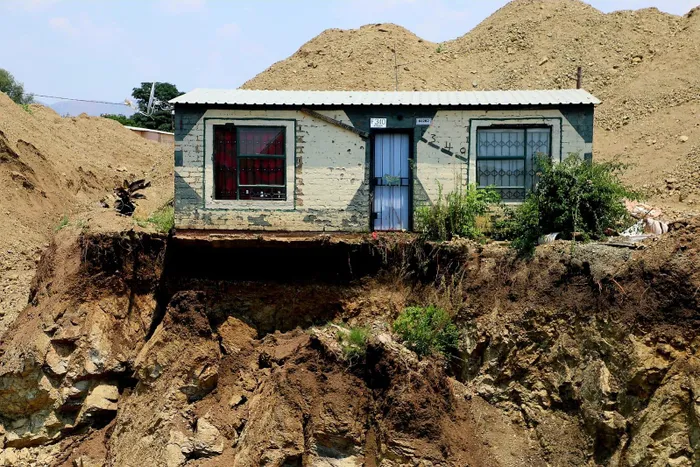
One of the houses in Bapong, North West, has been abandoned by its owners after illegal miners began digging in their yards. Mining group need to be part of the economic development of their surrounding communities, and the creation of opportunities outside mining,
Image: Timothy Bernard / Independent Newspapers
Mines need to plan economic development other than mining for their nearby communities, because mines will all, eventually close, said Anglo American Corporate Affairs Senior Vice President Nivashne Naicker.
Speaking at the Mining Indaba in Cape Town on Tuesday, she announced the launch of a R100 million initiative by the group's Impact Finance Network (IFN) platform, working with the Impact Finance Facility organisation, and a R50m additional contribution from Anglo American subsidiary Kumba Iron Ore, to finance suitable entrepreneurs and SME's, outside of mining. Some R50m of the funds are being ringfenced for communities around Kumba's mine in the Northern Cape.
Many speakers at the Mining Indaba have this year focused on the need for mines to invest outside of their normal social investment strategies, and operating and capital expenditures, to invest in communities surrounding their mines.
Mining groups have historically drawn criticism across Africa for simply exporting their products and profits, and leaving communities near their mines destitute, with degraded environments, after the mines close.
Naicker said another thing that happened too often in the past was mines that decided to work on sustainability initiatives at the end of mine life, which was too late, as economic development initiatives take a long time to bear fruit.
Tefo Molosiwa, head of policy and planning at De Beers, said their "Building Forever" strategy, a 12-goal sustainability framework to create a long term positive impact on communities, the environment and ethical governance, was the outcome of engagements with key stakeholders, who had, among their major concerns, expressed the desire to know the provenance of the groups diamonds.
He said a key goal of the strategy was to create four additional jobs, for every one job created at their mines. An example was their mining operations in Limpopo, which operate close to Musina and Blouberg.
Blouberg had challenges typical to rural communities in Africa, such as high unemployment at 47%. However, the soil had the ability to grow potatoes, cabbages and tomatoes well. Consequently, the group employed agronomists to turn over 1 500 Blouberg residents into farmers over 3000 hectares of land. The group also helped the farmers connect with buyers such as PepsiCo and Simba.
This initiative had create 5.47 jobs for every one job created by De Beers in the region, said Molosiwa.
Ian Cockerill, CEO of one of the biggest gold mining groups operating in West Africa, Endeavour Mining, said there had in the past been debate among critics about how mining group's share their profits, particularly in light of a high gold price.
However, he said, the reality was that even if the group owns a good ore body, it is worthless unless it can be made to produce visible benefits for the country and community where it operates. Mining groups are usually guests of the countries and communities where they operate.
For mines that need to operate within communities for sometimes up to 30 years, the mining group needed to create opportunities for young people in nearby communities, and these requirements were universal and included transparency, jobs, income advancement opportunities, education and technical skills.
Endeavour's workforce was 95% drawn from the communities surrounding their mines, and the group has invested in education, health and infrastructure facilities to create a legacy that would outlive the mine, he said.
Cockerill said that World Gold Council had calculated its members had generated $66 billion for the governments in Africa in the form of taxes, royalties and other payments, salaries for staff and other investments in local communities over ten years to 2024, while shareholders, who had taken the financial risk to develop the mines, had retained $1.6bn, money that was also be required for future investment or expansion.
He said it was essential that mines were able to generate a sufficient return for their long-term sustainability. These gold mining companies had employed about 380 000 people, and the economic impact extended far beyond the direct job, because in Southern Africa, it was common for one formal job opportunity to support an additional 6 to 10 people, he said.
Molosiwa said that at a business level, one could not speak of climate risk and its potential impacts on business without addressing community resilience. DSS+ Consulting EMEA MD Marco Pagnini said it is typical for managements to provide a short term view of mine operations, risk and profitability, and it was up to board members to measure management decisions against longer term sustainability requirements, and ensure any measures towards for these longer term goals were implemented.
He said such was the growing incidence of climate change and other risk events on large businesses in the past few years, that it was becoming essential for businesses to integrate extreme risk mitigation measures in their businesses.
BUSINESS REPORT