

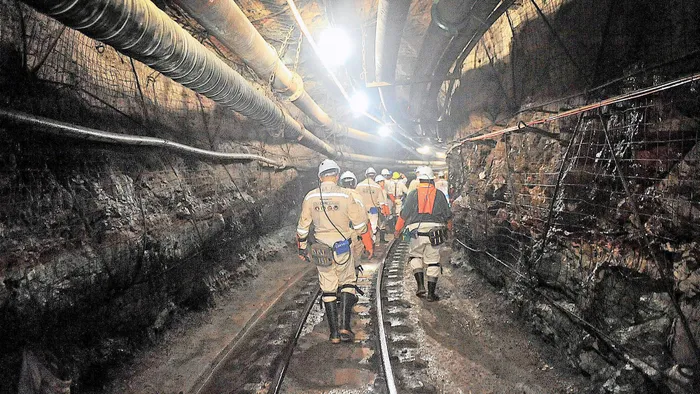
Workers dying from rock falls due to seismic activity is a big concern in the mining industry even though technology has already substantially reduced the number of occurrences over the past decade.
Image: Itumeleng English/ Independent Newspapers
The high incidence of fall of ground fatalities and injuries in mining are of concern, even though the total number of mining fatalities declined slightly to 41 in 2025 and the number of serious injuries fell by 12%, Japie Fullard, chairman of the Zero Harm Forum of the Minerals Council of South Africa said Tuesday.
Speaking at a briefing at the Mining Indaba, he said that while they could only report figures, every death was one too many for the CEOs that made up the Zero Harm Forum.There was a responsibility among mining groups to share their health and safety experiences to reduce the number of mining fatalities, he said,
Regarding the 15 fall of ground fatalities in 2025, he said six of these were due to seismic activity, which was difficult for miners to predict or control. Nine were gravity related, which mining companies could control to some extent with interventions that can include netting or early examinations, and by working together with all stakeholders.
In 2024 for instance, there had been zero fatalities from seismic incidents. The number of seismic related incidents at mines has fallen dramatically over the past ten years due to the introduction of new technologies, such as guided drilling which reduces the chances of cracking the surrounding rock.
Fullard said the incidence of mining accidents leading to fatalities had been particularly high in the first six months of 2025, so the mines intensified their safety measures, and as a result there had only been one or two fatalities per month for the rest of 2025. This was positive because "if we can keep this at one or two per month, we can reduce the annual fatalities to around 20," he said.
He said they had put in additional safety interventions in December and at the start of mining work in January, two periods where there were usually the most accidents. He said the 12% decline in serious injuries, also from other factors such as transport and logistics related, or from moving objects, was another positive indicator, because if this declines, typically, so too does the number of fatalities.
Most mine employees are on medical aid but typically, contract workers are not.
Dr Thuthula Balfour, head of Health at the Minerals Council South Africa said they had made progress on a number of fronts in occupational health last year, with for instance, the incidence of tuberculosis reducing to about half the average level in South Africa, except for gold mines, where the average was only slightly above the South African average.
A major cause of concern in occupational health was noise induced hearing loss - mining is typically a noisy industry - and by the end of 2022, the industry did not meet national milestones.
This was even though the average number of noise-producing pieces of equipment at mines had declined from 3 017 in 2016 to 1 121 in 2022.
The industry also did not meet a national occupational health target for 95% of employees to receive HIV testing and counselling, and by the fourth quarter of 2025, only 76% had been tested for HIV, while 60% had been offered HIV counselling and testing.
Dr Balfour said a major issue with HIV testing rates in the mining industry and counselling was that office employees did not test every year.
By the fourth quarter, some 60% of employees had also been screened for mental health, and a major issue here was the incidence of fatigue. She said the industry did also not meet targets for respirable coal dust.
The data showed this to be 11.6% of respirable coal dust samples that were bigger than 25mg per cubic metre, as the national occupational health target for this was 5%. She said the actual number of diseases from coal dust was however relatively low, and there had been some problems relating to the measurement of coal dust, as the readings were volatile.
BUSINESS REPORT