

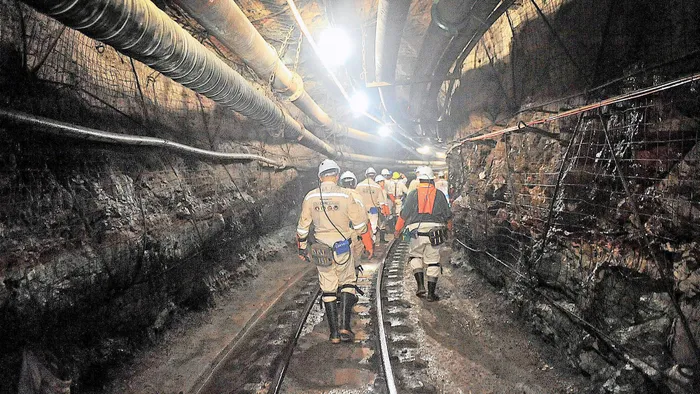
The BDO Annual Mining Report 2026 has found that sustainability has moved from a periphery, to the core of mining strategy. While ESG frameworks and reporting standards are expanding, their effectiveness is however inconsistent..
Image: Itumeleng English/ Independent Newspapers
Global mining is at an inflection point: demand for critical minerals, underpinned by the low-carbon transition, defence spend, transport electrification and data centres is accelerating in an environment where supply is rising, metals prices are volatile and government intervention is scaling up, said BDO Audit Partner and UK Head of Natural Resources and Energy, Matt Crane.
He was writing in BDO's Annual Mining Report 2024, which was released Wednesday. The report found that sustainability has moved from the periphery, to the core of mining strategy. While ESG frameworks and reporting standards are expanding, their effectiveness is however inconsistent.
"Many companies still grapple with fragmented disclosures and struggle to integrate sustainability into operational decision-making," the report found. Recycling and circularity was an opportunity. Recycled minerals could generate up to 80% fewer greenhouse gas emissions than primary production, yet recycling rates for materials like lithium and rare earths remained very low.
Scaling recycling infrastructure was becoming a critical lever for both decarbonisation and supply security.
"The industry is entering a period where long-term resilience matters more than short-term cycles," said Servaas Kranhold, Audit Partner and Head of Natural Resources at BDO South Africa.
"Mining companies are being asked to do more than simply produce commodities. They are now central to energy security, industrial policy, and economic development, particularly in emerging markets. The winners will be those who balance growth with sustainability, innovation, and meaningful stakeholder engagement," he said.
The 2024 report identified a shift in global demand toward critical minerals that underpin the low-carbon transition, electrification, and digital infrastructure. Copper, lithium, nickel, cobalt, and rare earth elements are essential to renewable energy systems, electric vehicles, defence technologies, and large-scale data centres.
Supply responses, however, were uneven. Rapid capacity expansion had created oversupply and price pressure in some markets, notably lithium and nickel, while regulatory intervention and export controls had tightened others, such as cobalt. The divergence had amplified volatility and made the securing of reliable supply chains more important.
The report said government intervention had become a defining feature of the sector. From strategic stockpiling and direct equity investments to export restrictions and local beneficiation policies, states are actively shaping mining markets.
In the US and Europe, securing access to critical minerals was by now firmly embedded in industrial and defence strategy.
"Resource-rich regions like Africa, meanwhile, are seeking to evolve from raw-material exporters to higher-value mining and processing hubs. Yet this ambition faces significant headwinds: infrastructure gaps, energy shortages, policy uncertainty, and declining exploration investment remain major constraints," the report found.
Meanwhile, gold had reasserted its role as a global safe-haven asset. Prices surged dramatically during 2023 amid geopolitical uncertainty and were expected to remain elevated into 2024.
Africa sat at the heart of the global mining narrative with significant reserves of cobalt, manganese, platinum group metals, and other energy-transition minerals. However exploration spending in Africa continued to trail global levels, while operational risks, including power supply disruptions, logistics bottlenecks, skills shortages, and political instability persist.
"Without targeted investment and policy alignment, the gap between mineral endowment and realised value risks widening further," the report found.
"Mining is becoming more complex, more visible, and more accountable. Companies that invest in future-proofing their operations, embrace partnerships, and take sustainability seriously will be best positioned to thrive in this new era." said Kranhold.
In 2025, critical mineral prices diverged driven by uneven supply responses, regulatory intervention and end-market demand resilience. Export controls, production curtailments and logistics normalisation tightened previously oversupplied markets such as cobalt. Meanwhile rapid capacity expansion and softer macroeconomic conditions sustained oversupply in lithium and nickel.
The demand for copper continued to grow and was a key driver behind a number of large merger and acquisition transactions through the year.
BUSINESS REPORT