

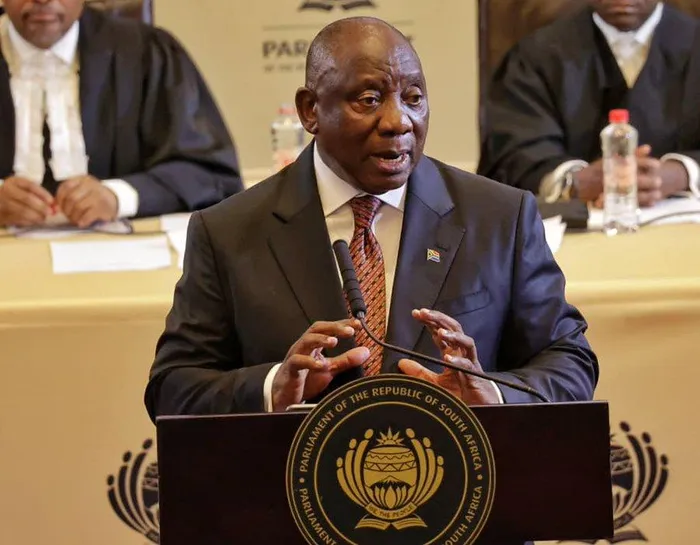
President Cyril Ramaphosa will deliver the 2026 State of the Nation Address at the Cape Town City Hall on Thursday at 7pm. Expectations over the SONA have once again converged on a familiar but decisive theme: confidence.
Image: GCIS
The rand strengthened more than 0.6% to R15.84 to the US dollar on Wednesday buoyed by elevated precious metals prices and a softer greenback, as President Cyril Ramaphosa prepares to deliver the State of the Nation Address (SONA) on Thursday.
At its highest since March 2022, the currency continued to be supported by positive domestic developments, including structural reforms, fiscal consolidation, credible monetary policy, and a stable governing coalition.
Expectations over the SONA have once again converged on a familiar but decisive theme: confidence. Across the economy, stakeholders are looking for tangible signals that South Africa’s fragile recovery can be sustained.
Early economic indicators in 2026 have pointed to what many describe as “green shoots.” Interest rates have begun easing, inflationary pressures have moderated, and load shedding has largely receded from daily economic discourse.
Yet beneath this improving surface lies a persistent anxiety about structural weaknesses that continue to weigh on growth.
Economists argue that the speech’s true significance lies less in headline announcements and more in whether it reinforces belief in policy continuity and institutional stability. The rule of law, governance capacity, and reform credibility are increasingly viewed as central to unlocking investment.
“Confidence is currency for investment,” noted Standard Bank chief economist, Goolam Ballim, emphasising that policy clarity and institutional effectiveness remain the bedrock of economic expansion.
“If SONA and the budget combined are able to imbue a sense of confidence that the broad reform agenda will continue, and it now focuses on State incapacity, generally, municipal infrastructure and the broad thesis of crime, then you're beginning to address institutional foundations of society, with respect to what one can call aggregate governance.”
Few sectors illustrate the intersection between governance and sentiment more clearly than property. The real estate industry, highly sensitive to interest rates and consumer psychology, is watching SONA for measures that could reinforce momentum seen at the start of the year.
Industry leaders have highlighted several priorities. Tax relief remains high on the agenda, with calls for adjustments to transfer duty thresholds to support first-time buyers.
Administrative efficiency is another concern, particularly bottlenecks within the Deeds Office and delays in zoning and planning approvals, factors that developers say suppress new construction and investment.
Municipal performance looms large in these discussions. Property values, especially in major metros, are closely tied to service delivery and infrastructure reliability.
“Property value is inextricably linked to service delivery as reflected in major property markets such as Johannesburg, Tshwane, and elsewhere, which continue to lag the Cape due to infrastructure deterioration and lack of service delivery,” said Samuel Seeff, chairman of the Seeff Property Group.
“This impacts investment and growth. The value growth is just not there to entice more buyers and investors, especially at the top end of the market which generates significant property taxes.”
Meanwhile, advocacy organisations such as Free SA are urging the President to move beyond broad aspirations. Their demands centre on measurable reforms such as reducing regulatory burdens on small businesses, revisiting labour market rigidities, accelerating infrastructure liberalisation, and lowering the tax burden to stimulate expansion.
Gideon Joubert, spokesperson for Free SA, stated that Ramaphosa is serious about “inclusive growth,” he must make it easier to start, run, and grow a business in South Africa.
Joubert said investors, both domestic and foreign, require a stable, predictable environment. Policy made through rushed processes or political expediency erodes confidence and deters capital.
“South Africa does not need another speech filled with aspirations and slogans. It needs a credible, costed, and time-bound reform agenda. If the President is serious about turning the economy around, he must reduce the size of government, empower the private sector, and restore policy certainty. Anything less will simply prolong stagnation.”
BUSINESS REPORT