

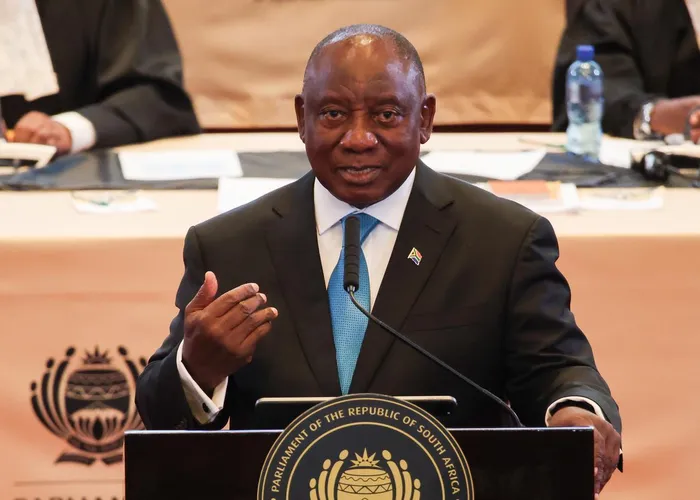
President Cyril Ramaphosa, speaking during his State of the Nation Address (SONA) on Thursday, said government will proceed with finalising the draft Business Licensing Bill, which was published for public comment in September 2025.
Image: GCIS
President Cyril Ramaphosa has reaffirmed government’s intention to push ahead with the controversial Business Licensing Bill, despite mounting opposition from business groups, civil society organisations, and small business owners who warn it could stifle entrepreneurship and deepen red tape.
Speaking during his State of the Nation Address (SONA) on Thursday, Ramaphosa said government will proceed with finalising the draft Business Licensing Bill, which was published for public comment in September 2025.
The proposed law seeks to establish a uniform legislative framework for business licensing across all spheres of government. It aims to reduce administrative burdens, promote economic inclusion and enhance regulatory efficiency by replacing the outdated Business Act of 1991 with a modernised system.
Under the Bill, all businesses would be required to register with and obtain licences from their local municipalities. Licences would be valid for five years, with municipalities given 30 days to approve or reject applications, extendable by a further 14 days in certain circumstances.
The Department of Small Business Development has conducted in-person provincial consultation workshops to further engage stakeholders and ensure broad-based input into the Bill.
Ramaphosa acknowledged concerns raised during the public consultation process, particularly from small and medium enterprises (SMEs), which he said currently face a maze of regulations, by-laws and licensing requirements.
“We take seriously the public comments on the draft Business Licensing Bill, and will ensure that the final Bill makes it easier, not harder, to start and run a small business in South Africa,” he said.
Ramaphosa also announced that government will provide more than R2.5 billion in funding to over 180,000 SMEs this year and extend a further R1bn in guarantees, with a focus on women- and youth-led enterprises.
Business Unity South Africa (BUSA) welcomed Ramaphosa's assurance that stakeholder inputs would be considered, stressing that the real test of reform lies in whether it reduces red tape and improves compliance certainty.
“The overall positive note in the speech was encouraging. It recognised the positive role business plays in our economy, and we stand ready to support the ambitious plan announced by the President,” said BUSA CEO Khulekani Mathe.
“A positive narrative, backed by clear plans, boosts confidence, which in turn attracts investment that drives growth. This speech has, in large measure, achieved a positive narrative. The next test is implementation.”
However, opposition to the Bill remains fierce and it has been rejected with a national petition even by the Democratic Alliance, one of the partners of the National Government of Unity.
Civil rights organisation Free SA has formally submitted its opposition to the Department of Small Business Development, calling for the legislation to be withdrawn in its current form.
Its submission, signed by more than 280 members of the public, argues that the Bill risks entrenching bureaucracy, centralising unconstitutional power and harming small and informal businesses already under strain.
Free SA has called on the Minister of Small Business Development to withdraw the Bill entirely and restart the legislative process with a narrower, risk-based approach that preserves municipal discretion and minimises regulatory burdens.
“This Bill is not a plan for economic inclusion. It’s a blueprint for regulatory suffocation,” said Free SA spokesperson Reuben Coetzer.
“Instead of supporting small enterprises and informal traders, the very engines of job creation, the Bill adds red tape, creates uncertainty, and hands unelected officials sweeping discretionary powers.”
Among the organisation’s concerns are the duplication of existing compliance processes, the centralisation of authority that could undermine municipal autonomy, and enforcement provisions that allow inspectors to demand proof of licensing, confiscate goods and impose penalties, in some cases without judicial oversight.
Critics argue that such powers, in a country grappling with governance weaknesses and corruption, could create opportunities for abuse and selective enforcement.
Independent commentator and small business owner, Nicholas Woode-Smith, has also criticised the Bill, warning that it introduces new obstacles in an economy already struggling with high unemployment and weak growth.
Woode-Smith argues that requiring almost every business, including informal traders and online sellers, to obtain and renew licences every five years will disproportionately affect smaller enterprises that lack the resources to navigate complex compliance systems.
"Municipalities cannot reliably issue building permits, manage electricity grids or handle basic sanitation," Woode-Smith said. "There is nothing to suggest they will handle business licensing any better. Promising a thirty-day turnaround is meaningless when those same institutions cannot meet simple service deadlines."
Ann Bernstein, executive director of the Centre for Development and Enterprise (CDE), has also previously slammed the Bill, saying it was a licence for corruption, not a pathway to growth.
"It potentially expands government control over almost every type of business and creates wide-ranging powers for inspectors to search premises, seize goods and impose penalties. It is irrational, unconstitutional and damaging. It should be withdrawn,” said Bernstein.
"These provisions are draconian. They will discourage entrepreneurship and weaken livelihoods that are already under immense pressure."
With South Africa’s real unemployment rate hovering near 45%, opponents contend that the country should prioritise deregulation and economic freedom rather than expanded oversight.
BUSINESS REPORT