

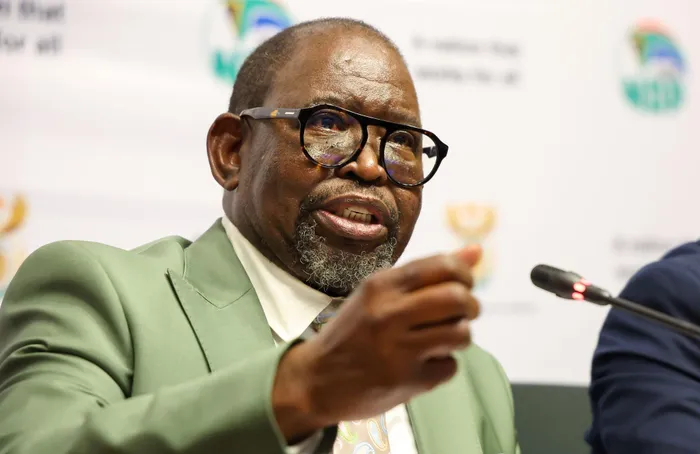
Finance Minister Enoch Godongwana will table the National Budget Review next week Wednesday in Parliament.
Image: Supplied/GCIS
Finance Minister Enoch Godongwana faces one of the most delicate balancing acts of his tenure when he tables the National Budget Review next week Wednesday, tasked with funding an ambitious slate of commitments announced by President Cyril Ramaphosa while safeguarding a fiscus that remains structurally constrained.
In his State of the Nation Address last week, Ramaphosa pledged a sweeping package of interventions aimed at improving service delivery and restoring confidence in a crucial year for local government.
These include deploying 10,000 additional labour inspectors to curb business non-compliance, allocating R2.5 billion to support small and medium-sized enterprises (SMEs), mobilising more than R1 trillion in infrastructure investment over three years, addressing collapsing municipal water systems, strengthening intelligence coordination to tackle organised crime, and deploying the military to assist police in gang-affected areas.
While the policy intent has been broadly welcomed, economists caution that ambition must be matched by credible fiscal execution.
Speaking at the North West University Business School Pitso 2026 on Monday, Sanisha Packirisamy, chief economist at Momentum Investments, noted that the fiscal backdrop has improved modestly in recent months, largely due to favourable commodity prices.
Packirisamy said these dynamics could produce better-than-expected revenue outcomes in the short term, but warned that this remains cyclical relief rather than structural repair.
"We are sitting with a still constrained fiscus. I would say that the fiscal dynamics have turned a bit more favourably in the last couple of months. South Africa has been gifted once again with the commodity price of windfall," she said.
"But it's really not enough for this very long list of competing priorities on the social front for South Africa. The key really is to start including the private sector. Through reform measures such as Operation Vulindlela, which really focuses on the network industries by liberalising some of these sectors, that's really how we are going to anchor a higher growth rate in order to meet some of those socio-economic demands."
Without sustained growth above current levels, Packirisamy said Treasury risks being forced to extract more revenue from a narrow and already stretched tax base.
Analysts broadly expect this year’s Budget to prioritise stricter enforcement and smarter incentives rather than sweeping tax increases. The South African Revenue Service has intensified compliance measures, particularly around provisional tax and capital gains reporting, as government leans more heavily on administrative efficiency to stabilise revenue.
There is increasing consensus among economists that additional tax hikes could prove counterproductive. Instead, relief from bracket creep—where inflation pushes taxpayers into higher tax brackets—has emerged as a potential measure to support households without undermining fiscal discipline.
For the property market, the Budget’s impact will be largely indirect but nonetheless significant.
Dr Andrew Golding, CEO of the Pam Golding, said consumers have reason for cautious optimism as subdued inflation, sustained rand strength, lower fuel prices and the prospect of further modest interest rate relief have eased cost pressures across the economy.
Golding said recent milestones - including the adoption of a lower inflation target, a credit rating upgrade and removal from the Financial Action Task Force grey list - have strengthened South Africa’s risk profile and lowered borrowing costs.
"However, even with a modest revenue buffer, fiscal pressures persist. A rising public wage bill, financially vulnerable state-owned enterprises and growing social expenditure continue to constrain fiscal flexibility," he said.
"Economic growth remains insufficient to significantly expand the tax base, requiring Treasury to balance deficit consolidation with social and political considerations. There is increasing consensus among analysts that further tax increases could prove counterproductive, potentially dampening revenue rather than enhancing it."
Small and medium-sized enterprises sit at the centre of the growth narrative.
In the SONA, Ramaphosa argued that if every SME hired just one additional worker, South Africa could generate three million jobs. Government has committed R2.5bn in funding to support more than 180,000 SMEs, alongside R1bn in guarantees and proposed amendments to the National Credit Act to improve access to affordable credit.
Simone Cooper, head of business and commercial banking at Standard Bank South Africa, said the Budget will be the real test of these commitments.
"Small businesses cannot grow on good intentions alone," she said. "They need funded programmes, streamlined regulations and improved payment cycles to translate policy into economic impact."
Cooper said financial institutions must complement government efforts with accessible funding solutions and advisory support, particularly in regions where entrepreneurial resilience is already evident.
Ultimately, the 2026/27 Budget is expected to adopt a prudent, credibility-focused framework—one that reassures markets while avoiding politically destabilising measures.
BUSINESS REPORT