

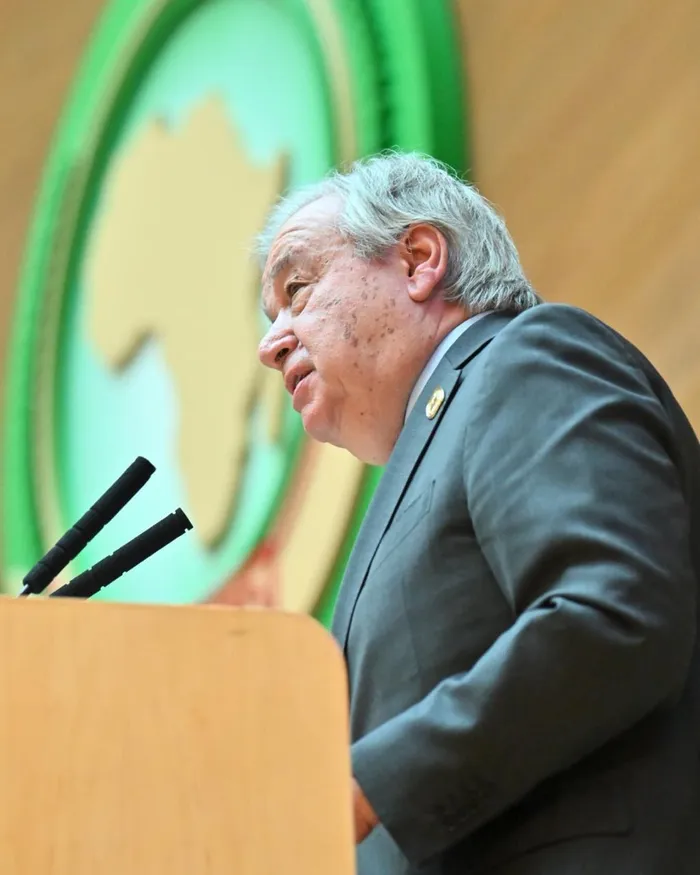
United Nations Secretary-General António Guterres speaking at the opening of the 39th African Union Summit over the weekend.
Image: António Guterres/X
United Nations Secretary-General António Guterres delivered a forceful call for sweeping economic reforms and urgent climate justice at the opening of the 39th African Union Summit over the weekend, warning that the global financial system remains “totally unjust” to developing nations and particularly to Africa.
Addressing heads of state and government, Guterres said developing countries are facing a staggering $4 trillion annual financing gap to meet the Sustainable Development Goals (SDGs).
At the same time, he noted, African countries are losing more money to debt servicing and illicit financial flows each year than they receive in foreign aid.
“It is simply unconscionable that Africa must contend with an economic and financial system that remains totally unjust,” Guterres said at a press briefing following his address.
Central to his economic message was a demand to triple the lending capacity of multilateral development banks (MDBs) to unlock affordable capital for developing economies.
Guterres urged the international community to reduce borrowing costs, leverage more private finance, and provide stronger support to countries facing debt distress.
He pointed out that African nations pay up to eight times more in borrowing costs than wealthier countries, severely constraining their ability to invest in infrastructure, health, education and climate resilience.
“We must triple the lending power of multilateral development banks, leverage more private finance, reduce borrowing costs and risks, and support countries facing debt distress,” he said.
Guterres also called for fundamental reform of the global financial architecture to ensure developing countries — particularly African states — have “a real voice and meaningful participation” in international financial institutions and economic decision-making.
The UN chief stressed that the fight against money laundering, tax evasion and illicit financial flows must become a global priority.
“The international community must assume its full responsibilities,” he said, underscoring that Africa’s resources should no longer be siphoned off through opaque financial systems.
Guterres emphasized that African nations must benefit directly from their vast natural wealth, including critical minerals essential to the global energy transition.
“No more exploitation. No more plundering,” he declared. “The people of Africa must benefit from the resources of Africa.”
He urged the creation of fair and sustainable value chains that allow African countries to move beyond raw material exports and into local processing and manufacturing, in line with recommendations from the UN Panel on Critical Energy Transition Minerals.
With Africa holding 60% of the world’s best solar potential, Guterres said the continent can become a global clean energy powerhouse. Yet it currently receives only 2% of global clean energy investment, a stark imbalance he described as unacceptable.
Turning to climate action, Guterres warned that the planet is on track to overshoot the 1.5°C warming limit enshrined in the Paris Agreement. While the overshoot may now be inevitable, he said, the global task is to ensure it is “as small, short and safe as possible.”
The Group of Twenty (G20), responsible for nearly 80% of global emissions, must deliver deep cuts this decade, he insisted.
“After contributing almost nothing to the crisis,” Guterres said. “Yet it faces faster-than-average warming, droughts, floods and deadly heat. This is climate injustice, plain and simple.”
He called on developed countries to triple adaptation finance, mobilize $1.3 trillion annually for developing countries by 2035, and scale up the Loss and Damage Fund to help vulnerable nations cope with irreversible climate impacts.
Expanding early warning systems and accelerating a just and equitable transition from fossil fuels to renewables were also highlighted as urgent priorities.
Beyond economics and climate, Guterres reiterated his long-standing support for reform of global governance institutions. The absence of permanent African representation on the UN Security Council, he said, is “indefensible.”
“This is 2026 — not 1946,” he said. “Whenever decisions about Africa and the world are on the table, Africa must be at the table.”
He praised the partnership between the United Nations and the African Union over the past decade, citing joint work on peace and security, sustainable development and human rights, as well as the adoption of Security Council Resolution 2719 to support AU-led peace operations.
BUSINESS REPORT