

StatsSA chief director of price statistics, Patrick Kelly, said fuel prices were the main drag on overall price growth while food and non-alcoholic beverages inflation remained steady at 4.4% for a third consecutive month, masking significant divergences within categories.
Image: Bloomberg
South Africa’s annual consumer price inflation slowed in January, returning to its November 2025 level as lower fuel costs and steady food inflation helped contain price pressures.
Data from Statistics South Africa (StatsSA) on Wednesday showed that the headline inflation rate edged down to 3.5% in January from 3.6% in December 2025, though slightly above expectations of 3.4%.
StatsSA chief director of price statistics, Patrick Kelly, said fuel prices were the main drag on overall price growth while food and non-alcoholic beverages inflation remained steady at 4.4% for a third consecutive month, masking significant divergences within categories.
"The index for fuel decreased by 3.7% in the 12 months to January. The monthly change for petrol was negative 3.1% and diesel negative 5.4%," Kelly said.
"The price of inland 95 octane petrol was R20.75 a litre in January, the lowest in almost four years, that is since February 2022 when we paid R20.14."
Meanwhile, StatsSA data showed that cereal products saw notable easing. The annual rate for the category slowed to 0.6% in January from 2.1% in December.
White rice continued its prolonged deflationary trend, recording an 11% annual decline, its eleventh consecutive month of price decreases. Maize meal inflation cooled sharply from 9.5% in December to 2.6% in January.
Inflation for oils and fats softened to 4% from 4.6%, with olive oil 7.9% cheaper than a year ago and butter down 0.7%.
Dairy and eggs also remained in deflationary territory. The milk, other dairy products and eggs category recorded an annual rate of -0.5%, compared with -1.1% in December. Fresh full-cream milk declined by 1.4%, low-fat milk by 1.6% and eggs by 7.6% year-on-year.
Egg prices in particular have eased meaningfully. A tray of six eggs cost R22.90 in January, down from R24.51 a year earlier and well below the peak of R25.85 recorded in December 2023.
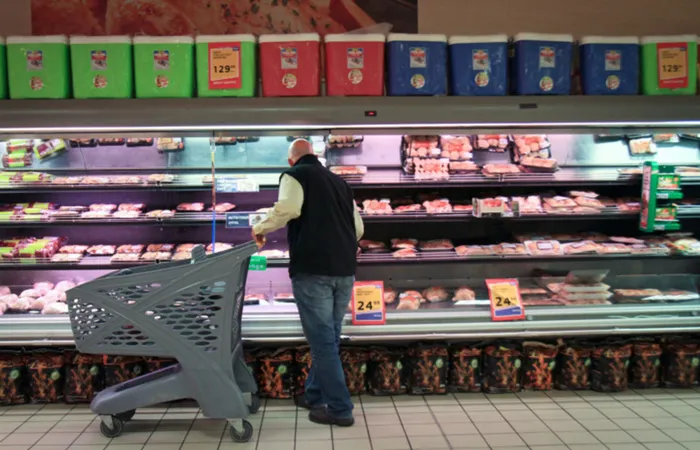
However, rising meat prices continue to strain household budgets and offset gains elsewhere in the food basket.
The annual rate for meat accelerated to 13.5% in January from 12.6% in December, the highest level since December 2017, when it reached 13.9%.
"Three beef products recorded the highest annual rates of all 391 products in the CPI basket. These were beef steak rising by 31.2%, stewing beef up to 30.3% and beef mince at 28%," Kelly said.
Even typically cheaper cuts were not spared. Beef offal inflation accelerated to 17.2% from 10.5% in December, while pork prices jumped sharply to 19.5% from 11.5%. Pork also experienced a significant rise, climbing to 19.5% from 11.5%.
On a monthly basis, the CPI rose by 0.2%, maintaining the same pace as December 2025.
Beyond food and fuel, January’s inflation dynamics reflected seasonal adjustments and administrative price changes.
Kelly said several banks increased annual fees at the start of the year, pushing the Financial Services Index up by an average of 4.1% month-on-month. This contributed to an annual rate of 4.9% in the category.
The beginning of the school year also brought higher costs for parents. School uniform items included in the CPI basket since January 2025 recorded price increases above the broader clothing and footwear category, which rose by 1.2% annually.
School jerseys increased by 7%, while school skirts and dresses rose 3.2% and school shoes 4.1% compared with January last year.
Stationery, however, offered some relief. Pens were 9.8% cheaper month-on-month in January, writing books declined 5%, and printing paper dropped 3.5% compared with December 2025. Textbook prices fell 1.3% on a monthly basis, taking the annual rate to -3.3%.
Overall, January’s data suggest that while headline inflation remains well-contained, underlying pressures persist in key food categories, particularly meat.
BUSINESS REPORT