

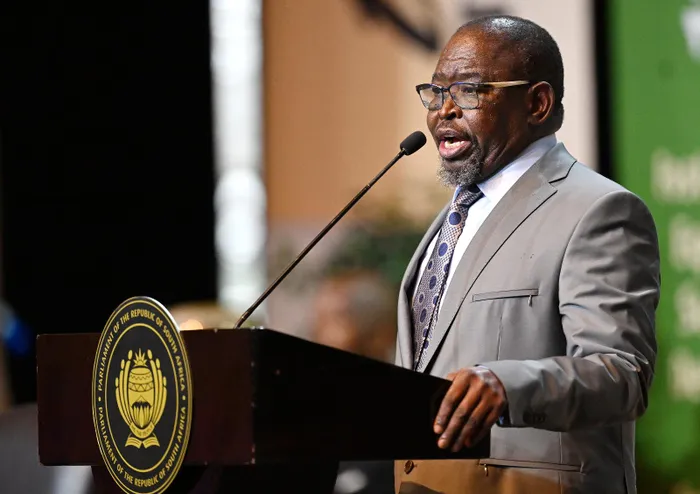
Tatonga Rusike, Sub-Saharan Africa analyst at Bank of America (BofA), expects the finance minister Enoch Godongwana to avoid significant tax hikes when the Budget is tabled next week, arguing that improved revenue collection and tighter spending controls have reduced the urgency for aggressive tax measures.
Image: Phando Jikelo/ Parliament of SA
South Africa’s 2026 Budget is expected to reinforce signs of fiscal stabilisation, with analysts forecasting continued deficit reduction, easing funding pressures, and no major tax increases.
According to Tatonga Rusike, Sub-Saharan Africa analyst at Bank of America (BofA), the upcoming budget could represent a meaningful turning point for the country’s public finances after years of persistent strain.
Rusike expects the finance minister Enoch Godongwana to avoid significant tax hikes when the Budget is tabled next week, arguing that improved revenue collection and tighter spending controls have reduced the urgency for aggressive tax measures.
“The main budget deficit is likely to improve to around -3.8% of GDP from roughly -4.1% in FY25,” Rusike said, citing favourable tax outcomes and expenditure discipline.
The National Treasury estimates the main budget deficit at approximately -4.1% of GDP, an improvement on the government’s baseline of -4.5%.
The anticipated deficit improvement comes despite ongoing fiscal risks that policymakers will need to navigate carefully.
Key pressure points include higher allocations for water infrastructure, the long-term implications of making the Social Relief of Distress (SRD) grant permanent, and the ever-present challenge of State-Owned Enterprise (SOE) support.
A central theme in the budget outlook is declining gross financing needs.
Rusike projects that funding requirements could fall by more than R100 billion, largely driven by the conclusion of extraordinary debt-relief measures for Eskom, larger drawdowns from the Gold and Foreign Exchange Contingency Reserve Account (GFECRA), and the overall narrowing of the deficit.
This shift could have tangible effects on the domestic bond market.
Rusike said reduced borrowing needs may allow the National Treasury to scale back issuance of fixed-rate government bonds.
Current weekly auctions of around R1bn per sale could potentially be trimmed to between R750 million and R900m, depending on whether the government prioritises building cash buffers ahead of heavy redemptions in the outer years.
Treasury faces elevated refinancing risks as maturities rise sharply from 2027 onward. As a result, it may opt for a balanced strategy that moderates issuance cuts while prefunding future obligations.
Revenue performance has been particularly supportive as tax collections have grown at their fastest pace since 2021, with company income tax and value-added tax meeting expectations. However, personal income tax remains a relative weak spot and could undershoot targets by as much as R10bn.
On the spending side, expenditure restraint has played a crucial role.
Overall government spending has undershot MTBPS targets by roughly R40bn, aided partly by lower-than-expected debt-service costs. Nominal expenditure growth has remained contained at about 6% yea-on-year, helping limit fiscal slippage.
Rusike argued that these trends support the view that South Africa is approaching a fiscal turning point.
"With no new Eskom support anticipated and the headline deficit moving below 4% of GDP, the primary surplus, a key measure of fiscal sustainability, is likely to reach 1.8% of GDP and stabilise debt," Rusike said.
"Progress on moving to a numerical fiscal rule could help anchor a turnaround. Consultations with key stakeholders are ongoing, with likely implementation in 2027."
Despite the improving outlook, Rusike said uncertainty persists around the timing of remaining Eskom debt-relief transfers.
An outstanding R80bn allocation, classified as a financing item rather than expenditure, has yet to be fully disbursed.
Rusike said that given Eskom’s near-term debt maturities, it is possible that only half the amount could be transferred before the fiscal year-end, with the balance rolled into the next year.
"It's also possible that only R40bn could be transferred by the end of March, while the other R40bn could be pushed into the next fiscal year," he said.
Beyond Eskom, attention remains focused on broader spending commitments outlined by President Cyril Ramaphosa during the recent State of the Nation Address.
The speech placed heavy emphasis on infrastructure investment, municipal reform, crime prevention, and the indefinite extension of the SRD grant.
Water infrastructure emerged as a particularly urgent priority. Government plans include large-scale investments in dams, reticulation systems, and maintenance programmes aimed at addressing chronic municipal failures.
While such spending is seen as growth-supportive and socially necessary, it also heightens pressure on an already constrained budget framework.
The indefinite extension of the SRD grant adds another layer of complexity. Costing an estimated R40bn annually, the programme represents a significant fiscal commitment.
Treasury is expected to rely on expenditure reprioritisation rather than new taxes to accommodate the grant, especially following political resistance to prior VAT-related proposals.
SOE finances remain a structural concern. Although no new large allocations are expected for Eskom or Transnet, financial vulnerabilities have not disappeared.
Eskom continues to grapple with rising municipal debt, while Transnet faces operational and balance-sheet challenges despite existing guarantees.
Rusike believes a credible fiscal rule could strengthen investor confidence, reduce sovereign risk premiums, and contribute to lower bond yields, particularly following South Africa’s recent shift toward a lower inflation target.
BUSINESS REPORT