

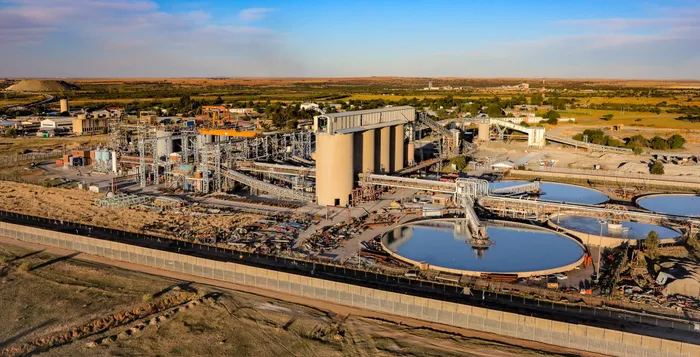
Beatrix, owned by Sibanye-Stillwater, is a large, mature, shallow to intermediate level gold mining and processing operation located in the Free State goldfields of the Witwatersrand Basin.
Image: Supplied
Sibanye-Stillwater sold 14% less gold in 2025, but much higher rand gold prices more than offset this, underpinning a 281% increase in group headline earnings per share while dividends were resumed for the first time since 2023.
The share price nudged up 0.4% to R62.17 on Friday morning. This only extended a rally in line with precious metals prices that saw Sibanye’s share price rise from R15.90 a year ago. A full-year dividend of R3.7bn, or R1.31 per share, was declared, representing 35% of normalised earnings.
HEPS for the international mining and metals processing group came to 244 SA cents for the year to December 31. Adjusted earnings before interest, tax, depreciation, and amortisation (EBITDA) increased 189% to R37.8 billion. There were six fatalities at group operations in the year.
CE Richard Stewart said in a statement that eliminating fatal incidents is their utmost priority and a drive on their Fatal Elimination Program in 2026 would focus on safety behaviours through compliance, management routines, and implementing safe behaviour.
He said all group operations other than the SA gold operations met or exceeded market guidance and costs were well managed. Improved operational delivery, combined with the higher commodity prices, underpinned materially improved financial performance.
“We expect continued improvement in earnings and balance-sheet resilience, providing a solid foundation as the group enters 2026,” he said.
During the second half, the leadership transition was “successfully navigated.” This included a refreshed strategy to look beyond short-term turbulence and emphasise long-term value creation, driven by demand for metals critical to global economic and energy transitions.
The industry trades against a volatile global backdrop of geopolitical tension, shifting supply chains, and accompanying record swings in commodity prices. Global competition for critical minerals has intensified, driving many commodity prices sharply higher during 2025.
Gold reached an all-time high spot price of $5,595/oz in late January 2026, while platinum, palladium, and rhodium all recorded substantial gains. Lithium prices rebounded sharply in the fourth quarter, driven by regulatory restrictions on higher-cost local supply, restocking in China, and persistent supply-side tightness.
Some overhanging matters in the group were resolved in the fourth quarter that would set a more stable operating platform for 2026. These included settling South African gold wage agreements, some key decisions including shortening Kloof life of mine, beginning the startup of the Keliber lithium project, and a focus on internal growth projects.
The SA PGM and gold operations saw substantial earnings uplift while the US PGM operations returned to profitability.
The SA PGM operations produced 1 797 928 4E ounces, in line with guidance. This was despite a decline in surface production of 29%, largely due to heavy rainfall and a transition between tailings storage facilities.
All-in sustaining costs (AISC) rose 10% to R24 193/4Eoz, mainly due to higher royalty payments linked to rising PGM prices and increased sustaining capital. The increasing PGM prices drove a 125% increase in adjusted EBITDA to R16.7bn.
The SA gold operations faced operational challenges, most notably at Kloof, where seismicity and infrastructure constraints resulted in the cessation of certain mining areas for safety reasons.
Revised mine planning and the exclusion of high-grade isolated high-risk mining areas reflected the group’s commitment to safe, sustainable mining practices, said Stewart.
Gold production from the SA gold operations fell 10% to 19 668 kg. Adjusted EBITDA increased 114% to R12.5bn.
The US PGM operations exceeded guidance for 2025, delivering 284 069 2Eoz, and AISC of $1 203/2Eoz, meaningfully below plan.
The Recycling business, strengthened by the Metallix acquisition, contributed a significant adjusted EBITDA of R4.1bn.
The Keliber lithium project advanced substantially and the group's first greenfield project was nearing completion. The first mining blast was taken in February 2026. A staged startup had been adopted to mitigate risks.
The Century zinc operation in Australia delivered a strong recovery, with production rising 22% to 101 kt and AISC improving by 17%. Adjusted EBITDA rose to $1.6bn due to improved production stability, zinc price support, and reduced treatment charges.
“Sibanye-Stillwater enters 2026 with positive momentum, supported by strong commodity-price leverage, improved operational stability, a stable balance sheet, and advancing high-quality organic growth opportunities.”
Visit:www.businessreport.co.za