

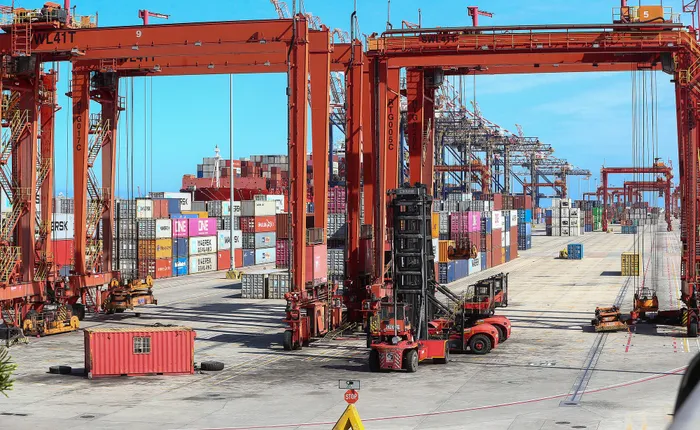
The Afreximbank noted that much of the government’s medium-term optimism rests on reform initiatives, particularly Operation Vulindlela, which aims to remove long-standing infrastructure and regulatory bottlenecks.
Image: Leon Lestrade/Independent Newspapers
The African Export-Import Bank (Afreximbank) has warned that South Africa’s economic growth is unlikely to exceed the 2% threshold for much of the next decade due to a prolonged period of modest expansion.
This is despite South Africa’s economy being poised for a modest but meaningful recovery in 2026 as reform momentum, easing inflation and renewed infrastructure investment begin to lift growth prospects in an increasingly complex global environment.
In its latest Country Focus report for South Africa released on Friday, the Afreximbank - through its Trade intelligence Solutions - said South Africa’s economy was expected to average growth of just 1.9% per annum between 2026 and 2035.
This growth forecast is in line with the National Treasury and the International Monetary Fund’s of a 1.4% expansion in 2026, gradually rising to 1.8% in the medium term as structural reforms begin to bear fruit.
“Longer-term growth will be supported by efforts to diversify trade and investment links and reduce exposure to external shocks. Real GDP will average 1.9% per annum between 2026 and 2035,” said the bank.
“Near-term growth will also be supported by stronger business activity as reform progress encourages higher investment, particularly in infrastructure.”
The implications of a decade of sub-2% growth are not purely statistical.
While not a recessionary outlook, the Afreximbank forecast paints a picture of an economy struggling to achieve the kind of momentum required to significantly dent unemployment, accelerate industrialisation, or materially improve living standards.
Slower expansion constrains revenue collection, complicates fiscal consolidation efforts, and limits the state’s ability to scale social and infrastructure spending without increasing debt.
It also shapes household expectations, influencing consumption patterns, savings behaviour, and credit demand.
Economists note that a significant portion of overall growth continues to reflect pressures rather than a sharp increase in real output, and that growth below 2% for an extended period carries structural implications.
At such levels, the economy typically expands too slowly to absorb new entrants into the labour market. In South Africa’s case, where unemployment hovers around exceptionally high levels at 31.4%, this raises concerns about persistent social and fiscal pressures.
Nedbank economist Johannes (Matimba) Khosa said they were forecasting GDP growth to improve only modestly, from 1.4% in 2025 to 1.5% in 2026 and 1.7% in 2027.
Khosa said these growth rates remain well below the 2%–plus needed to reduce unemployment materially.
“Accelerating economic growth and ultimately boosting job creation will require the government to create a more conducive economic environment by accelerating the pace of structural reforms, strengthening economic infrastructure, and improving service delivery,” Khosa said.
“Convincing progress on this front, particularly reducing operating costs and policy uncertainty, would help attract higher levels of private-sector investment and unleash more durable employment gains.”
The Afreximbank noted that much of the government’s medium-term optimism rests on reform initiatives, particularly Operation Vulindlela, which aims to remove long-standing infrastructure and regulatory bottlenecks.
The programme has been credited with enabling greater private sector participation in key network industries and helping reduce the intensity of load shedding. However, translating these reforms into sustained high growth is proving more difficult.
Nolan Wapenaar, head of fixed income and co-chief investment officer at Anchor, said GDP growth remains subdued as South Africa’s economy grew 0.5% in the third quarter of 2025, slower than the previous quarter’s revised 0.9% quarter-on-quarter growth.
Wapenaar said while multiple sectors have shown improvement, overall economic expansion remains insufficient to reduce unemployment, inequality or household income pressures meaningfully.
“Without accelerated reform to unlock investment and rebuild confidence, the economy risks remaining trapped in a low-growth equilibrium, where even small gains feel elusive against the weight of structural constraints and everyday cost pressures,” he said.
“Overall, reining in new expenditure pressures, eliminating waste and inefficiencies, and prioritising growth-enhancing initiatives will be essential. In an increasingly uncertain global environment, consistent delivery and credible reform can lower SA’s risk premium, attract investment, and support a more durable growth trajectory over time.”
The Afreximbank also said that external conditions add another layer of complexity. It noted that global growth remains uneven, trade patterns are increasingly fragmented, and geopolitical tensions continue to reshape investment priorities.
For a small open economy like South Africa, these dynamics influence export demand, commodity prices, and capital availability.
The bank said engagement with major partners such as the European Union (EU) is expected to support investment and trade diversification while commitments in areas such as clean energy and infrastructure provide pockets of opportunity.
“The Department of Trade, Industry and Competition’s Butterfly Strategy places export diversification at the centre of this approach, prioritising stronger engagement with Africa, Europe and Asia as global trade conditions become more fragmented,” it said.
“Engagement with the EU will remain important, highlighted by the EU’s €11.5 billion investment pledge, announced in October 2025, for clean energy, infrastructure and pharmaceutical projects.”
BUSINESS REPORT