

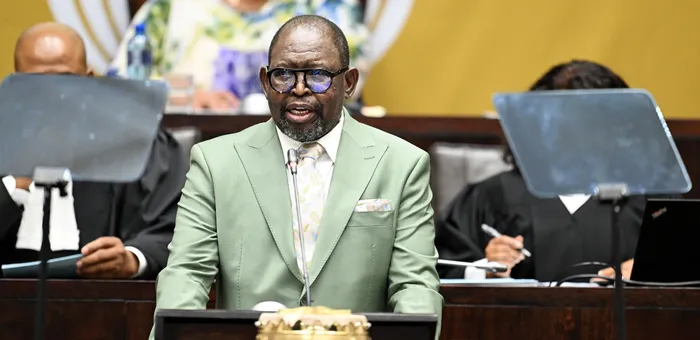
Finance Minister Enoch Godongwana will deliver the 2026 Budget Speech on Wednesday.
Image: Parliament RSA / Supplied
As South Africans brace for Finance Minister Enoch Godongwana’s 2026 Budget Speech on Wednesday, the loudest tax debate may not be about rate hikes or a VAT shock but about something far quieter and far more pervasive: bracket creep.
On the surface, this year’s Budget is expected to strike a reassuring tone.
Economists at Nedbank on Monday said gross tax collections are running well ahead of projections, buoyed by improved economic activity and a powerful rally in commodity prices.
Mining profits have surged as a result of high commodity prices, particularly gold, pushing up corporate income taxes while household consumption has supported personal income tax and VAT receipts.
Most analysts agree a full VAT hike is unlikely. Instead, smaller indirect adjustments in fuel levies or excise duties may be used to supplement revenue quietly.
In fact, Nedbank forecasts gross tax revenue will rise by 9.1% in the 2026 fiscal year, exceeding the November estimate by R18.8 billion and by R38.5bn compared with Budget 2025.
That gives National Treasury room, at least in theory, to offer modest relief to individuals by adjusting tax brackets upward by 3% or more.
Whether that relief materialises and whether it is sufficient, is the central question for millions of salary earners. However, bracket creep remains the most efficient and politically palatable mechanism available to the fiscus.
Bracket creep, also known as fiscal drag, occurs when tax brackets are not adjusted fully in line with inflation. When workers receive inflation-linked salary increases, they can be pushed into higher tax brackets even though their purchasing power has not improved.
The result is a higher effective tax burden without any formal change to tax rates.
For the past two fiscal years, personal income tax brackets were not adjusted to keep pace with inflation. This has quietly raised revenue for the fiscus while shrinking disposable income for households.
Lance Collop, a tax specialist and founder of Collop Tax Collective, describes it as the “Stealth Tax.”
Collop said fiscal drag allows the government to collect billions more in revenue without the political backlash of officially announcing a tax hike as it is silent, invisible, and incredibly effective.
"The government’s most effective tool for raising revenue isn't a new tax law; it’s inflation. If you receive an inflation-linked salary increase this year - say 5% - but the tax brackets aren't adjusted to match it, you effectively get pushed into a higher tax bracket. You earn more on paper, but you take home less in real terms," he said.
"The government is tightening the net not by changing the rules, but by aggressively enforcing the ones that already exist and letting inflation erode your benefits. The gap between what you earn and what you keep is widening - not with a bang, but with a whisper."
Medical aid tax credits, for example, have barely moved in recent budgets. Meanwhile, medical inflation continues to run well above headline CPI.
The irony is that Treasury currently enjoys a stronger revenue backdrop than in recent years. A gold price rally above $4,900 per ounce has boosted mining royalties, corporate income tax and reserve valuations.
Kristof Kruger, senior fixed income trader at Prescient Securities, said the commodity windfall gives government a buffer it did not have a year ago.
Kruger said the markets are watching closely to see how that buffer is deployed. From a taxpayer perspective, however, Kruger said the question was whether Treasury will return some of that windfall through meaningful bracket adjustments, or whether fiscal will drag remain a primary revenue lever.
"Bracket creep is already putting pressure on households. If tax brackets aren’t adjusted for inflation, people end up paying more tax in real terms, even though their purchasing power hasn’t improved," Kruger said.
In a year when Treasury is expected to emphasise fiscal discipline, stabilising debt ratios and widening the primary surplus, the temptation to rely on this silent revenue stream will be strong.
Samuel Seeff of Seeff Property Group argues that unlocking growth requires freeing up disposable income to stimulate spending and investment.
"To free up disposable income, there should be no increases in personal or corporate taxes, and no adjustment of tax brackets which would further burden the "inverted pyramid" of the tax base," Seeff said.
BUSINESS REPORT