

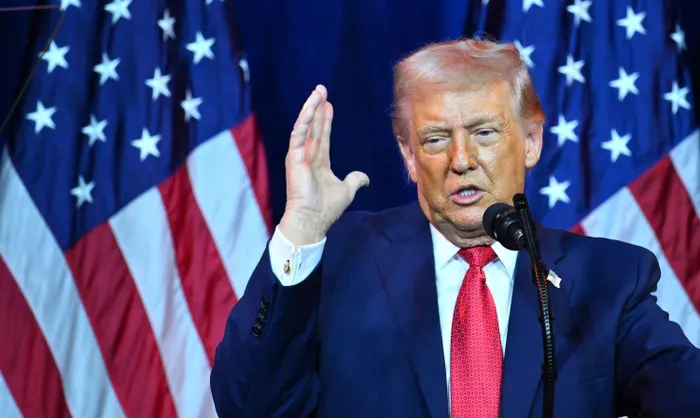
US President Donald Trump The White House argues the measure is necessary to address what it calls “fundamental international payments problems”, citing a $1.2 trillion goods trade deficit in 2024 and 2025, a current account deficit of 4% of GDP, and a sharply deteriorating net international investment position.
Image: Mandel Ngan / AFP
US President Donald Trump’s decision to impose a temporary 10% import surcharge on most goods entering the United States has injected fresh uncertainty into global trade, currency markets and South Africa’s export outlook.
The proclamation, issued on Friday under Section 122 of the Trade Act of 1974, introduces a 10% ad valorem duty for 150 days from 24 February.
The White House argues the measure is necessary to address what it calls “fundamental international payments problems”, citing a $1.2 trillion goods trade deficit in 2024 and 2025, a current account deficit of 4% of GDP, and a sharply deteriorating net international investment position.
The move follows a dramatic legal twist after the US Supreme Court ruled that Trump’s earlier reciprocal tariffs were illegal, reaffirming that changes to US import duties must comply with the rule of law.
While the court did not determine whether previously collected duties must be repaid, it remains unclear if the judgment effectively invalidated a recently imposed 30% tariff on South Africa.
North West University Business School economist, Prof Raymond Parsons, described the ruling as "a welcome respite for many countries, including South Africa, who have had to grapple with an aggressive US tariff policy."
However, he cautioned that the relief may be short-lived as he noted that certain sector-specific tariffs, including those on steel and automotives under Section 232 of the Trade Expansion Act of 1962, remain unaffected by the court’s decision.
"The immediate economic impact of the court’s verdict is therefore inevitably a recipe for more confusion and uncertainty, including for SA business, about future US trade policy," Parsons said.
"The net effect of the latest changes in US tariff levels needs to be urgently clarified by countries like South Africa, which do important business with the US."
Parsons said Trump is still determined to rebuild US tariff walls, and the threat of new tariffs remains real.
"The future of the African Growth and Opportunity Act (Agoa) and South Africa’s continued participation in it are also on a completely separate policy track. Tough negotiations with the US still lie ahead for South Africa."
August last year saw unilateral tariffs imposed after a number of delays, under the International Emergency Economic Powers Act (IEEPA), negatively affecting uncertainty and financial market sentiment on global growth.
Though the US Supreme Court on Friday invalidated the use of the IEEPA for tariffs, the US immediately announced section 122 tariffs instead, resulting in a new global tariff of 10% rising to 15%, while individual product tariffs remained.
Investec chief economist Annabel Bishop said the inflationary impact in the US will depend on whether the tariffs expire after 150 days.
If they lapse, she estimates the rise in US inflation would be between 0.5% and 0.6%, costing the average household between $600 and $800. If made permanent, inflation could rise by up to 1%, with household losses reaching $1,300 and unemployment lifting by 0.3% by the end of 2026.
Bishop said the US Federal Reserve is expected to look through the temporary price rise and not hike interest rates, but warned that entrenched higher inflation could still weigh on growth and employment.
"The uncertainty around the impact of the new tariffs in the US is high, but for SA will still have little impact on GDP even if the US maintains its 30% tariff on national security and other SA specific grounds, and also with a fall away in Agoa benefits," Bishop said.
"The rand has also seen some mild gains recently as the gold price has lifted on the escalation in geopolitical risks and US policy uncertainty, lifting the gold price, as the US masses forces close to Iran. The US still seeks to curtail Iran’s nuclear capability."
Neil Wilson, Saxo UK investor strategist, warned that Trump has other legislative tools available.
Wilson said Section 338 could allow tariffs of up to 50%, though it has not been tested recently, while Sections 301 and 232 provide avenues for further sectoral tariffs following investigations.
"Sections 301 and 232 can be used more prominently to impose sectoral tariffs relating to unfair trade practices and national security issues, respectively. The drawback to these is that they require lengthy investigations to be carried out first, which can take months," he said.
BUSINESS REPORT