

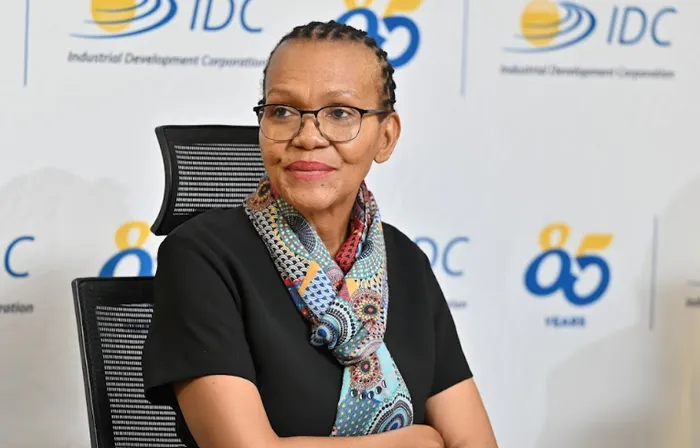
Mmakgoshi Lekhethe is the CEO of the Industrial Development Corporation. The tense session followed a presentation by the National African Federated Chamber of Commerce and Industry (Nafcoc), which alleged a troubling pattern in the IDC’s treatment of black-owned enterprises.
Image: Supplied
Parliament’s portfolio committee on trade and industry descended into a heated confrontation on Tuesday as MPs across party lines accused the Industrial Development Corporation (IDC) of failing black businesses and backed calls for a formal inquiry into the state financier’s conduct.
The tense session followed a presentation by the National African Federated Chamber of Commerce and Industry (Nafcoc), which alleged a troubling pattern in the IDC’s treatment of black-owned enterprises.
Nafcoc claimed that some businesses were aggressively pursued for funding, only to later face harsh enforcement measures when they encountered financial distress.
The Department of Trade, Industry and Competition (dtic) and the IDC had earlier reiterated their commitment to transparency, transformation and responsible governance. They acknowledged concerns about accessibility and client experience, particularly for black-owned firms.
But MPs were unconvinced.
ANC MP Lufefe Mkutu criticised what he described as a “technical” and legalistic response from the IDC, accusing it of failing to appreciate the strategic and historical imperative of transformation in post-apartheid South Africa.
Mkutu said he had witnessed first-hand how black-owned enterprises were treated. He alleged that black entrepreneurs were effectively confined to operating in townships and rural areas and were “ridiculed” and “stripped naked” compared to their white counterparts when they required business rescue support from the IDC.
“This reinforces the view that some of the policies of the governing party are meant for the elite few and don’t trickle down to people who are trying to build this economy,” he said.
"And we must take a very serious view about the behaviour of the IDC when it comes to black businesses. It's anti-black. We continue to be treated with disdain in this country, and it's very irritating. We must be firm in making this point, and we must take a very serious dim view with how the IDC has been treating black business in this country."
MK Party MP Siyabonga Gama described the meeting as “very sad”, saying Nafcoc had highlighted an alarming trend in the treatment of black business. He supported calls for a commission of inquiry, warning that the allegations painted a picture of companies being set up for failure.
“It would appear that there is an invisible hand aimed at demonising black business,” Gama said.
ANC MP Malusi Gigaba echoed the criticism, arguing that the IDC’s responses appeared to defend the status quo rather than confront whether it was fully aligned with its developmental mandate. He questioned whether earlier interventions could have resolved tensions between the IDC and Nafcoc and asked where stakeholder relations had broken down.
“We have already rejected the status quo-like response to transformation as insufficient and unwelcome,” Gigaba said.
While most MPs expressed outrage, ACDP MP Wayne Thring called for balance. He said that if the allegations were substantiated, consequence management must follow. However, he cautioned against automatically framing governance failures or irregular financial conduct as racially motivated if evidence pointed to mismanagement.
“Good governance is a neutral construct. It applies equally,” Thring said, while also advocating for an independent complaints and appeals mechanism and clarity on proposals for a moratorium on aggressive asset seizures.
DA MP Toby Chance requested data on the proportion of successful versus failed Nafcoc-member businesses funded by the IDC, noting that small business failure rates were generally high.
EFF MP Muzi Khoza was scathing, accusing IDC leadership of arriving unprepared and presenting “absolutely nothing” of substance. He said business collapses translated into lost jobs and devastated livelihoods, and Parliament could not be “disrespected” by vague assurances.
Committee chairperson Mzwandile Masina said the robust engagement reflected deep concern about transformation. He stressed that MPs were not opposing governance or compliance, but were highlighting what he described as a “fundamental” issue requiring scrutiny.
Masina signalled that further action, including possible inquiry mechanisms, would be considered under Parliament’s oversight powers.
The dtic director-general Simphiwe Hamilton said the department intervenes when notified of business distress and does not discriminate based on company profile. He committed to submitting detailed written responses and reviewing trends in firms placed under business rescue.
IDC CEO Mmakgoshi Lekhethe acknowledged that the corporation had received Nafcoc’s detailed presentation only on the morning of the meeting and undertook to respond comprehensively in writing.
She confirmed that the board had tasked management with exploring the creation of an independent complaints management panel reporting directly to the board.
“I have taken into account the recommendations that Nafcoc has made. Nafcoc has come here to say they are not seeking redress, but they are seeking to build going forward,” Lekhethe said. “However, in instances where we find that there’s been wrongdoing, we will take action.”
BUSINESS REPORT