

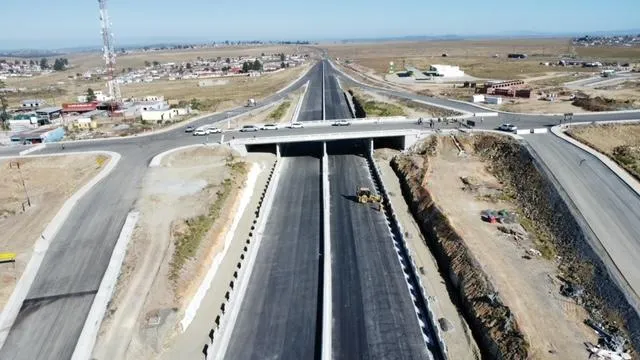
The National Treasury says it will spend R1 trillion on infrastructure investments over the medium term, including on roads, buildings, water facilities, transport and energy.
Image: Supplied
The government intends spending R1 trillion on infrastructure over the medium term to address backlogs in social delivery and other major capital projects that have arisen from weak economic growth, inefficient public investment management and limited state capacity, policy uncertainty, supply-side constraints and waning investor confidence.
National Treasury said Wednesday that fixed investment has not returned to pre-Covid-19 levels. "As government continues to shift the composition of spending towards growth-enhancing infrastructure, the focus is on improving value for money and the quality of spending. This includes addressing project delays, cost overruns and poor construction quality, which reflect weak planning and preparation, rigid and lengthy procurement processes, wasteful expenditure, weak contract management and disruptions linked to business forums," National Treasury said.
Finance Minister Enoch Godongwana announced the government had also raised R11.8bn in December 2025, through the issue of a sovereign infrastructure and development finance bond, amid strong investor appetite. This was part of the government's efforts to create a market for infrastructure financing as a standalone asset class.
"In 2025/26, the public sector is expected to reverse the pattern of underspending reported in previous years, and there are signs of early execution," National Treasury noted.
Public sector infrastructure spending over the 2026 medium term expenditure framework was estimated at R1.07 trillion, with state-owned companies the biggest with a projected R455bn spend over the next three years.
Provinces are expected to spend R217.8bn on infrastructure over the same period, while municipalities are expected to spend R205.7bn.
Budget 2026
Image: Logo
Transport and logistics account for the largest share of spending over the next three years at R417.6bn, followed by energy (R213.6bn), water and sanitation (R185.2bn), and social sectors such as health (R65.4bn) and education (R58.5bn).
Over the next three years, Transnet plans to spend R76.6bn to improve the efficiency and reliability of the logistics value chain. The Passenger Rail Agency of SA will modernise and restore signalling and telecommunications infrastructure, introduce technology systems to improve safety, increase train frequencies and expand network capacity. This will also underpin the rolling fleet renewal programme, says the National Treasury.
The Provincial Roads Maintenance Grant was allocated R54.2bn over the same period, to rehabilitate, reseal and re-gravel roads.
In energy, since April 2025, eight renewable energy projects reached commercial operation, adding 800MW to the grid. By December 2025, 7,741MW of contracted capacity was operational, including peaking capacity. A further 1,610MW was under construction at that period, with these expected to reach commercial operations between 2026 and 2028.
In the water and sanitation sector, the second phase of the Lesotho Highlands Water Project is under way. The Trans-Caledon Tunnel Authority (TCTA) had raised R24bn towards the revised capital investment estimate of R53bn, which includes delivering water to South Africa.
The second phase of the Mokolo-Crocodile River Water Augmentation Project, with an estimated capital cost of R12.3bn, is estimated to be completed by 2030. The TCTA has secured funding through a blended finance structure.
The R24bn uMkhomazi Water Augmentation Project is scheduled to be completed by 2032, supported with a R12bn allocation from the Budget Facility for Infrastructure.
The second phase of the R25bn Olifants Management Model Programme is scheduled to be completed by 2030.
The Berg River-Voelvlei Augmentation Scheme is expected to be completed in 2027 at an estimated cost of R1.1bn.
Over the next three years, the Urban Settlements Development Grant will invest R9.1bn in critical bulk infrastructure in metropolitan municipalities.
In health, over R24.3bn will be invested in health infrastructure through the Health Facility Revitalisation Grant.
The Education Infrastructure Grant has been allocated R50.4bn over the medium term, with R3.9bn set aside for university infrastructure projects.
Godongwana said the Budget Facility for Infrastructure is playing a pivotal role in helping the funding of strategic infrastructure projects. Since shifting from annual to quarterly windows last year, the BFI has approved R21.9bn for five major projects. These include Transnet’s coal and iron ore corridor projects, to restore rail capacity to 77 million tons for the coal line and 60 million tons for the ore line, and the Polokwane regional wastewater programme.
He said the BFI call for proposals for the 2026/27 cycle opened on Wednesday.
BUSINESS REPORT